Keynote Speakers
Courament en anglais seulement.
The following speakers have
agreed to give talks at CUPC!
(Though this list may be subject to change). Biographies and abstracts will be
available closer to the conference dates.
Lene Hau, Harvard – Experimental AMO
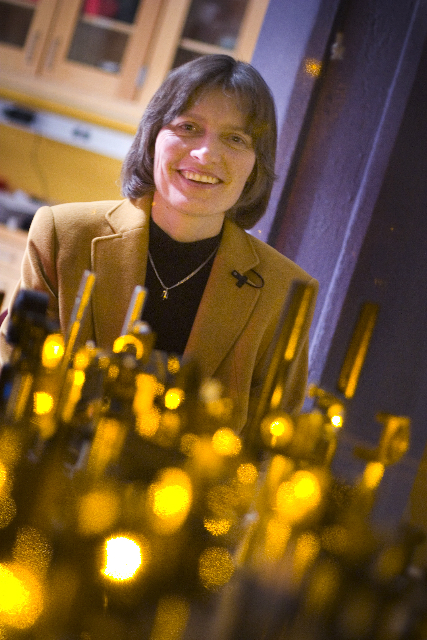
Wizardry with light: freeze, teleport, and go!
Abstract
We slow light to bicycle speed in clouds of atoms cooled with lasers to a few billionths of a degree above absolute zero. In our latest experiments, we stop and extinguish a light pulse in one part of space and revive it in a completely different location. In the process light is turned into matter and then back into light.
BiographyLene Vestergaard Hau obtained her Ph.D. in theoretical condensed matter physics from the University of Aarhus in Denmark in 1991. That same year she joined the Rowland Institute for Science in Cambridge, Massachusetts, as a scientific staff member. Since 1999 she has been on the faculty at Harvard University and currently holds the Mallinckrodt Professorship of Physics and of Applied Physics. In 2001, Lene Vestergaard Hau received the MacArthur "genius" award.
In 1999, Hau's team at the Rowland Institute reported in Nature that they had slowed light to bicycle speed in a Bose-condensed atom cloud. Two years later they reported -- also in Nature - how they had stopped a light pulse and then, several millli-seconds later, let it loose again.
Lene Hau has worked in the fields of experimental and theoretical optical, atomic, and condensed matter physics, and her research has spanned studies of ultra-cold atoms and superfluid Bose-Einstein condensates, as well as channeling of relativistiv MeV electrons and positrons in single crystals. The latter has involved the development of channeling radiation as a solid state probe of valence-electron and spin-magnetic densities and has included experiments at CERN, Brookhaven, and Lawrence Livermore National Laboratory.
Gary Slater, Université d’Ottawa –
Theoretical and Computational Polymer and Biological Physics

Résumé | Abstract
Molecular diffusion, or Brownian motion, is a fundamental aspect of Nature. One cannot stop it. Many industrial and biological phenomena actually exploit diffusion. In some cases, it is even possible to use random diffusion to drive directed molecular motion: we call such systems “molecular ratchets”. Dans cette présentation bilingue, nous allons explorer la diffusion et les modèles existants. In particular, we will examine how one can design a lattice numerical model of diffusion processes, and obtain “exact” numerical results with computers and lots of RAM! We will then explore some simple ratchet systems, as well as other biologically relevant examples of diffusion. Nous terminerons en examinant l’utilisation de tels modèles pour optimiser les méthodes de laboratoire en biochimie.
Biographie | BiographyGary W. Slater received his M. Sc. (1980) and Ph. D. (1984) degrees from the Université de Sherbrooke, both in theoretical physics. He was a Research Scientist at the Xerox Research Centre of Canada (Mississauga) for six years before joining the University of Ottawa in 1990. Il y fut vice-doyen de la Faculté des Sciences de 1996 à 2000, puis vice-doyen de la Faculté des études supérieures et postdoctorales entre 2001 et 2004. He has been the Dean of the Faculty of Graduate and Postdoctoral Studies since 2005. He currently holds a University of Ottawa Research Chair in Biological Physics.
In his research, prof. Slater is using Statistical Mechanics and Computational Physics to explore fundamental problems that have applications in Biology and Analytical Chemistry. C’est ainsi qu’il modélise depuis plus de 20 ans les méthodes de laboratoire qui permettent aux biologistes de séquencer l’ADN de notre génome. His work has lead to several patents. His group also works on drug delivery systems, colonies of bacteria (« biofilms »), micro- and nano- fluidics, polymer science, and nonlinear physics. Son groupe de recherche fonctionne dans les deux langues officielles du pays.
Dugan O’Neil,
Particle Physics at the Energy Frontier: The Golden Age of Hadron Colliders
Abstract
The goal of a particle physicist is to determine the fundamental constituents of matter and to understand their interactions. Ironically, studying the smallest constituents of matter requires some of the biggest machines on earth: hadron colliders. The world's highest energy particle collider, the Tevatron, is currently taking data at Fermilab, just outside Chicago. The programme of this facility covers a wide range of topics, including studies of the top quark. The Tevatron is about to be surpassed by a new generation energy-frontier machine: the Large Hadron Collider (LHC). The LHC is being built in Geneva, Switzerland with plans for first collisions in 2008. The LHC is a "new physics factory". Unprecedented energy and collision rates could help us answer fundamental questions like: what is the origin of mass? What is this "dark matter" which seems to fill the universe? Why do we live in a universe of matter and not anti-matter? I will present some current results from the Tevatron and preview some of the fantastic discoveries which could await us at LHC.
BiographyDugan O'Neil received his BSc. (honours physics) from the University of New Brunswick in 1994. He went on to an MSc. (particle physics) at the University of Alberta in 1996 followed by a PhD. (particle physics) at the University of Victoria in 1999. After working on the D0 experiment for 3 years while employed by Michigan State University, he joined the faculty of Simon Fraser University (SFU) in early 2003.
As a professor at SFU, Dr. O'Neil founded the first Canadian group in the D0 experiment. He worked on software for the D0 trigger system, detector calibration and high-performance computing for D0 before turning his attention to the search for single top quark production in 2005. His group published first evidence for this elusive signal in late 2006.
Dr. O'Neil's attention is now turning towards the next experiment at the energy frontier - ATLAS. Due to start taking data in 2008, ATLAS is expected to shed light on some of the deepest remaining questions in the field. Dr. O'Neil is interested in several types of searches for new particles at ATLAS and is currently working on new methods to identify tau leptons and on grid computing.
Karen Kavanagh and Robert Chaplin,
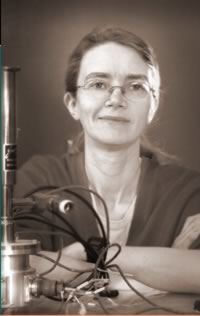
The Fine Art of Fibbing and Other Fables
Abstract
This talk will describe the art and science of fabricating whimsical and useful objects at scales from the occasional to the nanoscopic. The discussion will include a description of the latest nanoscale techniques for the fabrication of contemporary electronics, as well as The Crystal Cabbage, The Sacred Heart of Artichoke, and the world’s first nanoscopic book.
Karen Kavanagh - BiographyKaren L. Kavanagh is a Professor of Physics at Simon Fraser University, British Columbia. She obtained a B.Sc. degree in Chemical-Physics from Queen's University in 1978, and a Ph.D. in Materials Science and Engineering from Cornell University in 1987. After post doctoral work at IBM and MIT she accepted a faculty position in the ECE Dept. at UC San Diego until moving back to Canada in Jan. 2000.
Her main field of interest is electronic materials science, with current interests in nanophotonics, spintronics and nanostructural characterization. She has received an NSF Presidential Young Investigator Award and an NSERC University Faculty Award. Author of 80 journal papers and conference proceedings.
Robert Chaplin - BiographyRobert Chaplin is a fine artist from Telkwa, BC and a member of the Royal Canadian Academy, currently practicing in Vancouver. http://rchaplin.blogspot.com.