Education
- Auckland Teachers College, Teachers Certificate, 1950.
- University of New Zealand, B.A., 1953.
- University of New Zealand, M.A., First Class Hons., 1954.
- Australian National University, PhD., 1960.
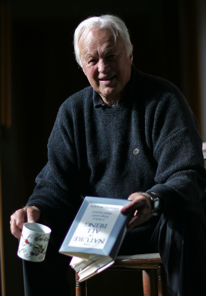
Biography
Teaching, SFU: 1980

Two main passions--for Philosophy and for ski-racing--have dominated much of my life. In both, I was a relatively late starter.
It wasn't until I was 24--when I took up a PhD scholarship at the Australian National University in Canberra--that I had the first opportunity to study Philosophy full time. Before that, I'd been a part-time student in Auckland while teaching primary school during the day.
Yet my first philosophical thoughts came in childhood, at the age of 8 when my cousin and I were trying to find two clover leafs that were exactly the same. It gradually dawned on me that our search was futile since no two objects, clover leafs or whatever, could be exactly the same, i.e., have all their properties – including being in the same place at the same time – in common. As I learned later, I had discovered Leibniz's Principle of the Identity of Indiscernibles for myself.
Since that time, much of my thinking has centered on issues to do with the modal distinctions between what must be the case (e.g., that 2 objects must have dissimilar properties), what cannot be the case (e.g., that 2 objects cannot have all the same properties), and what is merely contingent (e.g., that no two clover leafs that we could find even looked alike when viewed up close).
At age 10, modal issues raised their head again in the form of problems about God's foreknowledge and my freedom: How could I do other than what God knew I would do? Reading the volumes of systematic theology that had been bequeathed to me didn't help with that one. Neither did it help answer a question which continued to haunt me throughout my teen-age years, and eventually helped lead to the abandonment of my faith: How is it possible for a perfectly good God knowingly to create an evil world?
In pursuit of these questions I started reading what philosophers, rather than theologians, had to say. And thus, as a part-time student at Auckland University College, I was drawn into the study of Philosophy. Not surprisingly, my subsequent PhD thesis at the Australian National University (1955-57) was entitled Free Will and Logic. An exploration of the various senses of the expression "could not have been otherwise", it led me into an investigation of modal logic, metaphysics, philosophy of language, ethics, legal philosophy, and philosophy of physics (quantum indeterminacy, and all that). The upshot was eleven publications between 1958 and 1963 in journals such as Mind, The Australasian Journal of Philosophy, and The British Journal for Philosophy of Science.
Then came the first of two ventures in philosophy of mathematics, a paper in The Philosophical Review (1964) arguing that the propositions of pure Euclidean geometry, as opposed to its physical interpretation, are noncontingent and hence, if true, necessarily so. That led to exchanges with John Mackie (at that time a radical empiricist in Mill's tradition) and eventually, in 1971, to a paper in Nous, co-authored with a young colleague, Malcolm Rennie, arguing that the propositions of pure arithmetic are likewise noncontingent and nonempirical.
Back in the sixties, mobility in the academic world was a commonplace, not the rarity it is these days. Prior to becoming Professor and Head of Philosophy at my old campus, by then known as The University of Auckland, in 1964, I had taught at the University of New South Wales in Sydney for three years, at Oxford's Merton College for part of a year, and then at Canberra's Australian National University for two years.
By the time I went to Simon Fraser University in 1970 my interests had shifted to philosophical logic and a defense of the centrality of modal notions in logic. Hence the book, with Norman Swartz, Possible Worlds (1979), an attempt to bring modal intuitions to the forefront in the teaching of logic. Prior to that, in the late sixties, I had occasion to attend a lecture by Saul Kripke and to remark to him afterwards that several of his views on modal matters reminded me of the early Wittgenstein's. The upshot of that was a number of papers – some of them in Dialogue, others in The Canadian Journal of Philosophy and The Australasian Journal of Philosophy – on the Tractatus, and eventually, after several drafts, my book The Nature of all Being (1992).
If philosophy has taught me anything, it is the need to be careful with concepts and the words we use to express them. If a distinction has been made, it probably needs to be observed. Among the crucial, time-honored, distinctions that I have defended since the late fifties are those between ontic and epistemic matters, between the way the world is and the way we believe it to be, between truth and verifiability, between plausibility and possibility, between revisability and falsity. Conflate them in the kinds of ways idealists, pragmatists, postmodernists, relativists, and other anti-realists are apt to do – usually in pursuit of some sort of "organic" world-view – and confusion, I believe, will inevitably ensue. That, at any rate, was the conclusion I came to during the period when, as an undergraduate, I fought my way out of the metaphysical morass I'd been trapped in during my studies of idealists such as Hegel, F. H. Bradley, J. M. E. McTaggart, and Brand Blanshard. And it is a conclusion I've come to regard as equally pertinent to the writings of some of today's most influential philosophers: the likes of Dummett, Rorty, and Quine. As a case in point, I argued in "A Refutation of Quine's Holism" that Quine's holistic image of the man-made fabric or web of knowledge and belief within which no statement is immune to revision runs rough-shod over most of these distinctions. His metaphor is captivating but confused; and it lends itself to adoption by each of the "... ists" listed above. Like the early Wittgenstein, I believe that whatever can be said at all can be said clearly. More generally, I have come to think that metaphor, while it may enhance our prose, seldom enhances our thinking.
In some respects my latest philosophical interests have circled back to their starting point: philosophical questions about the content of religious – especially Christian – belief. Only my perspective has changed: from ardent theist to unabashed atheist. In that capacity I have, over the years, participated in numerous debates with leading theists such as William L. Craig. See, for example, our 1994 debate, "Can a Loving God Send People to Hell?". And since retiring 1996, I have written numerous articles (often based on addresses to various groups) in defence of secularism. [See Philosophy of Religion.]
I have also returned recently to another of my early philosophical interests: the philosophical interpretation of quantum theory. In a paper, "Anti-Realism in Quantum Mechanics", presented to the Physics Department of the University of Auckland in 2000, I argued that the kind of antirealism that has become endemic in so many of the social sciences and among all those thinkers who call themselves Post-Modernists has also corroded the thinking of most current interpreters of quantum phyics. In 2005, I was invited to contribute to the Philosophy of Science section of a website celebrating the 2005 International Year of Physics. [See Brief Articles.] I've also contributed other brief articles to various encyclopedias. [See Encyclopedia Articles.]
The same year (1955) that I started my PhD also saw my introduction to skiing. That, too, was while in Canberra. At first I was a so-called "weekend warrior" with an aptitude for speed, but little technique. It wasn't until I was 38, six years after returning to New Zealand, that I competed in my first NZ National Championships and surprised myself, and others, by earning a bronze medal in the speed event known as Downhill (the first one in which I'd ever competed).
Then (in 1970) came my move to Simon Fraser University in British Columbia and the opportunity for recreational skiing with family and friends in resorts such as Whistler Mountain (venue of the 2010 Winter Olympics). Eventually, nearly 20 years later after that, the desire to ski competitively once again drew me back into ski racing: this time at the Masters level (dominated largely by ex-Olympians and ski professionals from all around the world). By then I was 58. World-class coaching at Whistler Mountain soon yielded a string of successes in all four disciplines. By the time I retired from competition in 2005, I had won over 60 medals in major events, 52 of them in National Championship events (Canadian, US, and International Masters Cup). I was also 3 times FIS World Champion in Super G, never being beaten in that event anywhere in the world for 11 straight years (1994-2004), or in Downhill for 10 straight years. My life during all those years was enriched not only by the thrill of competition, but also by the friendship and camaraderie of superb athletes around the world, many of whom remain among my closest friends.


Super G in Italy (2004) |
Downhill in Canada (2005) |
Nor did Philosophy and skiing consume all my energies. Somehow, I found time, starting in 1973, to design and build a two-storey log cabin from trees I felled on my own 40-acre property in a remote inlet up the British Columbia coast, and learned to fly (but eventually crashed) an amphibious flying boat to gain quick access to it. There I spent 17 summer holidays, oft-times having to confront bears and cougars, and developing an oyster and clam farm for my caretakers to operate. All the while I managed to write a good deal of philosophy. And always, wherever located, I managed to indulge my lifelong passion for music, especially symphonic and operatic.


Cabin construction (1974) |
Amphibious flying boat |
After 31 years in Canada, 23 of them residing in Whistler, I returned to the country of my birth. That was in 2001. Now, retired to a beachside house I designed in the North Island of NZ, I continue to write philosophical articles for internet publication, teach Philosophy to adult classes in the local community, and do what I can to promote humanitarian causes, world peace, international and social justice, almost daily forwarding pertinent articles on these issues to a worldwide network of friends and contacts. (If you'd like to join my list of recipients, email me with a request.) Meanwhile, my life continues to be enriched by living with my sweetheart and close to my two sons and their families.


Omaha Beach and Inlet, NZ |
Summer sunset |
My life has not been a dull one. I firmly believe that the meaning of life lies in the richness of what you do in this life. If you think otherwise--that the meaning of this life lies in having a next one--then tell me: In what do you think that the meaning of that life will be found? Its sequel? Like a book, a life doesn't have to lack meaning just because it comes to an end.
BOOKS
- Possible Worlds: An Introduction to Logic and its Philosophy, co-authored with Norman Swartz, (Indianapolis: Hackett; and Oxford: Basil Blackwell), 1979.
- Environmental Ethics, Vol. 2, editor, (Institute for the Humanities, Simon Fraser University), 1989.
- The Nature of All Being: a Study of Wittgenstein's Modal Atomism, (New York, Oxford: Oxford University Press), 1992.
ARTICLES IN PHILOSOPHY JOURNALS
45 or so articles in refereed journals such as Mind, The Australasian Journal of Philosophy, The British Journal for Philosophy of Science, Philosophical Review, Nous, Sophia, Dialogue, The Canadian Journal of Philosophy. Subjects included Metaphysics, Philosophy of Time, Determinism and Fatalism, Ethics, Philosophy of Geometry, Philosophy of Arithmetic, Free Will, Philosophy of Religion, Philosophy of Science, Philosophy of Logic, Epistemology, Wittgenstein.
MAJOR ARTICLES ON THE INTERNET
Philosophy of Religion
- "The Meaning of Life: Reflections on God, Immortality and Free Will"
- "Did Einstein Believe in God?"
- "A Moral Argument for Atheism"
- "From Fundamentalist to Freethinker: It All Began with Santa"
- "The Rivalry of Religions"
- "An Open Letter to Professor Antony Flew"
- "Antony in Wonderland: A Rejoinder to Professor Flew"
- "Flew's Supernaturalism versus Secularist Bigotry"
- "The Free Will Defense Refuted and God's Existence Disproved"
- "Design: by God or Evolution?" [pdf download]
- "Intelligent Design or Natural Design?" [pdf download]
- "God's Gravediggers: Morality and Science" [pdf download]
- "Goobledygook Gods and Humpty Dumpty" [pdf download]
- "Free Will and God's Responsibility for Evil" [pdf download]
- "Warner's Apologetics" [pdf download]
Epistemology
- "A Refutation of Quine's Holism" [pdf download]
Philosophy of Science
- "Anti-Realism in Quantum Mechanics" [pdf download]
Semantics
- "What is Truth?" [pdf download]
Elementary Logic
- "Reasoning: Good and Bad" [pdf download]
- "How Good are Your Logical intuitions?" [pdf download]
Philosophy of Logic
- "The Nature and Status of Logic" [pdf download]
BRIEF ARTICLES (WITHOUT FOOTNOTES)
- "Does the Moon Exist Only when Someone is Looking at it?" [pdf download]
- "Does God Play Dice with the Universe?" [pdf download]
- "Is Everything Relative, Including Truth?" [pdf download]
- "Are the Laws of Nature Necessary or Contingent?" [pdf download]
Encyclopedia Articles
- "Cosmological Arguments" [pdf download]
- "Determinism" [pdf download]
- "Fatalism" [pdf download]
- "Possible Worlds" [pdf download]
- "Infinite Regress Arguments" [pdf download]
- "Contingency" [pdf download]
DEBATES
Debates with William L. Craig (1995)
- "Craig's Calamitous Kalam Argument" [pdf download]
- "Can a Loving God send People to Hell?" [pdf download]
Debate with Paul Chamberlain (1996)
- "Can there be Objective Morality without God?" [pdf download]
Debate with Matt Flanagan (2010)
"Is God the Source of Morality?" [pdf download]