UNIT 7 HOMEWORK AFTER SESSION One
SP7-1) A disk is turning
with uniform circular motion. A point on the rim of the disk is
moving with velocity
$$\vec{v}_1
= {(\rm 1.5~ m/s )} \hat{i} + {(\rm 2.0~ m/s)}\hat{j}$$
at t1 =
3.00 ms and
$$\vec{v}_2 = {(\rm -1.5~ m/s )} \hat{i} + {(\rm -2.0~ m/s)}\hat{j}$$
at t2 = 7.00 ms. (a) What is the magnitude of the point’s centripetal acceleration? (b) What is the point’s average acceleration during the time interval (t2– t1)?
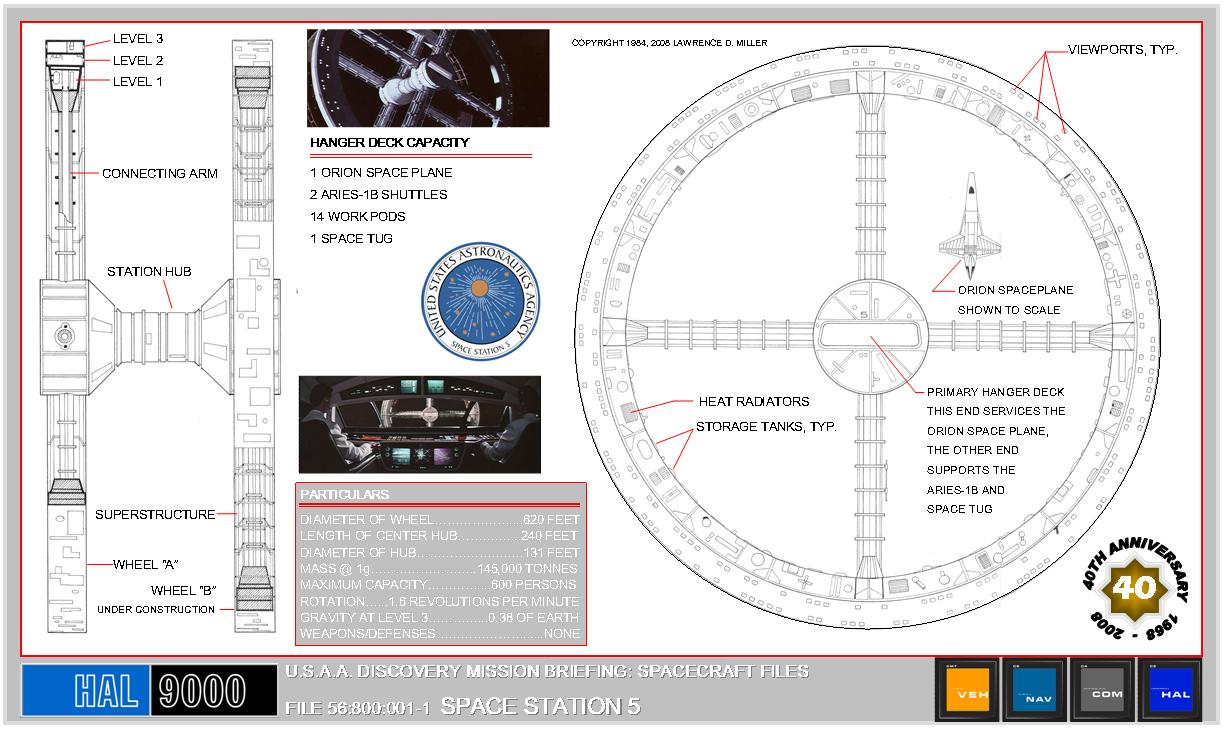
SP7-2) (20 pts) The 1960's classic movie 2001: A Space Odyssey was, in its time, one of the most elaborate and technically accurate science fiction films ever produced. One of the more exotic items in the film was a giant space wheel which was intended to serve as a space station orbiting the Earth to be used as base for trips to the moon. According to the 2001 science advisor, the station was "designed" to have a diameter of 620 ft (200 m) and to rotate at a rate sufficient to cause occupants in the outer rings to experience a centripetal force roughly equal to the gravitational force of the moon. An object on the moon only experiences one-sixth the force that it would experience on the surface of the Earth.

http://www.starbase79.com/images/2001Space/2001SpaceStation.JPG (The parameters listed are not consistent with the movie.)
To do this problem you should open the movie entitled RotatingStation1.mp4 or RotatingStation2.mp4. If you use Quicktime player to view the movies, exact timings can be found by opening Movie Properties under the Movie menu. Then select Movie and Time in the dialogue box.
SP7-3) (Tipler 67) Earth rotates on its axis once every 24 hours, so that objects on its surface execute uniform circular motion about the axis with a period of 24 hours. Consider only the effect of this rotation on the person on the surface. (Ignore Earth’s orbital motion about the Sun.) (a) What is the speed and what is the magnitude of the acceleration of a person standing on the equator? (Express the magnitude of this acceleration as a percentage of g.) (b) What is the direction of the acceleration vector? (c) What is the speed and what is the magnitude of the acceleration of a person standing on the surface at 35°N latitude? (d) What is the angle between the direction of the acceleration of the person at 35°N and the direction of the acceleration of the person at the equator if both persons are at the same longitude?
SP7-3) The planet Venus orbits the sun in nearly a perfect circle. If you have faith in Newton's laws then you must conclude that there is an invisible centripetal force holding Venus in orbit. The data on the orbit of Venus around the sun is shown in the figure below.

(a) Calculate the magnitude of the centripetal force needed to hold Venus in its circular orbit? Please use the proper number of significant figures. (b) What is the direction of the force as Venus orbits around the sun? (c) What is the most likely source of this force? (d) Could this force have anything in common with the force that attracts objects to the earth?
UNIT 7 HOMEWORK AFTER SESSION TWO
SP7-4) (a) When a force is exerted on one end of a string what is the magnitude of the force on the other end of the string? (b) How does the force get transmitted from one end of the string to the other? What does the stretching of the string have to do with this? (c) If a string has a force one it at one end and the direction of the string is changed by a frictionless post or pulley, what is the magnitude of the force on the other end of the string? (d) Refer to the diagram below in which a string exerts a force on a person's hand (at point A) and a force at a fixed point B at the other end of the string. Draw a diagram with arrows indicating the relative magnitudes and the directions of the two string forces at points A and B.

SP7-5) Refer to the words of the Bricklayer's Song reprinted in the Session 2 Activity Guide notes. (a) Assuming that there is no friction in the bricklayer's pulley and rope system, estimate the total amount of time that elapses during the injurious events described by the poor bricklayer in the song. Hint: To make this estimate you need to figure out approximate values for the height of the building, the mass of the bricklayer, and the mass of the bricks and the barrel. Then, you will need to use the Atwood's equation. (b) If friction were considered what effect would this have on your estimated time? Would the actual time be smaller, larger or the same as the one you estimated? Note: There is no single "right" or best answer. Different assumptions could be made that would lead to reasonable time estimates. You cannot simply assume that all of the bricklayer's travels occur at free-fall.
SP7-6) Refer to the diagrams below. (a) A hand pushes on a flexible piece of stretched fabric with a force of 5.0 N. The fabric assembly is fixed and does not move. What is the direction and magnitude of the normal force exerted back on the hand by the sheet? Is the normal force larger, smaller, the same, or zero? (b) What does the stretching of the fabric have to do with this? (c) Suppose the hand pushes in the same way on a wall. What is the direction and magnitude of the normal force exerted back on the hand by the wall? (d) Does the wall stretch noticeably? What causes the wall to be able to exert a force on the hand? How does the wall "know" what force to exert back on the hand?

SP7-7) Refer to the diagram below. A book has a mass of 0.56 kg. (a) What is the magnitude and direction of the force exerted on the table by the book? (b) What is the magnitude and direction of the normal force of the table on the book? (c) Sketch the relative magnitudes and directions of the forces on a diagram

UNIT 7 HOMEWORK AFTER SESSION THREE