Playing with a fan cart
In order to illustrate what happens when a constant force is applied I have brought a
fan cart. This is a little cart on wheels with a fan that can blow and propel it forward or
backward depending on which way the fan is turned. When I turn on the fan, I believe
that everyone would agree that the fan produces a force on the cart. When I hold the
cart the force is balanced by my arm, the net force is zero and it stays put. When I put
the cart on a table and let go, the fan's force is no longer balanced and that unbalanced
force accelerates the cart forward. I wish to let the cart go on a track in various
situations and show you what the graphs of velocity vs..... time look like in those
situations. You will also see how the force shows up in each case.
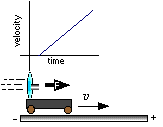
First I hold the cart on the track with the fan on. The cart is pointing towards the
positive side of our number line and the fan is pointing backward so the force pushes in
the positive direction. I'll start the time clock, then let go of the cart. The cart starts from
zero velocity a little after the t=0 point (because I waited a bit before I let it go). Then the
velocity increases with a constant positive slope. The slope of this graph is the
acceleration and it is positive. The net force is proportional to the acceleration, so this
graph implies a positive net force on the cart.
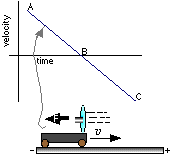
Next I turn the cart around and give it a big shove towards the positive end of the track.
After I let go the fan's force pushes in the negative direction, and the graph shows
negative acceleration. When the cart comes to a stop and I catch it, the velocity graph
stops at point B. But if the cart is allowed to keep going, it will turn around and keep
accelerating in the negative direction.
Notice that even though the velocity is instantaneously zero at point B on the graph, the
slope never changes. Thus the acceleration remains constant throughout the run, even
when the velocity passes though zero. The idea that there can be a nonzero acceleration
when the velocity is zero seems odd, but it follows from the way we define velocity and
acceleration.
Thus negative acceleration can occur both
- when the cart is going in the positive direction and is slowing down,
- when it is going in the negative direction and is speeding up and
- when the velocity is momentarily zero while the cart is changing from
moving in the positive direction motion to the negative direction.
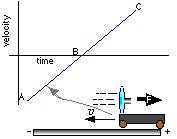
Finally think about the graph when I go to the other end of the track, and shove the cart
towards the negative direction. When the fan is pointed in the direction of the shove,
the force is positive and the cart slows down. The acceleration is positive because the
negative velocity decreases. As the cart passes through point B, even though the
velocity is momentarily zero, the positive acceleration never ceases as it turns around
and accelerates towards the positive end of the track.
Thus positive acceleration can occur
- when the cart is going in the positive direction and is speeding up,
- when it is going in the negative direction and is slowing down and
- when the velocity is momentarily zero while the cart is changing from
moving in the negative direction to the positive direction.
Force and Mass
The equation F = ma is one of the most important in physics. Yet we have so far not
explained how to get a quantitative operational definition of either mass or force.
Somehow, from this one expression, we are going to figure out an operational measure
of both of those undefined quantities. This probably seems akin to the miracle of the
loaves and fishes!
It is necessary to establish a standard mass. I doesn't matter when, how, or where it is
done, but that's the first step. If you were stranded on a desert island and wanted to
start from scratch, you could just pick up any convenient rock, set it aside and use that
as a standard mass. There is a lump of metal in a building near Paris that has served for
many years as the standard kilogram. [Nowadays we have more elegant ways of
defining the standard, but let's not get into that.] We can determine the inertial mass of
any other object by comparing the acceleration of it to the acceleration of the standard
mass under the same conditions. Here's how.
Op Def of Mass
- Figure out some way to apply a reproducible force on objects and
eliminate or cancel out any other forces acting on it such as friction (get rid
of it) or gravity (cancel it out).
- Apply the force to the standard kilogram mass, ms and measure its
acceleration as.
- Apply the same force to the unknown mass, mu and measure its
acceleration au.
- The ratio of the inertial masses is the same as the ratio of their
accelerations. That comes from F=ms as = muau because the force is
the same. Thus
mu/ms = as/au
or
mu = ms (as/au)
This way one can compare masses by just measuring accelerations with a clock and a
meter stick without knowing the value of the force used. The assumption is that the
same force is acting on both masses. One can check that the force doesn't change with
time by going back and trying it on the standard mass again and checking that the
acceleration hasn't changed from the first time.
Op Def of Force
To get a numerical value for forces one must use the following procedure:
- Apply the force to be measured to a mass of known value (as determined
above). Again one must eliminate the effects of other forces if they are
present.
- Measure the acceleration of the mass.
- Calculate the value of the force as as F = m a. The units of force will be
kilogram€meter/second-squared. This unit is composed of the three
fundamental SI units and is called a newton for short. It is abbreviated N.
(Note that units named after people start with a small letter when written
out in full, but use a capital letter when abbreviated.) How big is a
newton? What does it feel like? Pick up a small apple and your hand will
feel a newton. It's about the weight of a 100 g mass on earth.
It's difficult to define both force and mass absolutely rigorously while not making it
seem very obscure to the beginning student. The descriptions here are, I believe, better
than those usually found in introductory physics textbooks and agrees with the
treatments in some of the books I like such as the PSSC texts, Eric Rogers' Physics for the
Inquiring Mind and Arnold Arons' books. You can also read the discussions in March's
Physics for Poets.
Question The country of Nomassia refuses to establish a standard for mass. Instead it
has enshrined a standard spring in its Bureau of Standards. When extended an exact
length indicated on its case, then it exerts the Nomassian standard force called a
"nomass". How would the operational definitions of force and mass outlined above
have to be changed in Nomassia? What would be the unit of mass be expressed in
fundamental units of meters, seconds and nomasses?
Inertial Mass and Gravitational Mass
The method of determining mass by pulling it with a spring and measuring acceleration
seems very inconvenient. It is more convenient to compare two masses by putting them
on a balance. If an object with unknown mass on one side exactly balances a standard
kilogram mass on the other side, then the object has a mass of one kilogram. But you
might not see the logical connection between balancing two masses in earth's gravity
and comparing how hard it is to accelerate them with an applied force. You would be
right! One property of all objects is that the earth exerts a force on them downward.
This forces seems to be larger the more material there is. This is what the balance
compares and it has no obvious connection with the measure of how difficult it is to get
them moving. The casual observation that both properties seem to grow larger with the
amount of material is no guarantee that they grow larger in the same proportion for all
materials.
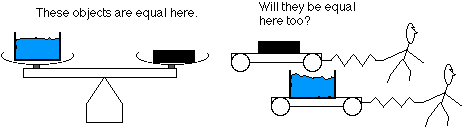
To see this consider a balance with a lump of iron on one side and a plastic bottle of
water on the other. Iron and water are very different materials. We know that water is
made of light elements oxygen and hydrogen and the bottle has some carbon in it
which is also light. Iron is a relatively heavy element, very different from water. If I
pour enough water in the bottle so that the force of earth's gravity on it is the same as
the force of gravity on the iron bar, then they balance. Can you be absolutely certain
that these two quantities of water and iron will also have equal resistance to being
accelerated by an applied force (i.e, the same inertia)? You really have to try it and see.
When it has been tried it has always been found that when the force of gravity is equal,
then the inertia is equal. This has been checked to a very high degree of accuracy!
Because these two properties are logically different, we should call them by different
words. The property that resists acceleration is called inertial mass. The property of an
object that causes earth to exert a force on it is called gravitational mass. It is only from
experiments that we can say that the number we get for one property can be also used
for the other property. Is this a coincidence?
In order to find a system where the equivalence of these two properties follows logically
we really have to envision strange things. Einstein's theory of general relativity is an
attempt to "explain" this equivalence. In this theory all bodies travel between two points
along the path of least distance: a geodesic. The way gravity comes about is that a mass
causes nearby space and time to curve. Then an object travelling through curved space
along the shortest path will be appear to be attracted to the other mass which is causing
the space to be curved. Of course each of the masses causes space around it to curve. In
this way the amount of gravitational attraction between two objects is proportional to
the amount inertial mass in both objects. This gets ahead of our subject because we
haven't even learned Newton's theory of gravitation, let alone Einstein's.
What's the use of all this?
The relationship between force, mass and acceleration is the first fact learned by
observing the physical world which we have encountered in this course. Let's look at
one practical application which we can appreciate right now. We all know how it's
dangerous for us to come to a sudden, unexpected stop when we are going at high
speeds. For this reason we are encouraged to wear helmets when riding bicycles and
motorcycles and airbags are recommended for car safety. All of these devices work by
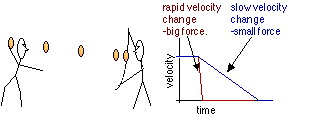
increasing the amount of time it takes to come to a stop from your cruising velocity.
You can illustrate the effectiveness of increasing the time between full speed and full
stop by hurling an egg into a bed sheet held up to catch the egg. If the sheet is held
loosely so that it can absorb the shock of the egg then it's almost impossible to break the
egg when it's caught in the sheet. On the other hand, an egg colliding with a hard object
tries to stop in a much shorter time period. It breaks.
We can understand this by estimating the force exerted on the egg by the object with
which it collides. The average acceleration is given by the difference in the velocities at
full speed and at zero speed divided by the time it takes to stop. The corresponding
average force is got by multiplying the average acceleration by the mass of the egg. Let's
do an example.
Let's assume that when a 30-gram egg hits a brick wall it stops in the time between two
TV pictures: 1/30th second. If Michael hurls the egg at a speed of 10 m/s then the force
will be
F = m a = 0.03 kg x 10 m/s /(1 /30) s = .03 x 30 x 10 = 9 N.
That's almost the force of a 1 kg mass on earth. That may be enough to break the shell,
especially if it's spread over a small area. The force on a contact area 1 mm by 1 mm
would be about 90 times atmospheric pressure. (Pressure is the force divided by the
area it is applied to.) Spread out the stopping time over half a second and then the force
would be reduced by 15 times. Another effect of the sheet would be to increase the
contact area so that the pressure would be further reduced.
Stay healthy, stop slowly!
Back to Main Page
©1997, 1999 Neil Alberding