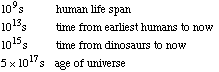
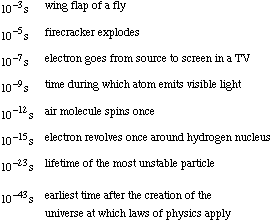
The theory of special relativity treats time as equivalent to a fourth dimension of space. But there is an obvious difference: one can go back in space, not in time. However, the quantum electrodynamic theory of subatomic particles developed by R. Feynman shows that particles of antimatter appear in the formalism with the sign of time reversed--they can be imagined as going backwards in time. Does that mean that there could be an antiuniverse whose future is in our past and whose past is in our future? We can't hope to answer these sorts of questions yet. What we need now is a good operational definition of time.
The daily cycle of light and dark serves as our most basic measure of time. Other cyclic events could serve to measure time as well such as our heartbeat or the sequence of seasons. Any of these processes might serve as the basis for a definition of time. For example, we could call the number of day-night cycles between two events the time, in days, between the events. We have found that the number of days between the yearly equinoxes is constant. Thus the solar year can serve as a measure of time for longer time intervals.
Until the modern era there was little need for accurate measures of time less than a day. Some indigeneous languages in Papua New Guinea still have no word for divisions of time less than the day. Ancient Rome divided the time between sunrise and sunset into twelve divisions, making these hourly divisions longer in summer than in winter. The real incentive to develop accurate time measurement was navigation. Knowing where you are in the sea north and south is not hard: one only has to measure the elevation of the North Star above the horizon. However, to know your position east to west (the longitude) one must know the exact time back home in London (or wherever).
For short time intervals, we must be careful that the cyclic process chosen to measure time is constant and reproducible. Our heartbeat would prove unreliable because different people would count a different number of heartbeats per day on different days. On the other hand, many other processes can have a reliable count of cycles every day. Try a pendulum of fixed length and constant amplitude of swing or a mass bobbing up and down on a spring. Both can serve as the basis of a reliable time measuring device because they can be fashioned to give the same number of cycles from high noon of one day to high noon the next.
Historically, then, the day is divided into 24 hours following the Roman lead. Then the hour is divided into 60 "small" parts. The word minute means small and sixty divisions followed the base 60 number system of ancient Babylon. When need arose for more accurate time division, a second minute, was added by dividing the first minute into another sixy divisions. The name "second minute" was soon shortened to just "second". Now the second is the standard. It's no longer defined in terms of the day, but in terms of the frequency of light emitted from the cesium atom. The day has been found to vary somewhat (a few milliseconds) from year to year and that's not good enough. You can contact the United States' cesium clock by dialing (at your cost) 303-499-7111 or go to http://www.time.gov.
All methods for accurately measuring time depend on periodic processes. In particular a mass vibrating on a perfect spring follows a very elegant kind of motion called simple harmonic motion. We shall study simple harmonic motion later. Hair springs in mechanical watches and piezoelectric quartz crystals in electronic watches are both examples of systems which are very nearly simple harmonic.
How many seconds in a day. Just figure....
1 day = (1 day) x (24 hrs/day) x (60 min/hour) x (60 s/min) = 86400 s
How many seconds in a year? You figure it out. You should get about 3.16 x 10⁷ (3.15 times ten to the seventh power)
High speed time measurement
Very short time intervals can be measured by high speed photography. Normally movies are photographed at 24 frames per second. Television pictures are displayed at 30 frames per second. Thus events of the order of 1/10 th second can be timed by counting the number of frames between beginning and end. High speed cinematography with a rate of 4000 frames per second, for example, allows much faster timings. Furthermore, if a movie photographed at 4000 frames per second is played back at normal speed, the action appears slowed down by a factor 4000/24.
Intervals even briefer can be timed by the electron beam in an oscilloscope.