
Chapter Contents

Previous

Next
|
Chapter Contents |
Previous |
Next |
| The AUTOREG Procedure |
The AUTOREG procedure can produce two kinds of predicted values for the response series and corresponding residuals and confidence limits. The residuals in both cases are computed as the actual value minus the predicted value. In addition, when GARCH models are estimated, the AUTOREG procedure can output predictions of the conditional error variance.
The predicted values are computed as

and the upper and lower confidence limits as
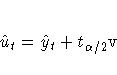
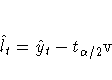
where v2 is an estimate of the variance of
 and
and  is the upper
 /2 percentage point of the t distribution.
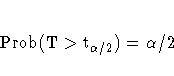
where T is an observation from a t distribution
with q degrees of freedom.
The value of can be set with the ALPHACLM= option.
The degrees of freedom parameter, q, is taken to be the number of
observations minus the number of free parameters in the
regression and autoregression parts of the model. For the
YW estimation method, the value of v is calculated as
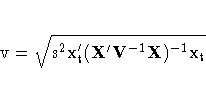
where s2 is the error sum of squares divided by q. For the ULS and ML methods, it is calculated as
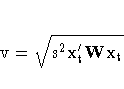
where W is the k×k submatrix of (J'J)-1 that corresponds to the regression parameters. For details, see "Computational Methods" earlier in this chapter.
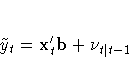
where xt is the vector of
independent variables and  is
the minimum variance linear predictor of the error term given
the available past values of
is
the minimum variance linear predictor of the error term given
the available past values of  , and the autoregressive
model for  .
If the m previous values of the structural residuals are available, then
.
If the m previous values of the structural residuals are available, then
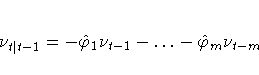
where
 are the estimated AR parameters.
The upper and lower confidence limits are computed as
are the estimated AR parameters.
The upper and lower confidence limits are computed as
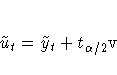
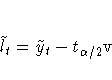
where v, in this case, is computed as
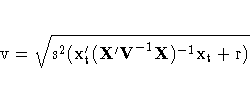
where the value rs2 is the estimate of the variance of
.
At the start of the series, and
after missing values, r is generally greater than 1.
See "Predicting the Conditional Variance" for computational details of r.
The plot of residuals and confidence limits in
Example 8.4 later in this chapter illustrates this behavior.
Except to adjust the degrees of freedom for the error sum of squares, the preceding formulas do not account for the fact that the autoregressive parameters are estimated. In particular, the confidence limits are likely to be somewhat too narrow. In large samples, this is probably not an important effect, but it may be appreciable in small samples. Refer to Harvey (1981) for some discussion of this problem for AR(1) models.
Note that at the beginning of the series (the first m observations, where m is the value of the NLAG= option) and after missing values, these residuals do not match the residuals obtained by using OLS on the transformed variables. This is because, in these cases, the predicted noise values must be based on less than a complete set of past noise values and, thus, have larger variance. The GLS transformation for these observations includes a scale factor as well as a linear combination of past values. Put another way, the L-1 matrix defined in the section "Computational Methods" has the value 1 along the diagonal, except for the first m observations and after missing values.
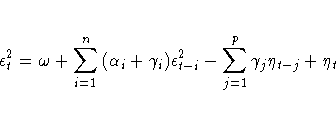
where  and n = max(p,q). This representation shows that the squared residual
 follows an ARMA(n,p) process.
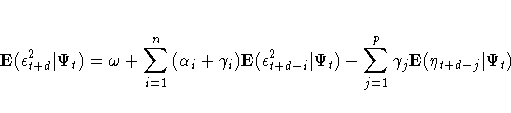
Then for any d > 0, the conditional expectations are as follows:
follows an ARMA(n,p) process.
Then for any d > 0, the conditional expectations are as follows:
The d-step-ahead prediction error,
 = yt+d - yt+d|t,
has the conditional variance
= yt+d - yt+d|t,
has the conditional variance
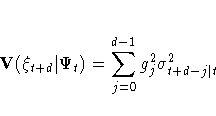
where
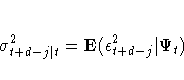
Coefficients in the conditional d-step prediction error variance are calculated recursively using the following formula:
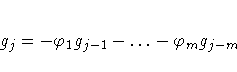
where g0=1 and gj=0 if j<0;
 , ...,
  are autoregressive
parameters.
Since the parameters are not known, the conditional variance is computed
using the estimated autoregressive parameters.
The d-step-ahead prediction error variance is simplified when there are
no autoregressive terms:
are autoregressive
parameters.
Since the parameters are not known, the conditional variance is computed
using the estimated autoregressive parameters.
The d-step-ahead prediction error variance is simplified when there are
no autoregressive terms:
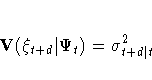
Therefore, the one-step-ahead prediction error variance is equivalent to the conditional error variance defined in the GARCH process:
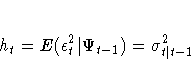
Note that the conditional prediction error variance of the EGARCH and GARCH-M models cannot be calculated using the preceding formula. Therefore, the confidence intervals for the predicted values are computed assuming the homoscedastic conditional error variance. That is, the conditional prediction error variance is identical to the unconditional prediction error variance:
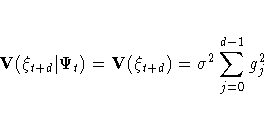
since  .
You can compute s2r, which is the second term of the variance for the predicted value
.
You can compute s2r, which is the second term of the variance for the predicted value
 explained previously in "Predicting Future Series Realizations,"
using the formula
explained previously in "Predicting Future Series Realizations,"
using the formula
 ;
r is estimated from
;
r is estimated from
 using the estimated autoregressive parameters.
Consider the following conditional prediction error variance:
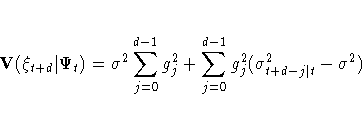
The second term in the preceding equation can be interpreted as the noise from using the homoscedastic conditional variance when the errors follow the GARCH process. However, it is expected that if the GARCH process is covariance stationary, the difference between the conditional prediction error variance and the unconditional prediction error variance disappears as the forecast horizon d increases.
|
Chapter Contents |
Previous |
Next |
 Top |
Copyright © 1999 by SAS Institute Inc., Cary, NC, USA. All rights reserved.