
Chapter Contents

Previous

Next
|
Chapter Contents |
Previous |
Next |
| Box Plots and Mosaic Plots |
 , where q is a quantile used to scale the circles
according to the test being used. For details on how each quantile is
computed, see refer to Hsu (1996).
If the jth group is selected (by clicking on its circle),
then its circle is
highlighted. This circle is red on color monitors. You can
determine whether another group is significantly different than
the selected group based on how much their corresponding circles
overlap. If their circles are nested or nearly overlap so that the
external angle of intersection is greater than 90 degrees, then you
cannot claim that the means of the two groups are different. If,
however, the two circles are disjoint or just barely overlap so that
their external angle of intersection is less than 90 degrees, then you
can conclude that the means of the two groups are significantly
different at the given confidence level.
, where q is a quantile used to scale the circles
according to the test being used. For details on how each quantile is
computed, see refer to Hsu (1996).
If the jth group is selected (by clicking on its circle),
then its circle is
highlighted. This circle is red on color monitors. You can
determine whether another group is significantly different than
the selected group based on how much their corresponding circles
overlap. If their circles are nested or nearly overlap so that the
external angle of intersection is greater than 90 degrees, then you
cannot claim that the means of the two groups are different. If,
however, the two circles are disjoint or just barely overlap so that
their external angle of intersection is less than 90 degrees, then you
can conclude that the means of the two groups are significantly
different at the given confidence level.
Circles corresponding to categories that are significantly different from the selected group are drawn in cyan on color monitors. Circles corresponding to categories that are not different are drawn with a dashed line and are red on color monitors.
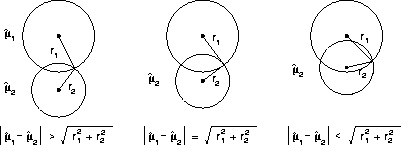
The geometry behind comparison circles is based on the Pythagorean
Theorem: since the radius of the ith circle is
 , and since the circle is centered at
 , then if the two circles meet at right
angles, the distance between centers
is the hypotenuse of the right triangle formed by the circles' radii.
Therefore, when the circles meet at right angles,
, then if the two circles meet at right
angles, the distance between centers
is the hypotenuse of the right triangle formed by the circles' radii.
Therefore, when the circles meet at right angles,
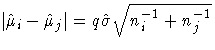 .
Statistically, this geometry corresponds to the critical case in which
zero happens to fall on the boundary of the confidence interval about
.
Statistically, this geometry corresponds to the critical case in which
zero happens to fall on the boundary of the confidence interval about
 . If
. If
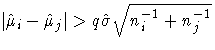 , then the external intersection of the circles is less
than 90 degrees, and zero is not contained in the confidence interval
about . Thus the circles are significantly
different.
, then the external intersection of the circles is less
than 90 degrees, and zero is not contained in the confidence interval
about . Thus the circles are significantly
different.
|
The statistics for Hsu's Test for Best and Hsu's Test for Worst are computed differently from the other tests. First, the comparison circles are not selectable. The Test for Best automatically selects the category with the largest sample mean; the Test for Worst selects the category with the smallest sample mean. Second, the quantile used to scale the comparison circles is the maximum of the quantiles computed by running Dunnett's one-sided test k-1 times, with each "non-best" (or "non-worst") group serving in turn as the "control" for Dunnett's test.
Because Hsu's Test for Best does not provide symmetric intervals
about , the comparison circle technique must be
modified. While the statistical table reports exactly which groups
can be inferred not to be the best, the comparison circles are more
conservative because the quantile used to scale the circle radii
is the maximum of all quantiles encountered during Hsu's test.
The same is true for Hsu's Test for Worst.
 Related Reading | Box Plots, Chapter 4. |
Related Reading | Mosaic Plots, Chapter 5. |
Related Reading | Distributions, Chapter 12. |
|
Chapter Contents |
Previous |
Next |
 Top |
Copyright © 1999 by SAS Institute Inc., Cary, NC, USA. All rights reserved.