
Chapter Contents

Previous

Next
|
Chapter Contents |
Previous |
Next |
| Distribution Analyses |
 .
. is the sample mean,
 .
. .
. .
.The summation  represents
a summation of
represents
a summation of  .
.
Based on the variance definition, vardef, the variance divisor d is computed as
 | for vardef=DF, degrees of freedom | |
 | for vardef=N, number of observations |
The skewness is a measure of the tendency of the deviations from the mean to be larger in one direction than in the other. The sample skewness is calculated as
 | for vardef=DF | |
 | for vardef=N |
where c3n = [n/((n-2))][1/((n-1))].
The kurtosis is primarily a measure of the heaviness of the tails of a distribution. The sample kurtosis is calculated as
 | for vardef=DF | |
 | for vardef=N |
where c4n = [(n(n+1))/((n-2)(n-3))][1/((n-1))] and cn = [((n-1)2)/((n-2)(n-3))].
When the observations are independently distributed
with a common mean and unequal variances,
 ,where wi are individual weights,
weighted analyses may be appropriate.
You select a Weight variable to specify
relative weights for each observation in the analysis.
,where wi are individual weights,
weighted analyses may be appropriate.
You select a Weight variable to specify
relative weights for each observation in the analysis.
The following notation is used in weighted analyses:
 is the average observation weight,
 .
. is the weighted sample mean,
 .
. .
. .
.In addition to vardef=DF and vardef=N, the variance divisor is also computed as
 | for vardef=WDF, sum of weights minus 1 | |
 | for vardef=WGT, sum of weights |
With  ,
,
 and the expected value

 Note | The use of vardef=WDF/WGT may not be appropriate since it is the weighted
average of individual variances,  , which have unequal
expected values. , which have unequal
expected values. |
For vardef=DF/N, s2w
is the variance of observations with unit weight
and may not be informative in the weighted plots of
parametric normal distributions.
SAS/INSIGHT software uses the weighted sample variance
for an observation with average weight,
 ,
to replace s2w
in the plots.
,
to replace s2w
in the plots.
The weighted skewness is computed as
 | for DF | |
 | for N |
The weighted kurtosis is computed as
 | for DF | |
 | for N |
The formulations are invariant under the transformation w*i = c wi, c > 0. The sample skewness and kurtosis are set to missing if vardef=WDF or vardef=WGT.
To view or change the divisor d used in the calculation of variances, or to view or change the use of observations with missing values, click on the Method button from the variables dialog to display the method options dialog.
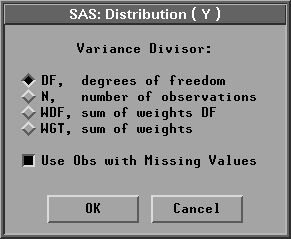
By default, SAS/INSIGHT software uses vardef=DF, degrees of freedom to compute the variance divisor.
When multiple Y variables are analyzed,
and some Y variables have missing values,
the Use Obs with Missing Values option uses
all observations with nonmissing values for
the Y variable being analyzed.
If the option is turned off, observations with missing values
for any Y variable are not used for any analysis.
|
Chapter Contents |
Previous |
Next |
 Top |
Copyright © 1999 by SAS Institute Inc., Cary, NC, USA. All rights reserved.