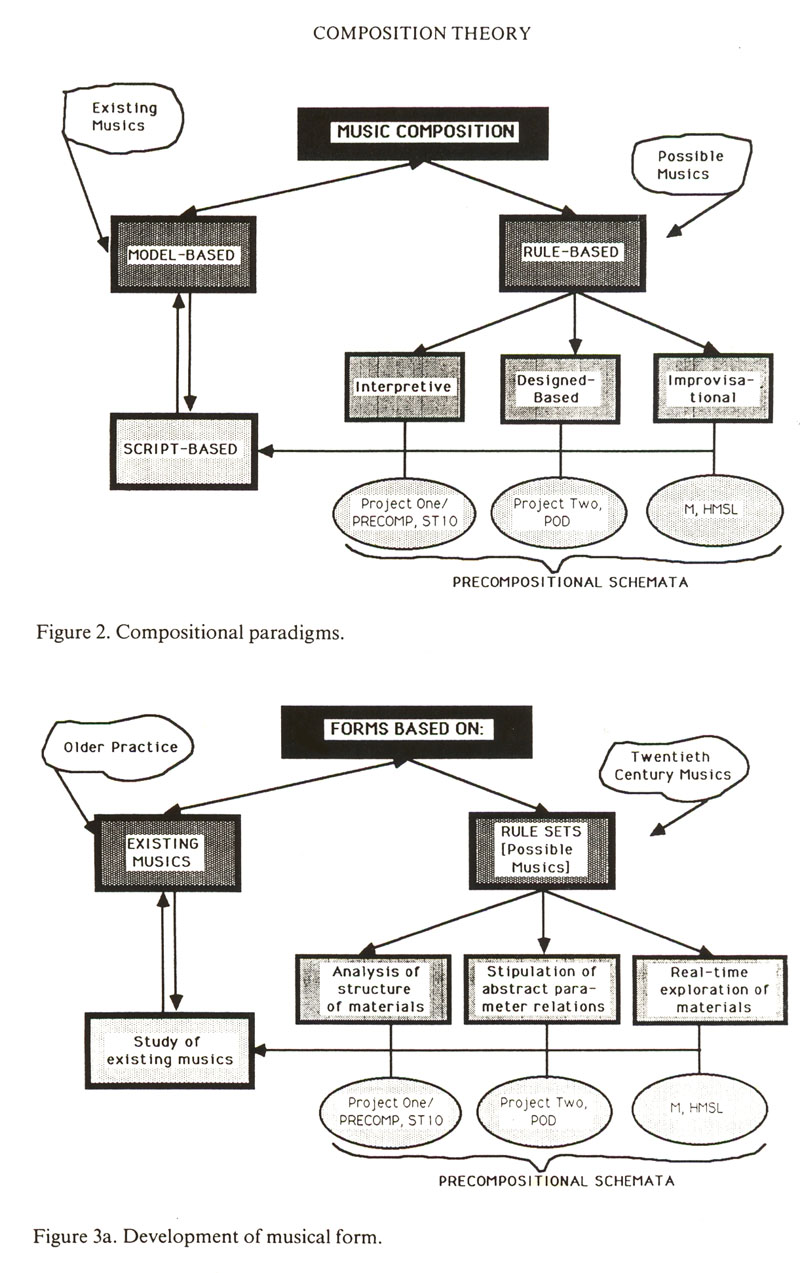
Otto Laske: Cognitive Models

Music as a cognitive process ("what is musical"), not as an analysis of artefacts, scores, in terms of "style" ("what is music?")

Musical knowledge as "sonological competence", as practiced through various performance strategies (e.g. listening, playing, composing ...)

20th century progression:

Model-based  --------->   Rule-based
(analysis/imitation)         (generative processes)


Theoretical Influences:

Noam Chomsky:
Surface Structure <----------> Deep Structure

Competence <--------------> Performance
(implicit knowledge)         (task specific strategies)

Generative Grammar: allows the speaker to encode/decode novel utterances

musical analogies:  Heinrich Schenker - levels of musical structure
Iannis Xenakis - outside time structures (hors temps)


Allan Newell & Herbert Simon:

Cognitive Problem Solving

Task Environment: physical situation plus task/goal

Simon: Design Sciences ("sciences of the artificial"): how artifacts function in their environment


 Marvin Minsky:

Artificial Intelligence: "society of mind"; mini-experts; expert systems


Application to Computer-based Composition Systems:

Composers/designers as experts in "virtual music" (music that does not yet exist)

Computers as the composer's "alter ego"

external knowledge base (of the composer) <----------> internal knowledge base (of the software)