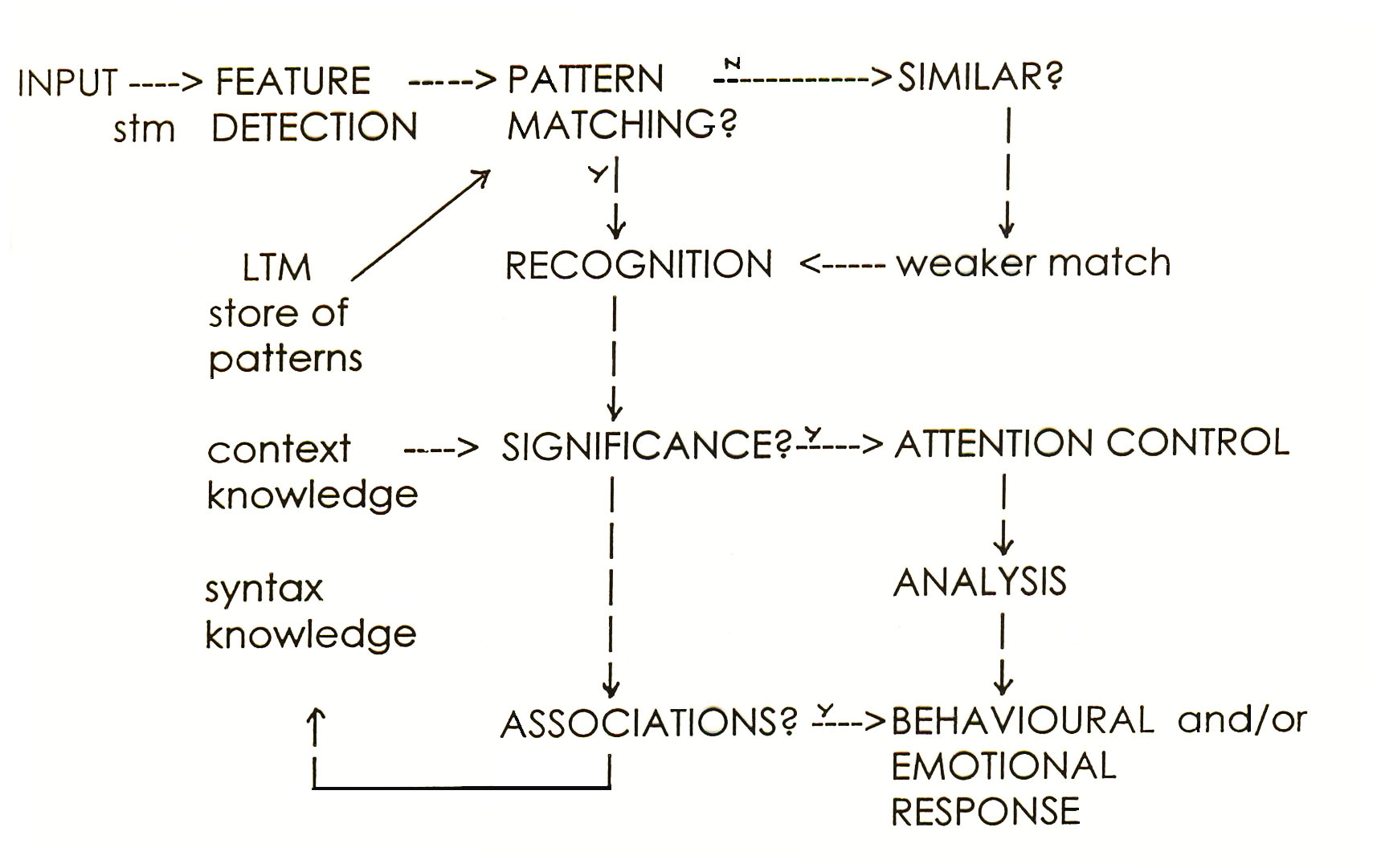
Wolvin & Coakley (1993): "listening always involves a basic process of receiving, attending to, and assigning meaning to messages" with the following types:
- discriminative (distinguishing auditory stimuli)
- comprehensive (understanding messages)
- therapeutic (empathic)
- critical (evaluation)
- appreciative (gaining a sensory impression; e.g. "listening to music, environmental sounds or to a television program"
___________________________________________________________________________________
Ballas & Howard (along with other experimental psychologists, e.g. S. McAdams, W. Gaver) have tested human auditory competence in extracting meaning from environmental sounds.
Some strategies (following linguistic competence):
- bottom-up: feature detection, spectral & temporal pattern recognition, stream segregation
- top-down: expectations/competence, syntax, causal and contextual knowledge (use to reduce ambiguity), familiarity
_____________________________________________________________________________________
Levels of Listening Attention
Background <--------------------------------> Foreground
Background Listening <--------------> "Listening in Readiness" <------------------> "Listening in Search"