centre frequency = 200 Hz; frequency range = 20 Hz; average grain duration = 20 ms; duration range = 5 ms; delay = 0 msA. Change centre frequency (100, 50, 200, 400, 800, 1600, 3200 Hz)
B. Change frequency range (10, 0, 20, 50, 100, 200, 500, 1000, 2000, 4000 Hz)C. Change duration (10, 15, 20, 25, 30, 40, 50, 75, 100, 250, 500, 1000 ms)D. Change delay (0, 5, 10, 20, 50, 75, 100, 250, 500 ms)
A. Change duration gradually to 500 ms, then 750, 1000 ms, then return to 20 msB. Increase delay gradually to 250 ms keeping grains in synch, then increase delay range to 50 ms to allow grains to become unsynchronized
C. Reduce delay and delay range back to 0 (original texture)
Synchronized sine wave grains going to unsynchronized grains
centre frequency = 500 Hz; frequency range = 25 Hz; grain duration = 20 ms; duration range = 10 ms; delay = 0 msA. Reduce number of voices to 1 (left channel only)B. Reduce random variation to 0 by changing frequency and duration ranges to 0 (note: AM signal with 50 Hz modulator)
C. Lengthen delay to 200 ms to separate grains
D. Change duration from 20 to 15, 8, 4, 2, ms and back to 20 ms
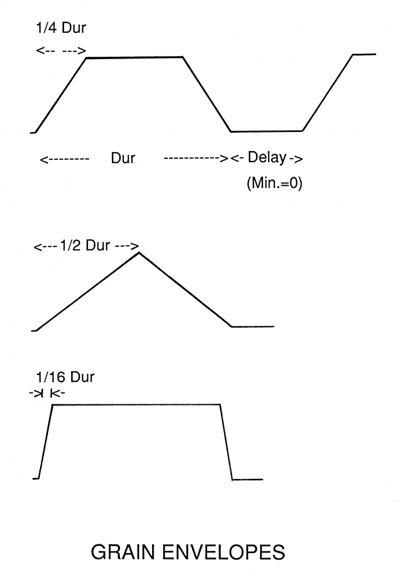
E. Change envelope shape from 1/4 attack to 1/2 attack, then 1/16 attack and back
F. Change frequency range gradually to 1000 Hz
G. Reduce delay from 200 to 30 ms (i.e. 30 + 20 = 50 ms grain repetition rate)
H. Increase number of voices to 20
I. Increase number of voices with waveform 2 (with harmonics) to 6; then increase number of voices with waveform 3 to 6
J. Change envelope shape to long attack, then short attack and back
A. ramp on frequency and frequency rangeB. ramp on duration and duration range
C. ramp on delay
A. C:M ratio = 1:1 and ramp on modulation indexB. C:M ratio = 1:5 and ramp on index and index range

Tendency masks used to control frequency range (light shading), grain duration (medium), and modulation index (dark), plus delay between grains (solid lines)
A. Ramp on offset causing the grains to move from the unvoiced aspirations at the beginning of the samples through the pitched vowel and then past it.B. Ramp on duration, moving from 50 to 15 ms, the increasing to 70 ms.
C. Ramp on duration range, starting from 0 (synchronized grains), then moving gradually to 150 ms duration range.
D. Ramp on delay, starting at 0 ms, then moving gradually to 400 ms delay between grains.
E. Global speed change followed by some voices being transposed upwards an octave at the same time, then downwards again.
F. Constant speed with some voices being transposed downwards an octave, then back upwards again.
Synchronized phoneme grains going to unsynchronized grains
