IMPULSE REVERB
CONVOLUTIONS
Convolutions in Large
Spaces
Two singers,
mezzo-soprano Sue McGowan and bass Derrick Christian, are
heard
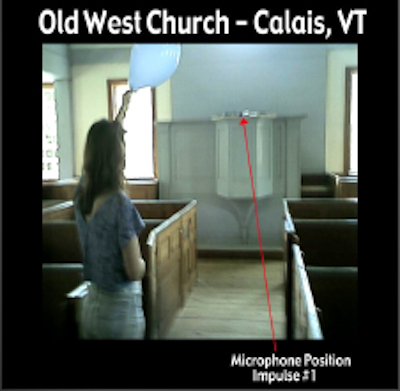
convolved with the impulse response (IR) of various
churches.
They now appear to be located at the same distance from the
microphone
as the original source, a balloon being burst. When they are
convolved twice
with the impulse response of the space, that distance
doubles. No
brightening of the output was used in these examples.
Shakespearean
actor
Christoper
Gaze is also heard convolved with an IR
of the Royal Drama Theatre in Stockholm. Although the reverb
time is
shorter, it is not what would be considered optimal for
speech
comprehension (i.e. less than one second). This is because
the IR was
made in an empty hall, without the absorption that would be
created by
an audience. This problem will be addressed in the main
module.
Convolution
with
Impulse
Response
|
Convolved
Twice
with
Impulse
Response
|
McGowan
*
Busseto
|
McGowan*Bus*Bus
|
McGowan
*
Santa Chiara
|
|
McGowan
*
San Francisco
|
|
McGowan
*
St Nikolai
|
|
McGowan
*
Temple
|
|
McGowan
*
Domkyrkan
|
|
DC
low
D*Busetto
|
DC
lowD*Bus*Bus
|
Gaze
*
Theatre
|
|
Convolutions in Smaller Spaces
Spaces
where speech comprehension is paramount, such as theatres
and most
Protestant churches, need to have a smaller spatial volume
and greater
absorptive qualities in order to reduce the reverberation
time to less
than a second. Even without amplification, a speaker can
also use a
“projected” voice, such as heard here with actor
Christopher Gaze, and
speak more slowly and articulately. Compare these male
examples in
smaller churches (photos in the links) with a female
voice, Thecla
Schiphorst, that is speaking more intimately, but with
great clarity.
Note: the reverberated sound (convolved with the
impulse response) is
mixed 50/50 with the original sound