In terms of early advertising around the notion
of fidelity, there were two prominent pictorial paradigms, one
based on hearing used by HMV (His Master's Voice)
owned by The Gramophone Co. in the UK, and later in the US by
RCA Victor, where a 19th century painting by Francis Barraud
of a Smooth Fox Terrier named "Nipper" was re-designed (with
the company logo) to suggest that he recognized his master's
recorded voice. This logo became so popular worldwide that the
Scott expedition in 1911 to the South Pole staged it (see
photo link) with one of their own dogs and a portable
phonograph they had brought (no electrical power required).
The illusion that the dog is "listening" is the typical
terrier cocking of the head. But it is an anthropomorphic
misinterpretation, as terrier fanciers know that since
terriers don't rely on sight to the same extent we do, they
have to "cock" their head to create movement in the visual
field – which we interpret as a listening stance (and their
owners know that certainly isn't true!). The dog in the Scott
expedition photo doesn't do this, of course, whereas a real
terrier is more likely to react as shown in this video of an outtake
for HMV - maybe that's why he was called Nipper!
The other paradigm
is based on writing characterized as "divine"
through the use of a "Recording Angel", perhaps
referencing the parallel transition from oral to written
traditions of the dictation of religious chant to Pope
Gregory via the Holy Spirit shown as a dove, with a
scribe behind a curtain doing the actual writing. Even
later re-issues on a budget label can be illustrated by
mirror repetitions.
The Recording
Angel
The Holy Spirit dictating the
chant to Pope Gregory (600 AD)
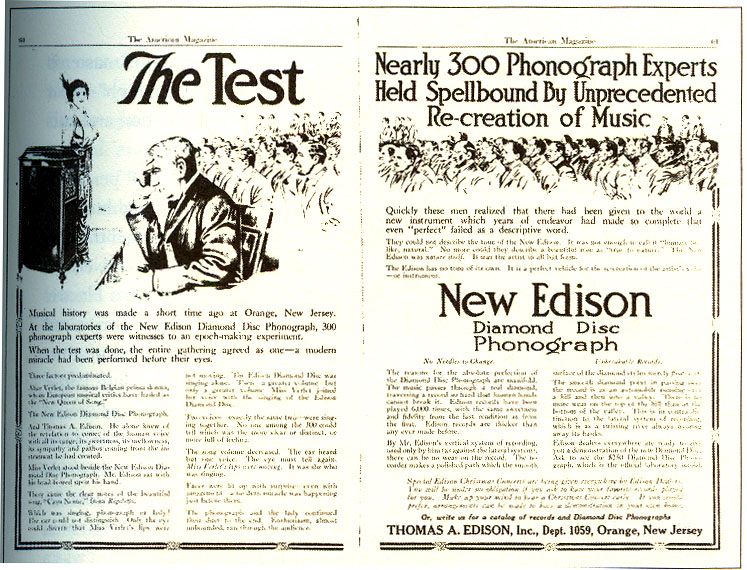
The so-called Edison
tone tests were carried out (and advertised)
between 1915 and 1926, often with large audiences. A
singer (contracted with Edison) would appear and sing
live, and then with the lights typically dimmed, would
be "replaced" by the recorded version of his or her
voice. Keep in mind this was the era of acoustic
recording and playback, which clearly lacked the ability
to reproduce anything but the middle range of
frequencies, including those of the voice.
Audiences routinely claimed to "not be able to tell the
difference" between the live and recorded versions. It
would appear that once the listener could identify the
voice and hear it as musical, it would seem to be the
"same" – perfect fidelity!
Edison Tone
Tests: 1915-1926
1812
Overture,
coarsegroove disc, acoustic recording, mono, 1916
(source: British Library);
note the gender roles being played out in the
above ad
In the following ad, an ensemble of opera singers
(all contracted with Edison) try to determine
whether the phonograph recording of their female
colleague standing beside it at the back, is being
heard live or recorded. The male singers in front
seem to be pondering the question quite seriously,
while the women.... well, you decide.
Geraldine
Farrar
sings Carmen, acoustic recording, mono,
ca. 1915
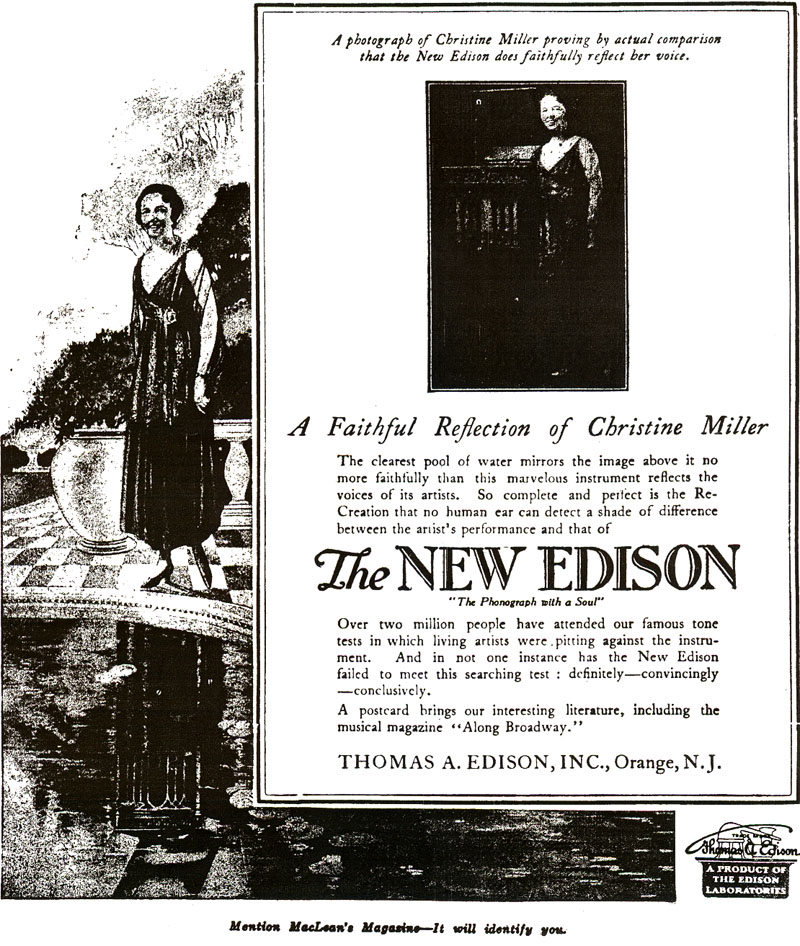
In the above ad, the problem of
how to depict "fidelity" of reproduction is
attempted by first showing (in the insert
box) a photograph of the singer standing
beside the phonograph, similar to the Edison
Tone Tests, and in the drawing,
showing her being reflected in the
pool with her reflection being the
phonograph! The message is, they are the same
(as in the Farrar ad). Below we see the same
approach based on reflection with the
Walkman 60 years later, except that it is
treated in a more explicitly sexist manner.
Walkman Ad 1980
Memorex (1970s)
The
tagline for Memorex (literally,
the "king of memory"), a cassette
manufacturing company, was extensively
advertised as "Is it live, or
is it Memorex?" featuring a variety of
personalities, both black and white, being
unable to tell the difference, just as the
Edison Tone Tests did much earlier. The
other meme that was used was the cliche
about a soprano being able to shatter a
wine glass. In this case, it's presumably
the soprano voice being reproduced on
cassette that is going to do the trick. In
the final ad, we see the longtime logo of
the listener being "blown away" by the
reproduced sound.
The
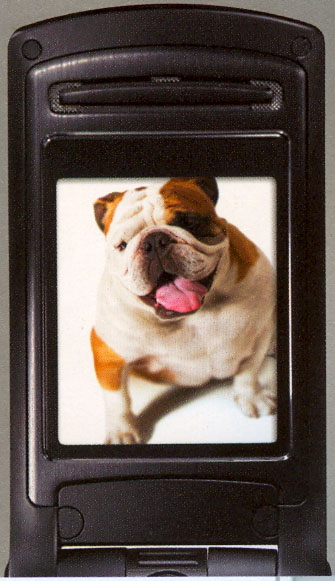
1990s: FIDO
In the 1990s,the
cellphone provider, Fido,
mounted a large ad campaign with the
visual theme of people who looked like
their dogs.
Of course, the canine image refers back
to Nipper in His Master's Voice,
and the trait of fidelity, as in
"what could be more faithful than a
dog?"
Note that the dog got
modernized to a robotic version, with the consumer becoming
to its "master", even though
many cellphone users feel more
"tethered" to the
leash.









 "Fidomatic"