Also called flanging or flangeing. An effect created by adding together two identical SIGNALs separated by a very short time delay (less than 25 ms, but strongest below 10 ms). These short delays are within the audio WAVELENGTH range, and the combination of the two signals affects the frequency SPECTRUM of the composite sound.
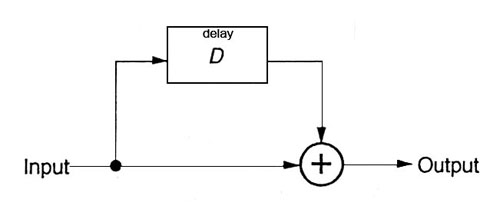
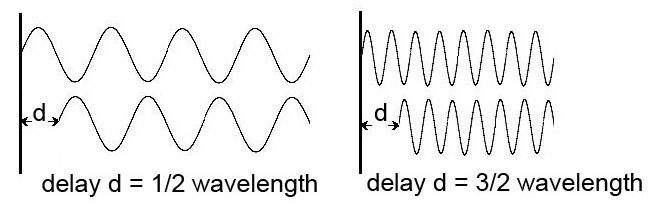
Because different frequencies have unique wavelengths, there is a different time or PHASE delay for different frequencies. For example, a time delay of 1 millisecond causes a 360° PHASE DIFFERENCE in a 1 kHz wave, but only a 180° phase difference (a half WAVELENGTH) for a 500 Hz wave. Thus CANCELLATION will occur at 500 Hz, and reinforcement at 1 kHz. In addition, other frequencies will cancel where the time delay produces a half wavelength difference, as show below. In practice, cancellation is not complete but results in a drop of about 20 dB.
For two signals of amplitude A and frequency f, the resulting combined amplitude Ar, where the time delay between them is t, is given by:
The resulting amplitude will be at its lowest when ft = n/2, n = 1,3,5,7,...

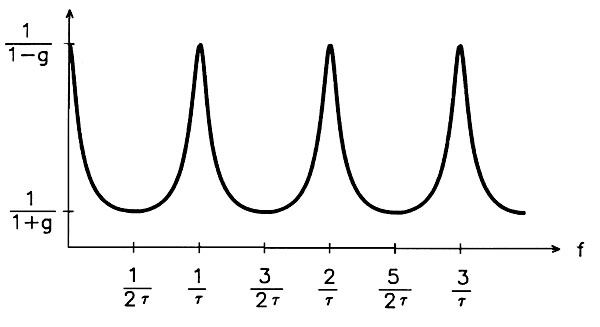
For example, with t = 1 ms, cancellation in a complex spectrum will occur at 500, 1500, 2500, 3500,..... Hz. The effect is similar to that of a COMB FILTER at these frequencies, i.e. the odd harmonics. Likewise, the even harmonics will be reinforced. The resulting colouration is described as a 'swishing' or 'jet-like' sound, and is often heard on commercial recordings. The time delay, however, is seldom constant in practice, and so there will seem to be a rising and falling pitch as well. The pitch heard corresponds to a frequency whose PERIOD equals the time delay, and is sometimes referred to as "repetition pitch". It is more pronounced when the reflected sound is stronger or there are multiple reflections with the same delay.
The effect was noticed as early as 1693 by the astronomer Christiaan Huygens while standing at the foot of a staircase at the castle at Chantilly de la Cour in France and listening to a nearby fountain. He ascribed the pitch he heard to the symmetrical reflections off each step of the staircase, the horizontal depth of which corresponded to the wavelength of that pitch.
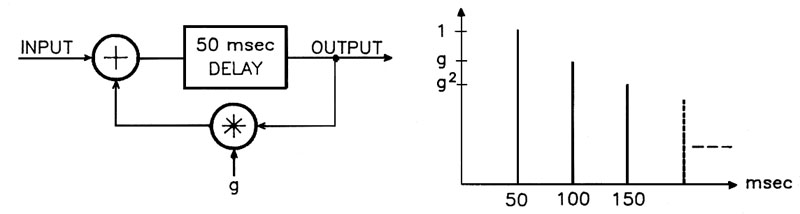
When the delayed signal is fed back into a circuit, or there are multiple reflections of a similar duration, the bandwidth of the cancelled frequencies increases, and thus the frequencies which are reinforced become more prominent. In most cases, it appears as if a pitched component is being added.
The effect may be heard environmentally when a
BROAD BAND NOISE
is combined with its reflected sound (as with a passing car or
plane). The resultant filtering is heard as a change in TIMBRE because the time delay
is changing as a result of the speed of movement.