iSpace
Showcase:
Iterative design, construction, and evaluation
of unique multi-modal VR laboratory at SIAT, SFU
The iSpace program is centered on investigating what constitutes effective, robust, and intuitive human spatial orientation and behaviour. This fundamental knowledge will be applied to design novel, more effective human-computer interfaces and interaction paradigms that enable similar processes in computer-mediated environments like virtual reality (VR) and multi-media.
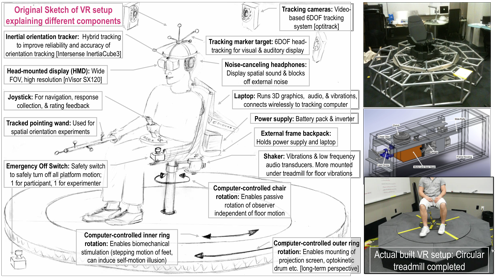
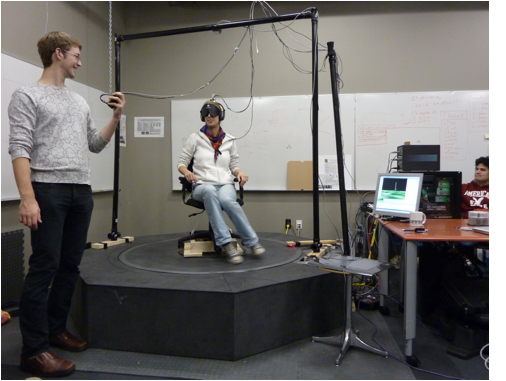
To tackle this ambitious agenda, we had to design and build our own flexible research apparatus, which consists of a motion chair mounted on top of a “circular treadmill” (see Fig. below), which allows us to physically rotate participants and/or elicit compelling self-rotation illusions (induced by biomechanical cues from stepping along with the rotating turntable).
To design and build such a setup (which is commercially unavailable), I started a highly fruitful collaboration with several professors in Mechatronics and employed three Mechatronics 3rd year undergraduate students as part of a co-op placement and later as RAs. Together, we started to iteratively design, build, and evaluate a worldwide unique multi-modal VR lab for perceptual/behavioural experiments (see links/illustrations/DVD). The most challenging part, the construction of the circular treadmill-based motion simulator was recently successfully completed by the three undergraduates and will be the center piece of the showcase. This included the design and 3D modeling of the mechanical components in solidworks including simulation and stress testing as well as the selection and integration of the electronics, motors, control, gears, etc. and basic interfacing to a control computer.
Together with my graduate students, we are currently working on the 3D visual, 3D auditory, and subsonic/vibrational simulation, which will also be showcased.
Presentations and Publications
http://www.sfu.ca/~ber1/web/iSpaceMecha/
& attached DVDs
Collaborators:
Mechatronics 3rd year undergraduates
Etienne Naugle, Adam Hoyle, Anton Brosas
Between December 2009 and Fall 2010, They did all the main work of designing, simulating, building, and testing the circular treadmill, as illustrated in the CSME student design competition paper available at
Graduate Students (SIAT):
Daniel Feuereissen (co-supervision and collaborator since the project start)
Salvar Sigurdarson (interfacing circular treadmill with control computer, since Fall 2010)
Andrew Milne (3D sound and vibration simulation, motion chair, since Fall 2010)
Amir Aziz & Mark Nazemi (video production of intro video and video tutorial of circular treadmill, Fall 2010)
Supervisors
Prof. Gary Wang & Siamak Arzanpour (Mechatronics, co-supervisors)
Prof. Bernhard Riecke (SIAT, supervisor and project leader)