 Linguistics 222
Pro-forms 222
Linguistics 222
 Contents: Prounouns
| Pronominals | Anaphors
Contents: Prounouns
| Pronominals | Anaphors
 Pro-forms include pronouns and words closely related
to pronouns. Pro-forms are words and phrases that have no referential
meaning with the exception of the the grammatical features person
and number. Pro-forms are also marked for case, but case is functional,
it has no referential meaning. Noun, verbs, adjective, and prepositions
all have referential meaning with the exception of certain grammatical
classes of each category. Pro-forms are one such exception. Consider
the following sentence:
Pro-forms include pronouns and words closely related
to pronouns. Pro-forms are words and phrases that have no referential
meaning with the exception of the the grammatical features person
and number. Pro-forms are also marked for case, but case is functional,
it has no referential meaning. Noun, verbs, adjective, and prepositions
all have referential meaning with the exception of certain grammatical
classes of each category. Pro-forms are one such exception. Consider
the following sentence:
The key words here are John, Mary, he, and she. John and Mary are referential. There is only referent for John in the discourse of (1), say John Q. X. Smith. Similarly, Mary is referential as there is only only one referent for her in the discourse of (1) as well. On the other hand the two pronouns he and her have no direct referent. Without a context there is no way to know who these to pronouns refer to. However, in (1), there is a context--the discourse encompassing the two sentences. The two pronouns are linked to John and Mary, respectively:

The pronoun he is marked with the features [+masc] and [-plural]. The pronoun must match its antecedent in features--the form which the pronoun is linked to. This is another case of agreement. Agreement in one form or another is very common in languages of the world. In other words, her cannot be linked to John, and he cannot be linked to Mary, as long as John and Mary refer to male and females humans, respectively
There are two types of pronouns--pronominals
and anaphors. Pronominals include the class of pronouns
discussed above. The antecedent of a pronminal cannot be linked
to an antecedent in the same clause as the pronominal:

The pronominal him cannot be linked to John. Only an anaphor may be linked to John. Anaphors are discussed below. The antecedent may occur in a dominate CP:
In (1) and (2) if John and Mary are the only human members of the discourse, then he is linked to John and her is linked to Mary. The linking is unbounded:


It is possible that there are more than just two persons in the discourse. If so, then it is possible that the pronominals could be linked to some other appropriate antecedent in the discourse.
Note that the antecedent of a pronominal must agree with it for the features of gender, number, and person. The following interpretations are unacceptable:


If the subject of the first embedded clause is replaced with a feminine antecedent, two interpretations are possible:

Here, the antecedent of her is either Mary or Betty, but not both. Note that in the appropriate discourse context the antecedent of both he and her may occur in a preceding sentence.
There are special uses of pronominals where a pronominal may used where the antecedent is understood either from non-verbal context or as a code amongst consenting speakers. These won't be covered here.
Anaphors are pronouns that are bounded within a
clause. There are three kinds of anaphors in English: reflexives,
reciprocals, and 'own'-possessives. Reflexive reciprocals include
pro-NPs that end with the morpheme -self:
As in the above examples the antecedent of an anaphor must be in the same clause as the anaphor. If the anaphor occur in an embedded clause not containing the anaphor, the sentence crashes:
Bill, the antecedent, occurs in a higher clause:

The only possible antecedent for the anaphor is Mary, but Mary is (normally) marked as feminine, while him is marked as masculine. Like pronominals anaphors must agree with their antecedents for gender, number, and person:

This sentence crashes, since himself has no antecedent. All anaphors must have an antecedent.
One of the conditions on the antecedent-anaphor relationship is that the antecedent must c-command the anaphor with which it is linked. C-command is defined as:
The key here is immediate dominance. The c-commanding node must be immediately dominated by the node that dominates the c-commanded node. In the following structure:
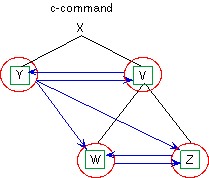
The c-commanding node is circled in red; the c-commanded node is enclosed in the green square. Y c-commands V, W, and Z; V c-commands Y. W and Z c-command each other. X c-commands nothing since it dominates everything. V does not c-command W and Z since V dominates them. W does not c-command Y since V, which immediately dominates W, does not dominate Y. The same holds for Z and Y. Note that sisters always c-command each other.
Now consider the following sentence:
Bill does not c-command the anaphor himself. Therefore, Bill cannot be the antecedent for the anaphor. And the only possible antecedent is mother; it fails to agree with the anaphor for gender. Hence, the sentence crashes.

To return to course outline Click here.
