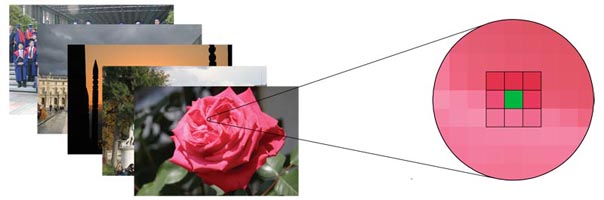
 |
|
Are you
interested in digital photography or imaging sensors? We are
exploring ways of improving the digital imaging sensors used in
cameras. Our group is focused on improving digital camera
performance and lifetime. Unfortunately, digital imagers like
any other microelectronic devices, develop defects over time.
Unlike other microchips, most in-field defects in digital
imagers begin appearing soon after fabrication, are permanent,
and their number increases continuously over the lifetime of the
sensor. These faulty pixels degrade the quality of the image
generated by the sensor. Although the impact of defects can be
overcome by factory recalibration, this is often expensive and
even infeasible for imagers used in many applications (eg those
in remote locations). We have been investigating imager in-field
defect development for several years now and have identified the
characteristics and rate of faulty pixel development.
We are working
on 3 areas: the identification of defects as cameras age,
creating new ways to recover the missing pixel information, and
the testing of new sensor designs. As sizes of imaging sensors
become larger both in pixel count and area, the possibility of
pixel defects increases during manufacturing, and over the
lifetime of the sensor. People do not want to throw away
expensive cameras just because they have dead pixels in it, but
find such dead spots annoying in pictures. We are exploring ways
of correcting this using both software which knows the defect’s
characteristics and potentially fault tolerant pixels. Students
will help us test, analyze and simulate the response of this
design. Previous students have also been part of published
conference papers on these results and part of it has resulted
in a patent application.
Links to more information
Want to learn
more about defects in cameras – go to the the Image
Sensor overview paper for a more complete introduction.:
Depending on the student’s background this project would range
from:
(1) Experimental testing of digital cameras to identify and
evaluate defects. This can include hardware development
for the testing the cameras in the lab, and software development
to run the tests (controlling the cameras). You will gain
experience in fully understanding the operation of digital
cameras (how the sensor transforms the raw image into a final
picture).
(2) Developing software programs to analyze the image data to
locate the defects, and extract their parameters. This will
involve expanding our software which detects digital defects
both from laboratory tests and from regular digital images.
Statistical analysis of the data will allow us to identify the
causal source of the defects, relates defects growth to camera
parameters such as pixel size, and suggest ways to improve
imaging sensor lifetimes. Hence you gain an idea of how
experimental design and statistical data analysis is applied for
real research.
(3) Help develop algorithms and software for recovering the true
image hidden by the defects. You will be using
experimental methods to compare the original true image,
captured by a sensor without damage, to what an algorithm
projects as the corrected image. This is applying
programming skills (Matlab or C) to real world image
applications.
(4) Potentially working to develop programs that will use
digital images posted on the internet to detect the presence of
defects in those cameras. We want to gather information
from images on the web that help us identify defects in those
images. Potentially creating a citizen science web site so
the public can be part of this.
Previous summer students have also been part of published
conference papers on these results (including one that is part
of a patent application),
Skills Needed:
Student should be in third year or above. Some combination
of the following skills are needed, but not all are required
. The skill set will determine the type of project.
(1) A background in digital photography and a general liking of
experimental work, but. you need not be a serious amateur
photographer. This work involves testing cameras ranging from
high end DSLRs to cell phones.
(2) Good computer skills for PC based systems: spreadsheets
& Matlab and/or C programming.
(3) Taken an introductory Optics courses from physics.
(4) Experience with adobe photoshop is useful though not
required.
(5) Electronics or Physics background.
(6) Taken a statistics course .