


Example:  . Then

and the chain is otherwise specivied by  and
and  . The matrix
  is
is

The backward equations become

while the forward equations are

Add  first plus
  third backward equations to get

so

Put t=0 to get  . This gives

Plug this back in to the first equation and get

Multiply by  and get

which can be integrated to get

Alternative calculation:
can be written as

where


and

Then

Now

so we get

where

Notice: rows of  are a stationary initial distribution. If rows are
 then
then

so

Moreover

Fact: 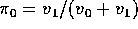 is long run fraction of time in
state 0.
is long run fraction of time in
state 0.
Fact:

Ergodic Theorem in continuous time.
Birth and Death Processes
Consider a population of X(t) individuals. Suppose
in next time interval (t,t+h) probability of population
increase of 1 (called a birth) is  and
probability of decrease of 1 (death) is
and
probability of decrease of 1 (death) is  .
.
Jargon: X is a birth and death process.
Special cases:
All  ; called a pure birth process.
All  (0 is absorbing): pure death process.
 and
and  is a linear
birth and death process.
is a linear
birth and death process.
 ,
,  : Poisson Process.
 and is a linear
birth and death process with immigration.
and is a linear
birth and death process with immigration.
Queuing Theory
Ingredients of Queuing Problem:
1: Queue input process.
2: Number of servers
3: Queue discipline: first come first serve? last in first out? pre-emptive priorities?
4: Service time distribution.
Example:
Imagine customers arriving at a facility at times of a Poisson
Process N with rate  . This is the input process,
denoted M (for Markov) in queuing literature.
. This is the input process,
denoted M (for Markov) in queuing literature.
Single server case:
Service distribution: exponential service times, rate  .
.
Queue discipline: first come first serve.
X(t) = number of customers in line at time t.
X is a Markov process called M/M/1 queue:


Example:  queue:
Customers arrive according to PP rate . Each
customer begins service immediately. X(t) is number
being served at time t. X is a birth and death process
with

and

Stationary Initial Distributions
We have seen that a stationary initial distribution is
a probability vector solving
Rewrite this as

Interpretation: LHS is rate at which process leaves state j; process is
in state j a fraction  of time and then makes transition at rate
 . RHS is total rate of arrival in state j. For each state

 is fraction of time spent in state i and
then
is fraction of time spent in state i and
then  the instantaneous rate of transition from i to j.
So equation says:
Rate of departure from j balances rate of arrival to j. This is called balance.
Application to birth and death processes:
Equation is

for  and
and

Notice that this permits the recursion

which extends by induction to

Apply  to get

This gives the formula announced:

If

then we have defined a probability vector which solves
Since

we see that

so that  is constant. Put t=0 to discover that
the constant is .
is constant. Put t=0 to discover that
the constant is .