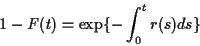
,
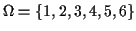
of all possible outcomes. Six sides to the three cards.
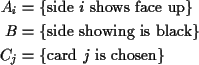
Label three red sides 1, 2, 3 with sides 1, 2 on the all red card (card
# 1).
Label three black sides 4, 5, 6 with 3, 4 on opposite sides of mixed
card (card #2). Define some events:
,
of all possible outcomes. Six sides to the three cards.
Label three red sides 1, 2, 3 with sides 1, 2 on the all red card (card
# 1).
Label three black sides 4, 5, 6 with 3, 4 on opposite sides of mixed
card (card #2). Define some events:
Course outline:
Example 1: Three cards: one red on both sides, one black on both sides, one black on one side, red on the other. Shuffle, pick card at random. Side up is Black. What is the probability the side down is Black?
Solution: To do this carefully, enumerate sample space,
,
of all possible outcomes. Six sides to the three cards.
Label three red sides 1, 2, 3 with sides 1, 2 on the all red card (card
# 1).
Label three black sides 4, 5, 6 with 3, 4 on opposite sides of mixed
card (card #2). Define some events:
One representation
 .
Then
.
Then
 ,
,
 ,
,
 and so on.
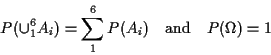
Modelling: assumptions about some probabilities; deduce probabilities of other events. In example simplest model is
Apply two rules:
 ,
,

 .
(Of course
B has happened rules out 3.)
.
(Of course
B has happened rules out 3.)
Definition of conditional probability:

Example 2: Monte Hall, Let's Make a Deal. Monte shows you 3 doors. Prize hidden behind one. You pick a door. Monte opens a door you didn't pick; shows you no prize; offers to let you switch to the third door. Do you switch?
Sample space: typical element is (a,b,c) where a is number of door with prize, b is number of your first pick and c is door Monte opens with no prize.
| (1,1,2) | (1,1,3) | (1,2,3) | (1,3,2) |
| (2,1,3) | (2,2,1) | (2,2,3) | (2,3,1) |
| (3,1,2) | (3,2,1) | (3,3,1) | (3,3,2) |
Model? Traditionally we define events like
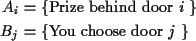
and assume that each Ai has chance 1/3. We
are assuming we have no prior reason to suppose
Monte favours one door. But these and all other
probabilities depend on the behaviour of people
so are open to discussion.
The event LS, that you lose if you switch is


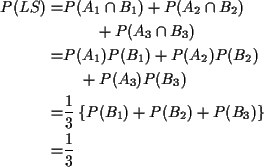
So the event you win by switching has probability 2/3 and you should switch.
Usual phrasing of problem. You pick 1, Monte shows 3. Should
you take 2? Let S be rv S = door Monte
shows you. Question:
Modelling assumptions do not determine this; it depends on Monte's method for choosing door to show when he has a choice. Two simple cases:
Use Bayes' rule:

Numerator is

Denominator is

which simplifies to

which in turn is

For case 1 we get


Notice that in case 2 if we pick door 1 and Monte shows us door 2 we should definitely switch. Notice also that it would be normal to assume that Monte used the case 1 algorithm to pick the door to show when he has a choice; otherwise he is giving the contestant information. If the contestant knows Monte is using algorithm 2 then by switching if door 2 is shown and not if door 3 is shown he wins 2/3 of the time which is as good as the always switch strategy.
Example 3: Survival of family names. Traditionally: family name follows sons. Given man at end of 20th century. Probability descendant (male) with same last name alive at end of 21st century? or end of 30th century?
Simplified model: count generations not years. Compute probability, of survival of name for n generations.
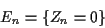
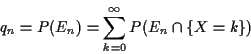
Technically easier to compute qn, probability of extinction by generation n.
Useful rvs:


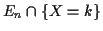 .
Let
.
Let


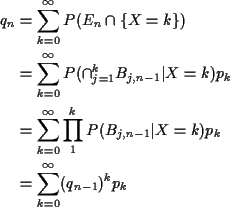
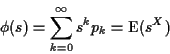

 so that the limit of
the qn, say
so that the limit of
the qn, say  ,
must exist and (because
,
must exist and (because  is
continuous)
solve
is
continuous)
solve

Geometric Distribution: Assume

 is probability of success.)
Then
![\begin{align*}\phi(s) & = \sum_0^\infty s^k (1-\theta)^k \theta
\\
& = \theta \...
...fty \left[s(1-\theta)\right]^k
\\
& = \frac{\theta}{1-s(1-\theta)}
\end{align*}](img41.gif)
Set
 to get
![\begin{displaymath}s[1-s(1-\theta)]=\theta
\end{displaymath}](img43.gif)


 the only root which is a probability is 1 and
 .
If
.
If
 then in fact
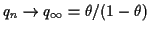 .
.
Binomial( ): If
): If

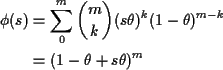 has two roots. One is 1. The other is
less than 1 if and only if
has two roots. One is 1. The other is
less than 1 if and only if
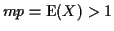 .
.
Poisson( ): Now

 has two roots. One is 1. The other
is less than 1 if and only if
has two roots. One is 1. The other
is less than 1 if and only if
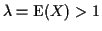 .
.
Important Points:
Example 3: Mean values
Zn = total number of sons in generation n.
Z0=1 for convenience.
Compute
 .
.
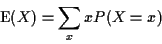
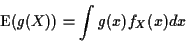
Recall definition of expected value:
If X is discrete then
If X is absolutely continuous then
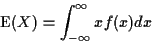
Theorem: If Y=g(X), X has density f then

Key properties of  :
:
1: If  then
then
 .
Equals iff
P(X=0)=1.
.
Equals iff
P(X=0)=1.
2:
 .
.
3: If
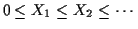 then
then

4:
 .
.
Conditional Expectations
If X, Y, two discrete random variables then

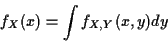
Extension to absolutely continuous case:
Joint pmf of X and Y is defined as
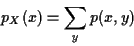


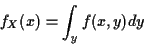
Example:
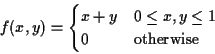
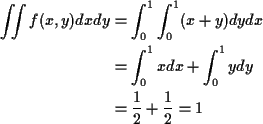
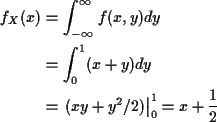
The marginal density of X is, for
 .
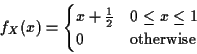
.
For x not in [0,1] the integral is 0 so
Conditional Densities
If X and Y have joint density
fX,Y(x,y) then
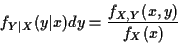
we define the conditional density of Y given X=x by
analogy with our interpretation of densities. We take limits:

in the sense that if we divide through by dy and let
dx and dy tend to 0 the conditional density is the limit
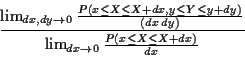
Going back to our interpretation of joint densities and ordinary
densities we see that our definition is just
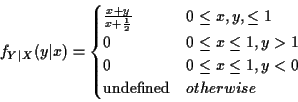
Example: For f of previous example conditional density
of Y given X=x defined only for
:
 random variable. Observe X then toss
a coin X times. Y is number of heads. P(H) = p
random variable. Observe X then toss
a coin X times. Y is number of heads. P(H) = p
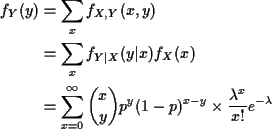
WARNING: in sum
 is required and x, y integers
so sum really runs from y to
is required and x, y integers
so sum really runs from y to 
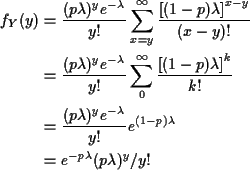
which is a Poisson( )
distribution.
)
distribution.
Conditional Expectations
If X and Y are continuous random variables with joint density
fX,Y we define:

Key properties of conditional expectation
1: If  then
then
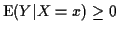 .
Equals iff
P(Y=0|X=x)=1.
.
Equals iff
P(Y=0|X=x)=1.
2:
 .
.
3: If Y and X are independent then

4:
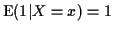 .
.
Example:
,
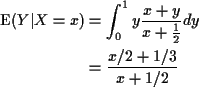
Computing expectations by conditioning:
Notation:
 is the function of X you get by
working out
is the function of X you get by
working out
 ,
getting a formula in x and replacing
x by X. This makes
a random variable.
,
getting a formula in x and replacing
x by X. This makes
a random variable.
Properties:
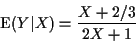
1:
 .
.
2: If Y and X are independent then

3:
 .
.
4:
![${\rm E}\left[{\rm E}(Y\vert X)\right] = {\rm E}(Y) $](img101.gif) (compute average
holding X fixed first, then average over X).
(compute average
holding X fixed first, then average over X).
In example:

![\begin{align*}{\rm E}(Z_n) & = {\rm E}\left[{\rm E}(Z_n\vert X)\right]
\\
& = {...
...Z_{n-2})
\\
& \quad \vdots
\\
& = m^{n-1}{\rm E}(Z_1)
\\
& = m^n
\end{align*}](img104.gif)
For m < 1 expect exponential decay. For m>1 exponential growth (if not extinction).
We have reviewed the following definitions:
 set
of possible outcomes,
set
of possible outcomes,  .
.
.
 and
and
 .
.
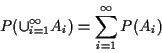
 pairwise disjoint
(
pairwise disjoint
(
 )
)




 is previous with x replaced by X after getting
formula.
is previous with x replaced by X after getting
formula.
Tactics:
 is a partition
then
is a partition
then
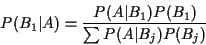
Tactics for expected values:

![\begin{displaymath}{\rm E}\left[{\rm E}(Y\vert X)\right] = {\rm E}(Y)
\end{displaymath}](img123.gif)
Last names example has following structure: if, at generation n there are m individuals then the number of sons in the next generation has the distribution of the sum of m independent copies of the random variable X which is the number of sons I have. This distribution does not depend on n, only on the value m of Zn. We call Zn a Markov Chain.
Ingredients of a Markov Chain:
 of random variables whose values
are all in S.
of random variables whose values
are all in S.
 with entries Pi,j for
  .
is required to be stochastic:
.
is required to be stochastic:

The stochastic process
is called a
Markov chain if

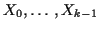 and for all i,j,k. Usually used with

 .
.
The matrix
is called a transition matrix.
Example: If X in the last names example has
a Poisson
distribution then given Zn=k,
Zn+1 is like sum of k independent Poisson
rvs which has a Poisson( )
distribution.
So
)
distribution.
So
![\begin{displaymath}{\bf P}= \left[\begin{array}{llll}
1 & 0 & 0 & \cdots
\\
e^{...
...ts
\\
\vdots &
\vdots &
\vdots &
\ddots
\end{array}\right]
\end{displaymath}](img133.gif)
Example: Weather: each day is dry (D) or wet (W).
Xn is weather on day n.
Suppose dry days tend to be followed by dry days, say 3 times in 5 and wet days by wet 4 times in 5.
Markov assumption: yesterday's weather irrelevant to prediction of tomorrow's given today's.
Transition Matrix:
![\begin{displaymath}{\bf P}= \left[\begin{array}{cc} \frac{3}{5} & \frac{2}{5}
\\
\\
\frac{1}{5} & \frac{4}{5}
\end{array} \right]
\end{displaymath}](img134.gif)
Now suppose it's wet today. P(wet in 2 days)?

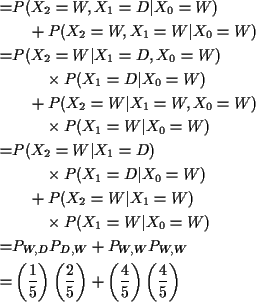 .
Look at the matrix product
.
Look at the matrix product
 :
:
![\begin{displaymath}\left[\begin{array}{ll} \frac{3}{5} & \frac{2}{5}
\\
\\
\fr...
...ac{2}{5}
\\
\\
\frac{1}{5} & \frac{4}{5}
\end{array} \right]
\end{displaymath}](img138.gif) .
.
General case. Define
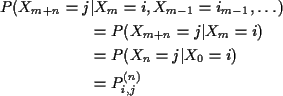
Proof of these assertions by induction on m,n.
Example for n=2. Two bits to do:
First suppose U,V,X,Y are discrete variables.
Assume

for any x,y,u,v. Then I claim
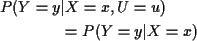
In words, if knowing both U and V doesn't change the
conditional probability then knowing U alone doesn't
change the conditional probability.
Proof of claim:

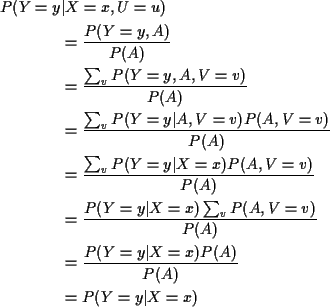
Second step: consider
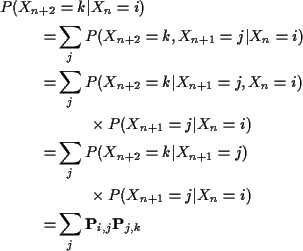
This shows that

 means the matrix product
.
Notice both
that the quantity does not depend on n and that we can
compute it by taking a power of .
means the matrix product
.
Notice both
that the quantity does not depend on n and that we can
compute it by taking a power of .
More general version

 we get the Chapman-Kolmogorov
equations:
we get the Chapman-Kolmogorov
equations:

Summary: A Markov Chain has stationary n step transition probabilities which are the nth power of the 1 step transition probabilities.
Here is Maple output for the 1,2,4,8 and 16 step transition matrices for our rainfall example:
> p:= matrix(2,2,[[3/5,2/5],[1/5,4/5]]);
                      [3/5    2/5]
                 p := [          ]
                      [1/5    4/5]
> p2:=evalm(p*p):
> p4:=evalm(p2*p2):
> p8:=evalm(p4*p4):
> p16:=evalm(p8*p8):
This computes the powers (evalm understands
matrix algebra).
Fact:
![\begin{displaymath}\lim_{n\to\infty} {\bf P}^n = \left[
\begin{array}{cc} \frac{...
...ac{2}{3}
\\
\\
\frac{1}{3} & \frac{2}{3}
\end{array}\right]
\end{displaymath}](img150.gif)
> evalf(evalm(p));
            [.6000000000    .4000000000]
            [                          ]
            [.2000000000    .8000000000]
> evalf(evalm(p2));
            [.4400000000    .5600000000]
            [                          ]
            [.2800000000    .7200000000]
> evalf(evalm(p4));
            [.3504000000    .6496000000]
            [                          ]
            [.3248000000    .6752000000]
> evalf(evalm(p8));
            [.3337702400    .6662297600]
            [                          ]
            [.3331148800    .6668851200]
> evalf(evalm(p16));
            [.3333336197    .6666663803]
            [                          ]
            [.3333331902    .6666668098]
Where did 1/3 and 2/3 come from?
Suppose we toss a coin
 and start the
chain with Dry if we get heads and Wet if we get
tails.
and start the
chain with Dry if we get heads and Wet if we get
tails.
Then

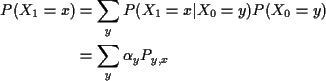
 by matrix .
A special :
if we put
by matrix .
A special :
if we put
 and
and
 then
then
![\begin{displaymath}\left[ \frac{1}{3} \quad \frac{2}{3} \right]
\left[\begin{ar...
...array} \right] = \left[ \frac{1}{3} \quad \frac{2}{3} \right]
\end{displaymath}](img157.gif)
A probability vector
is called an initial distribution for
the chain if
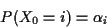
A Markov Chain is stationary if
An initial distribution is called stationary if the chain is
stationary. We find that
is a stationary initial distribution
if

Suppose  converges to some matrix
 .
Notice that
.
Notice that
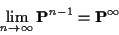
![\begin{align*}{\bf P}^\infty & = \lim {\bf P}^n
\\
& = \left[\lim {\bf P}^{n-1}\right] {\bf P}
\\
& = {\bf P}^\infty {\bf P}
\end{align*}](img163.gif)
This proves that each row
of
satisfies

Def'n: A row vector x is a left eigenvector of A with
eigenvalue
if

So each row of
is a left eigenvector of
with eigenvalue 1.
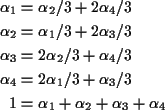
Finding stationary initial distributions. Consider the for the weather example. The equation
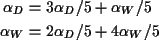
 is to be a
probability vector then
is to be a
probability vector then


![\begin{displaymath}{\bf P}= \left[\begin{array}{cccc}
0 & 1/3 & 0 & 2/3
\\
1/3...
...\\
0 & 2/3 & 0 & 1/3
\\
2/3 & 0 & 1/3 & 0
\end{array}\right]
\end{displaymath}](img171.gif)
 and get
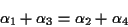
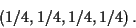
p:=matrix([[0,1/3,0,2/3],[1/3,0,2/3,0],
          [0,2/3,0,1/3],[2/3,0,1/3,0]]);

               [ 0     1/3     0     2/3]
               [                        ]
               [1/3     0     2/3     0 ]
          p := [                        ]
               [ 0     2/3     0     1/3]
               [                        ]
               [2/3     0     1/3     0 ]
> p2:=evalm(p*p);
             [5/9     0     4/9     0 ]
             [                        ]
             [ 0     5/9     0     4/9]
        p2:= [                        ]
             [4/9     0     5/9     0 ]
             [                        ]
             [ 0     4/9     0     5/9]
> p4:=evalm(p2*p2):
> p8:=evalm(p4*p4):
> p16:=evalm(p8*p8):
> p17:=evalm(p8*p8*p):
> evalf(evalm(p16));
    [.5000000116 , 0 , .4999999884 , 0]
    [                                 ]
    [0 , .5000000116 , 0 , .4999999884]
    [                                 ]
    [.4999999884 , 0 , .5000000116 , 0]
    [                                 ]
    [0 , .4999999884 , 0 , .5000000116]
> evalf(evalm(p17));
    [0 , .4999999961 , 0 , .5000000039]
    [                                 ]
    [.4999999961 , 0 , .5000000039 , 0]
    [                                 ]
    [0 , .5000000039 , 0 , .4999999961]
    [                                 ]
    [.5000000039 , 0 , .4999999961 , 0]
> evalf(evalm((p16+p17)/2));
  [.2500, .2500, .2500, .2500]
  [                          ]
  [.2500, .2500, .2500, .2500]
  [                          ]
  [.2500, .2500, .2500, .2500]
  [                          ]
  [.2500, .2500, .2500, .2500]
doesn't converges but
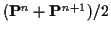 does.
Next example:
does.
Next example:
![\begin{displaymath}p = \left[\begin{array}{cccc}
\frac{2}{5} & \frac{3}{5}
& 0 &...
...{3}{5}
\\
0 &0 &
\frac{1}{5} & \frac{4}{5}\end{array}\right]
\end{displaymath}](img177.gif) :
:
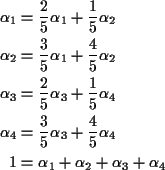
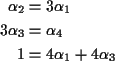
Pick  in [0,1/4];
put
in [0,1/4];
put
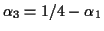 .
.
 .
So solution is not unique.
.
So solution is not unique.
> p:=matrix([[2/5,3/5,0,0],[1/5,4/5,0,0],
            [0,0,2/5,3/5],[0,0,1/5,4/5]]);

               [2/5    3/5     0      0 ]
               [                        ]
               [1/5    4/5     0      0 ]
          p := [                        ]
               [ 0      0     2/5    3/5]
               [                        ]
               [ 0      0     1/5    4/5]
> p2:=evalm(p*p):
> p4:=evalm(p2*p2):
> p8:=evalm(p4*p4):
> evalf(evalm(p8*p8));
        [.2500000000 , .7500000000 , 0 , 0]
        [                                 ]
        [.2500000000 , .7500000000 , 0 , 0]
        [                                 ]
        [0 , 0 , .2500000000 , .7500000000]
        [                                 ]
        [0 , 0 , .2500000000 , .7500000000]
Notice that rows converge but to two different vectors:

 revisited?
Check that
revisited?
Check that


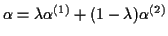 (
(
 )
then
)
then
> p:=matrix([[2/5,3/5,0],[1/5,4/5,0],
             [1/2,0,1/2]]);

                  [2/5    3/5     0 ]
                  [                 ]
             p := [1/5    4/5     0 ]
                  [                 ]
                  [1/2     0     1/2]
> p2:=evalm(p*p):
> p4:=evalm(p2*p2):
> p8:=evalm(p4*p4):
> evalf(evalm(p8*p8));
  [.2500000000 .7500000000        0       ]
  [                                       ]
  [.2500000000 .7500000000        0       ]
  [                                       ]
  [.2500152588 .7499694824 .00001525878906]
all rows converge to some .
In
this case this
is a stationary initial distribution.
the locations of zeros flip flop.
does
not converge. Observation: average
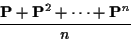
some rows converge to one
and some to
another. In this case the solution of
is not
unique.
Basic distinguishing features: pattern of 0s in matrix .
State i leads to state j if
 for some n.
It is convenient to agree that
for some n.
It is convenient to agree that
 the identity matrix;
thus i leads to i.
the identity matrix;
thus i leads to i.
Note i leads to j and j leads to k implies i leads to k(Chapman-Kolmogorov).
States i and j communicate if i leads to j and j leads to i.
The relation of communication is an equivalence relation; it is reflexive, symmetric and transitive: if i and j communicate and j and k communicate then i and kcommunicate.
Example (+ signs indicate non-zero entries):
![\begin{displaymath}{\bf P}= \left[\begin{array}{ccccc}
0& 1 & 0 & 0 &0
\\
0 & 0...
...\\
+ & 0 & 0 & + & 0
\\
0 & + & 0 & + & +
\end{array}\right]
\end{displaymath}](img192.gif)
For this example:
 ,
,
 ,
,
 so 1,2,3 are all in the same communicating class.
 but not vice versa.
 but not vice versa.
So the communicating classes are
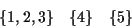
A Markov Chain is irreducible if there is only one communicating class.
Notation:

State i is recurrent if fi=1, otherwise transient.
If fi=1 then Markov property (chain starts over when it gets back to i) means prob return infinitely many times (given started in i or given ever get to i) is 1.
Consider chain started from transient i.
Let N be number of visits
to state i (including visit at time 0). To return m-1 times must return once
then starting over return m-1 times, then never return.
So:
 .
.
N has a Geometric distribution and
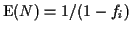 .
.
Another calculation:
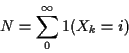
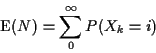
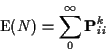

For last example: 4 and 5 are transient. Claim: states 1, 2 and 3 are recurrent.
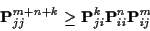
Proof: argument above shows each transient state is visited only finitely many times. So: there is a recurrent state. (Note use of finite number of states.) It must be one of 1, 2 and 3. Proposition: If one state in a communicating class is recurrent then all states in the communicating class are recurrent.
Proof: Let i be the known recurrent state so


 so
so

Proposition also means that if 1 state in a class is transient so are all.
State i has period d if d is greatest common
divisor of

![\begin{displaymath}{\bf P}= \left[\begin{array}{ccccc}
0& 1 & 0 & 0 &0
\\
0 & 0...
...\\
0 & 0 & 0 & 0 & 1
\\
0 & 0 & 0 & 1 & 0
\end{array}\right]
\end{displaymath}](img212.gif)
 is a class of period 3 states
and
is a class of period 3 states
and  a class of period 2 states.
![\begin{displaymath}{\bf P}= \left[\begin{array}{ccc}
0& 1/2 & 1/2
\\
1 & 0 & 0
\\
1 & 0 & 0
\end{array}\right]
\end{displaymath}](img215.gif)
A chain is aperiodic if all its states are aperiodic.
Example: consider a sequence of independent coin tosses with probability pof Heads on a single toss. Let Xn be number of heads minus number of tails after n tosses. Put X0=0.
Xn is a Markov Chain. State space is  ,
the integers and
,
the integers and
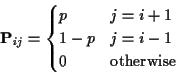
This chain has one communicating class (for  )
and
all states have period 2. According to the strong law of large
numbers Xn/n converges to 2p-1. If
)
and
all states have period 2. According to the strong law of large
numbers Xn/n converges to 2p-1. If  this guarantees
that for all large enough n
this guarantees
that for all large enough n
 ,
that is, the number
of returns to 0 is not infinite. The state 0 is then transient
and so all states must be transient.
,
that is, the number
of returns to 0 is not infinite. The state 0 is then transient
and so all states must be transient.
For p = 1/2 the situation is different. It is a fact that

Local Central Limit Theorem (normal approximation to
P(-1/2 < Xn < 1/2)) (or Stirling's approximation) shows


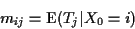
Start irreducible recurrent chain Xn in state i.
Let Tj be first n>0 such that Xn=j.
Define
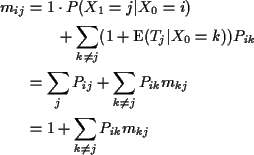
Example
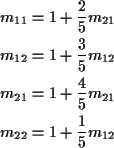


Notice stationary initial distribution is

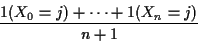
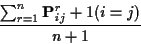 converge to
  then fraction converges to
 ;
i.e. limiting fraction of time in state j is .
;
i.e. limiting fraction of time in state j is .
Heuristic: start chain in i. Expect to return to i every mii time units. So are in state i about once every mii time units; i.e. limiting fraction of time in state iis 1/mii.
Conclusion: for an irreducible recurrent finite state space
Markov chain

Previous conclusion is still right if there is a stationary initial distribution.
Example:
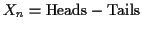 after n tosses
of fair coin. Equations are
after n tosses
of fair coin. Equations are
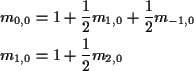
and many more.
Some observations:
You have to go through 1 to get to 0 from 2 so
Symmetry (switching H and T):
The transition probabilities are homogeneous:
Conclusion:
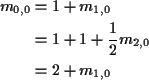
Notice that there are no finite solutions!
Summary of the situation:
Every state is recurrent.
All the expected hitting times mij are infinite.
All entries
 converge to 0.
Jargon: The states in this chain are null recurrent.
Page 229, question 21: runner goes from front or back door, prob 1/2 each. Returns front or back, prob 1/2 each. Has k pairs of shoes, wears pair if any at departure door, leaves at return door. No shoes? Barefoot. Long run fraction of time barefoot?
Solution: Let Xn be number of shoes at front door on day n. Then Xn is a Markov Chain.
Transition probabilities:
k pairs at front door on day n. Xn+1 is k if goes out back door (prob is 1/2) or out front door and back in front door (prob is 1/4). Otherwise Xn+1 is k-1.
0 < j < k pairs at front door on day n. Xn+1 is j+1if out back, in front (prob is 1/4). Xn+1 is j-1 if out front, in back. Otherwise Xn+1 is j.
0 pairs at front door on day n. Xn+1 is 0 if out front door (prob 1/2) or out back door and in back door (prob 1/4) otherwise Xn+1 is 1.
Transition matrix :
![\begin{displaymath}\left[\begin{array}{cccccc}
\frac{3}{4} & \frac{1}{4} & 0 & 0...
... 0 & 0 & \cdots & \frac{1}{4} & \frac{3}{4}
\end{array}\right]
\end{displaymath}](img239.gif)
Doubly stochastic: row sums and column sums are 1.
So
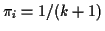 for all i is stationary initial distribution.
Solution to problem: 1 day in k+1 no shoes at front door. Half of those go barefoot. Also 1 day in k+1 all shoes at front door; go barefoot half of these days. Overall go barefoot 1/(k+1) of the time.
Insurance company's reserves fluctuate: sometimes up, sometimes down. Ruin is event they hit 0 (company goes bankrupt). General problem. For given model of fluctuation compute probability of ruin either eventually or in next k time units.
Simplest model: gambling on Red at Casino. Bet $1 at a time. Win
$1 with probability p, lose $1 with probability 1-p. Start with
k dollars. Quit playing
when down to $0 or up to N. Compute

Xn = fortune after n plays. X0=k.
Transition matrix:
![\begin{displaymath}{\bf P}=
\left[\begin{array}{cccccc}
1 & 0 & 0 & 0 &\cdots &...
...ots & \vdots
\\
0 & 0 & 0 & \cdots & 0 & 1
\end{array}\right]
\end{displaymath}](img242.gif)
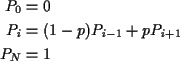
Middle equation is
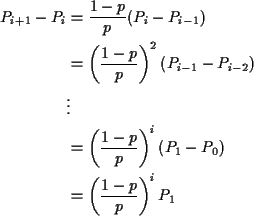
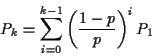
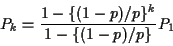
For k=N we get
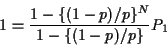
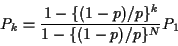
Notice that if p=1/2 our formulas for the sum of the geometric series
are wrong. But for p=1/2 we get

![\begin{displaymath}{\bf P}= \left[\begin{array}{cccc}
\frac{1}{2} & \frac{1}{2} ...
... & \frac{1}{4} & \frac{3}{8} & \frac{1}{8}
\end{array}\right]
\end{displaymath}](img250.gif)
For i=1 or i=2 and j=3 or 4:
For j=1 or j=2

For
 first step analysis:
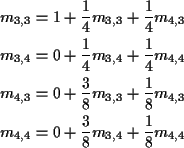
In matrix form
![\begin{align*}\left[\begin{array}{cc} m_{3,3} &m_{3,4} \\ \\
m_{4,3} &m_{4,4}\e...
...ray}{cc} m_{3,3} &m_{3,4} \\ \\
m_{4,3} &m_{4,4}\end{array}\right]
\end{align*}](img254.gif)
Translate to matrix notation:
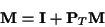
 is the identity,
 is the matrix of means and
  the
part of the transition matrix corresponding to transient states.
the
part of the transition matrix corresponding to transient states.
Solution is
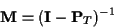
![\begin{displaymath}{\bf I} - {\bf P}_T =
\left[\begin{array}{rr} \frac{3}{4} &...
...rac{1}{4} \\ \\
-\frac{3}{8} & \frac{7}{8}
\end{array}\right]
\end{displaymath}](img260.gif)
![\begin{displaymath}{\bf M} = \left[\begin{array}{rr} \frac{14}{9} & -\frac{4}{9} \\ \\
-\frac{2}{3} & \frac{4}{3}
\end{array}\right]
\end{displaymath}](img261.gif)
Particles arriving over time at a particle detector. Several ways to describe most common model.
Approach 1: numbers of particles arriving in an interval has Poisson distribution, mean proportional to length of interval, numbers in several non-overlapping intervals independent.
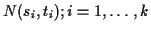
For s<t, denote number of arrivals in (s,t] by N(s,t). Model is
 distribution.
 the variables
 are independent.
Approach 2:
Let
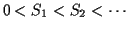 be the times at which the particles
arrive.
be the times at which the particles
arrive.
Let Ti = Si-Si-1 with S0=0 by convention.
Then
 are independent Exponential random variables with mean
  .
.
Note
 is called survival function of Ti.
Approaches are equivalent. Both are deductions of a model based on local behaviour of process.
Approach 3: Assume:

All 3 approaches are equivalent. I show: 3 implies 1, 1 implies 2 and 2 implies 3. First explain o, O.
Notation: given functions f and g we write
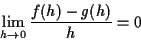
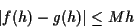
[Aside: if there is a constant M such that
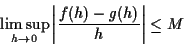
 and M s.t. for all

Model 3 implies 1: Fix t, define ft(s) to be conditional probability of 0 points in (t,t+s] given value of process on [0,t].
Derive differential equation for
f. Given process on [0,t] and 0 points in (t,t+s] probability of no
points in (t,t+s+h] is



 and find
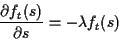

Notice: survival function of exponential rv..
General case:
Notation: N(t) =N(0,t).
N(t) is a non-decreasing function of t. Let
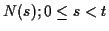 and N(t)=j.
Given N(t)=j probability that N(t+h) = k is conditional probability of k-j points in (t,t+h].
So, for  :
:

For j=k-1 we have

For j=k we have

N is increasing so only consider  .
.
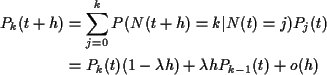
Rearrange, divide by h and let
t get

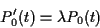


 to see
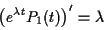
With P1(0)=0 we get
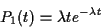

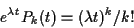
 distribution.
Similar ideas permit proof of

From which (by induction) we can prove that Nhas independent Poisson increments.
If N is a Poisson Process we define
to be the times between 0 and the first point, the first point and
the second and so on.
Fact:
are iid exponential rvs with
mean .
We already did T1 rigorously. The event T>t is exactly the
event N(t)=0. So

I do case of T1,T2. Let t1,t2 be two positive numbers and
s1=t1,
s2=t1+t2. The event

This is almost the same
as the intersection of the four events:
![\begin{align*}N(0,t_1]&=0
\\
N(t_1,t_1+\delta_1] & = 1
\\
N(t_1+\delta_1,t_1+\delta_1+t_2] & =0
\\
N(s_2+\delta_1,s_2+\delta_1+\delta_2] & = 1
\end{align*}](img301.gif)
which has probability

 and let
  and
and  go to 0
to get joint density of T1,T2 is
go to 0
to get joint density of T1,T2 is

More rigor:
 .
.
 .
.
First step: Compute

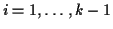 (s0=0) and at least one point in
(sk-1,sk] which has probability
(s0=0) and at least one point in
(sk-1,sk] which has probability

Second step: write this in terms of joint cdf of
.
I do k=2:

Notice tacit assumption s1 < s2.
Differentiate twice, that is, take




That completes the first part.
Now compute the joint cdf of T1,T2 by
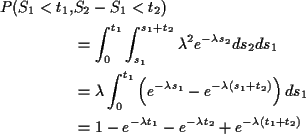

Summary so far:
Have shown:
Instantaneous rates model implies independent Poisson increments model implies independent exponential interarrivals.
Next: show independent exponential interarrivals implies the instantaneous rates model.
Suppose
 iid exponential rvs with means .
Define
Nt by Nt=k if and only if
iid exponential rvs with means .
Define
Nt by Nt=k if and only if

Let A be the event
 .
We
are to show
.
We
are to show
![\begin{displaymath}P(N(t,t+h] = 1\vert N(t)=k,A) = \lambda h + o(h)
\end{displaymath}](img322.gif)
![\begin{displaymath}P(N(t,t+h] \ge 2\vert N(t)=k,A) = o(h)
\end{displaymath}](img323.gif)
If n(s) is a possible trajectory consistent with N(t) = kthen n has jumps at points

So given
with n(t)=k we are essentially being given

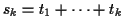 )
and asked the conditional probabilty in the first case
of the event B given by
)
and asked the conditional probabilty in the first case
of the event B given by
 irrelevant (independence).
![\begin{align*}P(N(t,t+h] = 1\vert& N(t)=k,A) /h
\\
& = P(B\vert T_{k+1}> t-s_k)/h
\\
& = \frac{P(B) }{he^{-\lambda(t-s_k)}}
\end{align*}](img328.gif)
The numerator may be evaluated by integration:
 to get the limit
![\begin{displaymath}P
(N(t,t+h] = 1\vert N(t)=k,A) /h \to \lambda
\end{displaymath}](img330.gif)
The computation of
![\begin{displaymath}\lim_{h\to 0} P(N(t,t+h] \ge 2\vert N(t)=k,A) /h
\end{displaymath}](img331.gif)
Convolution: If
 iid Exponentialthen
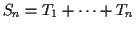 has a Gamma
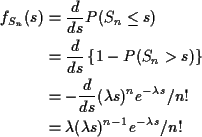
 distribution. Density
of Sn is
distribution. Density
of Sn is

Proof:
![\begin{align*}P(S_n>s)& = P(N(0,s] \le n)
\\
& = (\lambda s)^n e^{-\lambda s}/n!
\end{align*}](img336.gif)
Then
Extreme Values: If
 are independent exponential rvs
with means
are independent exponential rvs
with means
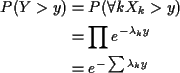
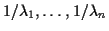 then
then
 has an exponential distribution with
mean
has an exponential distribution with
mean

Proof:
Memoryless Property: conditional distribution of
X-x given  is
exponential if X has an exponential distribution.
is
exponential if X has an exponential distribution.
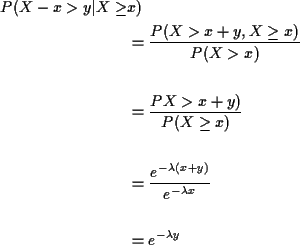
Proof:
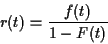
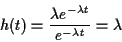
The hazard rate, or instantaneous failure rate for a positive
random variable T with density f and cdf F is

 this is
Weibull random variables have density

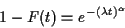
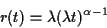
 ,
decreasing for
,
decreasing for  .
For
.
For  this is the exponential distribution.
Since