In the long run on what fraction of days does she commute via route A and on what fraction of her trips does she find construction? Your answer must set down clearly what assumptions you are making to answer the question. Answers with inadequate explanations will get low marks. [9 marks]
Extra space for Q1
 At the end of the day I may or may not decide to throw out some
of the papers that have accumulated. Given that
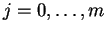
there are m papers the probability that I throw j of them out is 1/(m+1)for
At the end of the day I may or may not decide to throw out some
of the papers that have accumulated. Given that
there are m papers the probability that I throw j of them out is 1/(m+1)for
 .
Let Xn be the number of papers left at the end of day n
(after I do the throwing out).
.
Let Xn be the number of papers left at the end of day n
(after I do the throwing out).
- (a)
- What must you assume in order to have Xn be a Markov chain?
[2 marks]
- (b)
- Suppose U is a random variable with

Show that .
[2 marks]
.
[2 marks]
- (c)
- Let
 be the expected number of papers delivered to my house on
a given day.
Show that [3 marks]
be the expected number of papers delivered to my house on
a given day.
Show that [3 marks]
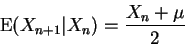
- (d)
- Let m be the long run expected number of papers I have at the
end of a day. That is
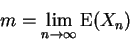
Show that .
[3 marks]
.
[3 marks]
 and
transition matrix
and
transition matrix
![\begin{displaymath}\left[\begin{array}{ccc} 1/3 & 2/3 & 0 \\ 1/6 & 1/2 & 1/3 \\ 0 & 1/4 & 3/4
\end{array}\right]
\end{displaymath}](img10.gif)
and initial distribution (1/5,2/5,2/5).
- (a)
- Find
P(X2=0,X1=0,X0=0) [1 mark]
- (b)
- Find
P(X1=0|X2=0,X0=0) [2 marks]
- (c)
- Find the stationary initial distribution for this chain.
[2 marks]
- (d)
- Starting from state 0 how many steps do you expect to need to get to state 2. [3 marks]
 .
When a collision occurs
it is equally likely to be between any of the n(n-1)/2 pairs
of particles. When two black particles
collide there is a chance p that (precisely) one will turn white
(instantaneously); otherwise they both stay black.
When two white particles collide there is
a chance q that (precisely) one will turn black (instantaneously); otherwise
they both stay white. When two
opposite colour particles collide there is a chance r/2 that
they both become white and a chance r/2 that they both become
black.
.
When a collision occurs
it is equally likely to be between any of the n(n-1)/2 pairs
of particles. When two black particles
collide there is a chance p that (precisely) one will turn white
(instantaneously); otherwise they both stay black.
When two white particles collide there is
a chance q that (precisely) one will turn black (instantaneously); otherwise
they both stay white. When two
opposite colour particles collide there is a chance r/2 that
they both become white and a chance r/2 that they both become
black.
- (a)
- Describe an appropriate Markov Chain to analyze this system. Give
the transition matrix for the skeleton chain, the instantaneous transition
rates and the mean holding times in each state. [5 marks]
- (b)
- For n=3 what fraction of the time are all three balls
the same colour? [3 marks]
 is a standard Brownian motion. Fix
0 < a < b.
is a standard Brownian motion. Fix
0 < a < b.
- (a)
- Show that [3 marks]
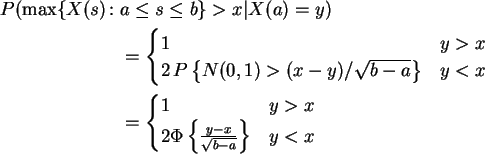
where
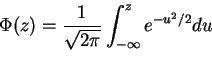
- (b)
- Use the formula in (a) to compute [3 marks]

A correct answer will involve an integral with the function in it; DO NOT try to do the integral.
 is a homogeneous Poisson Process
with rate .
Find a function w(t) such that
is a homogeneous Poisson Process
with rate .
Find a function w(t) such that

is a martingale (and prove that the w you have found works). [4 marks]