

Decision analysis of hypothesis testing takes
 and
and
 make an error
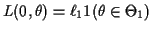 and
and
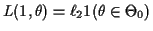 for two positive
constants
for two positive
constants  and
and  . We make the decision space convex
by allowing a decision to be a probability measure on
. We make the decision space convex
by allowing a decision to be a probability measure on  . Any such measure
can be specified by
. Any such measure
can be specified by
 reject
 so
so
![$ {\cal D} =[0,1]$](img11.gif) . The
loss function of
. The
loss function of
![$ \delta\in[0,1]$](img12.gif) is
is

Simple hypotheses: Prior is  and
and  with
with
 .
.
Procedure: map from sample space to  - a test function.
Risk function of procedure  is a pair of numbers:




 is
is
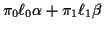

 ;
you can use this to find the minimax test in this context.
;
you can use this to find the minimax test in this context.