Postscript version of this assignment
PDF version of this assignment

STAT 802

Assignment 2

  1. In order to assess the effect of a drug on the level of 3 chemicals in the brain a group of 24 mice was randomly divided into 2 groups of 12 - treatment and control. In the control group 2 mice died of causes thought unrelated to the drug. Data are in the file
    
    ~lockhart/Teaching/Courses/802/Data/Asst2Q1
    
    Does the drug have an impact on the levels of the brain chemicals? If you conclude it does use multiple comparison procedures to determine which of chemicals A, B and C have affected levels.


  2. At a certain institution 64 patients are rated by three staff members on three 7 point behavioural scales. The means for the 64 patients on the 3 scales are 3.05, 3.31 and 2.92 while the sample variance covariance matrix is

    1.28 1.05 0.75
      1.35 0.93
        1.12

    Is there any difference between the three staff members ratings? If it appears that the answer is yes give simultaneous 95% confidence intervals for the differences in means. Discuss briefly the real world interpretation of the population means.


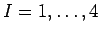
  3. Two samples of rats are weighed initially and at one week intervals. The initial weight $x_0$ is recorded along with the weight gains $d_i$ for $I=1,\ldots,4$. One group is treated with Thiouracil; the other is a control. Are the growth curves parallel in the two groups and are the actual levels of weight gain the same in the two groups?

    Control Thiouracil
    $x_0$ $d_1$ $d_2 $ $d_3$ $d_4$ $x_0$ $d_1$ $d_2 $ $d_3$ $d_4$
    57 29 28 25 33 61 25 23 11 9
    60 33 30 23 31 59 21 21 10 11
    52 25 34 33 41 53 26 21 6 27
    49 18 33 29 35 59 29 12 11 11
    56 25 23 17 30 51 24 26 22 17
    46 24 32 29 22 51 24 17 8 19
    51 20 23 16 31 56 22 17 8 5
    63 28 21 18 24 58 11 24 21 24
    49 18 23 22 28 46 15 17 12 17
    57 25 28 29 30 53 19 17 15 18


  4. Seven subjects are given an alcoholic drink at time 0. Blood glucose levels are recorded at 14 time intervals (from 10 minutes before the drink to 5 hours after). The experiment is repeated after the patients are treated with a dietary additive of guar gum. Here is the data; an electronic version is in
    
    ~lockhart/teaching/courses/802/Data/Asst2Q4
    
    For each subject the first line is with guar and the second without; the measurements are milligrams of glucose per 10 liters of blood.

Time (minutes after alcohol)
Subj -10 0 20 40 60 80 100 120 150 180 210 240 270 300
1 2.2 2.8 4.4 5.6 5.8 4.5 3.6 3.3 3.2 3.3 3.0 3.0 3.2 3.1
3.0 3.0 4.7 6.0 6.3 4.3 3.0 2.0 4.5 3.8 3.2 2.6 2.6 2.6
2 4.1 4.2 6.3 7.0 8.3 5.7 2.9 3.0 3.4 3.5 3.2 3.8 4.3 3.7
4.0 3.6 6.0 8.6 8.8 7.2 5.0 3.8 4.2 4.0 2.6 2.5 2.6 3.8
3 3.8 3.8 5.0 5.5 7.0 5.0 3.8 3.6 3.6 3.5 3.5 3.5 3.5 4.0
3.5 3.5 6.0 7.3 7.5 6.2 5.0 4.1 4.3 4.1 3.4 3.8 3.8 3.9
4 3.6 3.6 4.3 5.5 6.3 5.7 5.3 4.7 4.0 3.5 3.6 3.7 4.0 3.7
3.8 3.8 4.4 6.0 6.8 5.7 4.6 3.8 4.3 4.5 4.5 4.2 3.8 4.2
5 3.8 3.8 4.7 7.0 7.7 6.0 5.0 4.7 4.3 4.2 3.7 3.4 3.7 3.8
3.7 4.0 5.2 7.0 6.6 6.0 5.2 4.7 4.5 4.5 4.2 3.5 3.7 3.8
6 3.6 3.5 4.4 6.2 7.0 5.9 4.8 3.9 3.9 4.0 3.7 3.5 3.8 3.8
3.5 3.1 3.1 3.6 4.2 3.8 3.5 4.2 3.7 4.1 3.2 3.4 3.4 3.2
7 3.3 2.9 4.2 5.8 5.8 5.8 4.4 4.0 3.8 3.7 3.4 3.6 3.6 3.6
3.0 2.9 5.0 6.2 7.7 5.9 3.9 5.8 5.0 5.2 4.3 4.0 3.5 3.5

For each subject you have 28 measurements and you only have 7 subjects. You will not, therefore be able to use a Hotelling's $T^2$ test on the raw data. You must use plots of the data against time to select linear combinations of the responses to lower the number of response variables and then look to see if the guar affects either overall blood sugar levels or the pattern of changes in blood sugar levels after drinking.

  1. A sample of 15 male undergraduates exercised on a treadmill until their pulse rates reached 180 beats per minute. They were then treated with either an abdominal cold pack, a cold shower or just rest. (All 15 subjects were tried with each of the 3 treatments.) They then exercised on the treadmill until their heart rates again reached 180 beats per minute. Measurements made were, for each of the three treatments: initial heart rate, time to get to 180 beats per minute the first time and time to get to 180 beats per minute after the treatment. Here is a table of the data:

Treatment
Cold Pack Shower Pack Rest
HR TR HR TR HR TR
Subj First Second First Second First Second
1 73 113 132 78 105 100 78 102 86
2 66 84 149 66 224 105 66 210 110
3 78 86 100 78 70 80 78 70 65
4 54 89 101 54 70 67 54 64 72
5 78 75 102 72 54 60 72 100 52
6 90 61 121 90 160 192 78 87 79
7 54 173 201 54 200 80 60 90 106
8 66 83 116 66 60 135 66 68 110
9 60 61 72 60 75 141 72 73 58
10 54 75 125 54 95 160 48 101 86
11 96 70 194 96 85 107 96 96 66
12 72 78 259 66 82 122 72 110 80
13 66 80 110 66 70 84 66 73 86
14 78 76 190 72 70 71 72 85 71
15 96 71 141 85 83 74 96 73 66

Here HR stands for heart rate in beats per minute and TR is time on the treadmill in seconds.

The question is to discover whether any of the treatments differs from the others in its effect on fatigue as measured by the second treadmill time. I want you to consider both a simple analysis which ignores the base line information and a more sophisticated analysis which adjusts for initial heart rate and first treadmill time. For the simple analysis I want you to do both a one sample MANOVA analysis and a mixed model analysis of variance analysis. Look at statistics to diagnose the appropriateness of the mixed model analysis.

  1. From the text question 6.5.


  2. From the text questions 6.13 and 6.14.


  3. From the text question 6.18. Data are in
    
    ~lockhart/teaching/courses/802/Data/Asst2Q8
    

  4. From the text question 6.27. Data are in
    
    ~lockhart/teaching/courses/802/Data/Asst2Q9


Richard Lockhart
2002-10-21