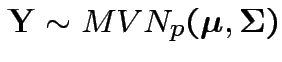
 . Imagine that
  is
a vector of scores on various tests.
is
a vector of scores on various tests.
Suppose
. Imagine that is
a vector of scores on various tests.
Idea: study structure of
 or of
or of  , look to see if is ``explained'' by
a small number of factors common to all variables together with
some variability in individual variability which is independent
between variables.
, look to see if is ``explained'' by
a small number of factors common to all variables together with
some variability in individual variability which is independent
between variables.
This amounts to writing
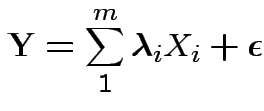
 has independent components
and the
has independent components
and the
 are
are  vectors.
In matrix form we assume
vectors.
In matrix form we assume
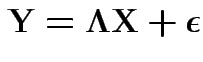
 is
is  (hopefully with
  small) and
has diagonal variance covariance
small) and
has diagonal variance covariance

 is independent of
.
is independent of
.
Then the variance covariance of has the form
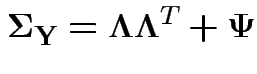
Specificities: (or specific variances or uniquenesses) -- the
 , the diagonal entries in
 .
.
Common factors: the variables
 .
.
Loading:
 is the ``loading of the
  th response
on the
th response
on the  th common factor''.
Communalities: The parts of the variances of the  which
arise from the common factors, that is,
which
arise from the common factors, that is,

What can be estimated?
Given
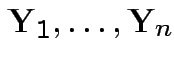 iid
iid
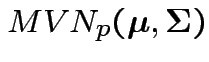 .
.
Assume
has factor structure for factors.
Log likelihood is
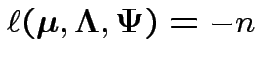 |
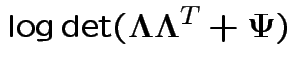 |
|
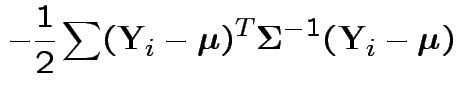 |
depends only on
 so that if
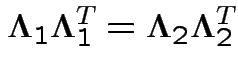

This means that  is not identifiable.
If two parameter values each give the same density for the data then the data do not distinguish between the two parameter values.
In factor analysis we use subject matter understanding to try to
pick one particular
from the collection
which maximize  on the basis of external or a priori
criteria.
on the basis of external or a priori
criteria.
But: MLE of
and
possible.
| Case | Growth | Profit | New | Creat | Mech | Abst | Math |
| 1 | 93.0 | 96.0 | 97.8 | 9 | 12 | 9 | 20 |
| 2 | 88.8 | 91.8 | 96.8 | 7 | 10 | 10 | 15 |
| 3 | 95.0 | 100.3 | 99.0 | 8 | 12 | 9 | 26 |
,
number of factors:
data sales;
 infile "T9-12.DAT";
 input growth profit new
           create mech abst math;
proc factor method=prin
           rotate=none all;
run;
The (edited) output is
Initial Factor Method: Principal Components
                      Inverse Correlation Matrix
       GROWTH PROFIT  NEW  CREATE  MECH  ABST    MATH
GROWTH 35.14  -8.26  15.74 -13.90 -1.55 -13.86 -23.71
PROFIT -8.26  31.62  -2.70   1.41 -8.18   6.58 -19.50
NEW    15.74  -2.70  21.69 -13.24 -0.13 -10.46 -19.06
CREATE-13.90   1.41 -13.24  10.53 -0.12   7.64  14.25
MECH   -1.55  -8.18  -0.13  -0.12  4.56  -0.88   7.22
ABST  -13.86   6.58 -10.46   7.64 -0.88   8.68   7.99
MATH  -23.71 -19.50 -19.06  14.25  7.22   7.99  43.09

  Partial Correlations Controlling all other Variables

      GROWTH PROFIT   NEW  CREATE  MECH   ABST   MATH
GROWTH 1.000  0.248 -0.570  0.722  0.123  0.793  0.609
PROFIT 0.248  1.000  0.103 -0.077  0.681 -0.397  0.528
NEW   -0.570  0.103  1.000  0.876  0.013  0.762  0.623
CREATE 0.722 -0.077  0.876  1.000  0.018 -0.798 -0.668
MECH   0.123  0.681  0.013  0.018  1.000  0.140 -0.515
ABST   0.793 -0.397  0.762 -0.798  0.140  1.000 -0.413
MATH   0.609  0.528  0.623 -0.668 -0.515 -0.413  1.000
             Prior Communality Estimates: ONE
Eigenvalues of the Correlation Matrix:
                             Total = 7  Average = 1
              1     2     3       4     5       6       7
Eigenvalue 5.0346 0.9335 0.4979 0.4212 0.0810 0.0203 0.0113
Difference 4.1011 0.4356 0.0767 0.3402 0.0607 0.0090
Proportion 0.7192 0.1334 0.0711 0.0602 0.0116 0.0029 0.0016
Cumulative 0.7192 0.8526 0.9237 0.9839 0.9955 0.9984 1.0000
1 factors will be retained by the MINEIGEN criterion.
           Eigenvectors
        GROWTH     0.43367
        PROFIT     0.42021
        NEW        0.42105
        CREATE     0.29429
        MECH       0.34909
        ABST       0.28917
        MATH       0.40740
          Factor Pattern
                   FACTOR1
        GROWTH     0.97307
        PROFIT     0.94287
        NEW        0.94475
        CREATE     0.66032
        MECH       0.78329
        ABST       0.64883
        MATH       0.91413
 Variance explained by each factor
               FACTOR1
              5.034598
 Communality Estimates: Total = 5.034598
GROWTH PROFIT   NEW  CREATE  MECH   ABST   MATH
0.9468 0.8890 0.8925 0.4360 0.6135 0.4209 0.8356
Note: matrix of loadings called Factor Pattern.
Can estimate latent variables (Factor Scores).
 Scoring Coefficients Estimated by Regression
Squared Multiple Correlations of
                 the Variables with each Factor
               FACTOR1
              1.000000
 Standardized Scoring Coefficients
                   FACTOR1
        GROWTH     0.19328
        PROFIT     0.18728
        NEW        0.18765
        CREATE     0.13116
        MECH       0.15558
        ABST       0.12887
        MATH       0.18157
 Residual Correlations With Uniqueness on the Diagonal
        GROWTH PROFIT   NEW  CREATE  MECH   ABST    MATH
GROWTH   0.053  0.008 -0.035 -0.070 -0.054  0.043  0.037
PROFIT   0.008  0.110 -0.048 -0.081  0.007 -0.146  0.082
NEW     -0.035 -0.048  0.107  0.076 -0.102  0.028 -0.011
CREATE  -0.070 -0.081  0.076  0.563  0.073 -0.281 -0.190
MECH    -0.054  0.007 -0.102  0.073  0.386 -0.122 -0.141
ABST     0.043 -0.146  0.028 -0.281 -0.122  0.579 -0.026
MATH     0.037  0.082 -0.011 -0.190 -0.141 -0.026  0.164
Root Mean Square Off-diagonal Residuals:
                 Over-all = 0.10322669
GROWTH PROFIT   NEW  CREATE  MECH   ABST   MATH
0.0456 0.0787 0.0589 0.1519 0.0947 0.1408 0.1045
 Partial Correlations Controlling Factors

       GROWTH PROFIT    NEW  CREATE  MECH   ABST    MATH
GROWTH  1.000  0.111  -0.467 -0.407 -0.377  0.245  0.404
PROFIT  0.111  1.000  -0.441 -0.324  0.035 -0.577  0.609
NEW    -0.467 -0.441   1.000  0.310 -0.503  0.112 -0.083
CREATE -0.407 -0.324   0.310  1.000  0.157 -0.492 -0.627
MECH   -0.377  0.035  -0.503  0.157  1.000 -0.258 -0.561
ABST    0.245 -0.577   0.112 -0.492 -0.258  1.000 -0.086
MATH    0.404  0.609  -0.083 -0.627 -0.561 -0.086  1.000
Root Mean Square Off-diagonal Partials:
                 Over-all = 0.38975152
GROWTH PROFIT   NEW  CREATE  MECH   ABST   MATH
0.3566 0.4122 0.3612 0.4140 0.3660 0.3472 0.4580
The procedure selects only one factor on which all the variables are fairly
highly loaded. The factor is the first principal component of the
correlation matrix.
Now insist on two factors, use varimax rotation and plot factor loadings before and after rotation.
proc factor m=prin nfactor=2 rotate=v
                 preplot plot all;
The output
Factor Pattern

            FACTOR1   FACTOR2
GROWTH     0.97307  -0.10798
PROFIT     0.94287   0.02830
NEW        0.94475   0.00889
CREATE     0.66032   0.64581
MECH       0.78329   0.28497
ABST       0.64883  -0.62066
MATH       0.91413  -0.19359
Variance explained by each factor
FACTOR1   FACTOR2
5.034598  0.933516
         Plot of Factor Pattern for FACTOR1 and FACTOR2

                    FACTOR1
                       1
                   A   B
                 G    .9

                      .8       E

                      .7
    F                                     D
                      .6

                      .5

                      .4

                      .3

                      .2
                                                 F
                      .1                         A
                                                 C
-.7-.6-.5-.4-.3-.2-.1  0 .1 .2 .3 .4 .5 .6 .7 .8 T
                                                 O
                     -.1                         R
                                                 2
                     -.2
GROWTH=A PROFIT=B NEW=B CREATE=D MECH=E ABST=F MATH=G
Rotation Method: Varimax
Orthogonal Transformation Matrix
                 1         2
       1      0.73145   0.68189
       2     -0.68189   0.73145

      Rotated Factor Pattern

              FACTOR1   FACTOR2
   GROWTH     0.78538   0.58455
   PROFIT     0.67037   0.66364
   NEW        0.68498   0.65072
   CREATE     0.04261   0.92265
   MECH       0.37862   0.74256
   ABST       0.89781  -0.01155
   MATH       0.80065   0.48174

 Variance explained by each factor

          FACTOR1   FACTOR2
         3.127683  2.840431
 Plot of Factor Pattern for FACTOR1 and FACTOR2

                    FACTOR1
                       1

                      F9

                      .8             G  A

                      .7                  C
                                          B
                      .6

                      .5

                      .4                     E

                      .3

                      .2
                                                       F
                      .1                               A
                                                  D    C
-.7-.6-.5-.4-.3-.2-.1  0 .1 .2 .3 .4 .5 .6 .7 .8 .9 1.0T
                                                       O
                     -.1                               R
                                                       2
GROWTH=A PROFIT=B  NEW=C CREATE=D  MECH=E ABST=F  MATH=G
With principal components factor analysis fitting a second factor does
not change the first factor (before rotation). Creativity and
abstract reasoning are loaded on the second factor with opposite signs
which would appear to represent a difference between people on a dimension of
creativity as opposed to abstract reasoning.
After rotation everything except creativity is loaded on factor 1, though Mechanical reasoning has a rather smaller loading. Abstraction is not loaded on factor 2.
Now I tried iterated principal factor analysis with varimax rotation. The option heywood permits iteration to continue if the estimated uniqueness of a variable drops below 0.
proc factor m=prinit nfactor=2 rotate=v
             preplot plot all heywood;
run;
Initial Factor Method:
    Iterated Principal Factor Analysis
Prior Communality Estimates: ONE
2 factors will be retained by the NFACTOR criterion.
IterChange   Communalities

 1 0.3052   0.958 0.889 0.892 0.853 0.694 0.806 0.873
 2 0.1223   0.968 0.874 0.879 0.805 0.600 0.683 0.850
 3 0.0903   0.980 0.874 0.880 0.797 0.574 0.593 0.855
 4 0.0638   0.988 0.876 0.881 0.807 0.568 0.529 0.866
 5 0.0401   0.993 0.877 0.882 0.824 0.564 0.489 0.878
 6 0.0229   0.995 0.879 0.882 0.844 0.562 0.466 0.886
 7 0.0191   0.996 0.880 0.882 0.863 0.560 0.453 0.892
 8 0.0183   0.996 0.880 0.882 0.881 0.558 0.447 0.895
 9 0.0174   0.996 0.880 0.881 0.899 0.556 0.443 0.897
10 0.0165   0.996 0.881 0.881 0.915 0.554 0.440 0.899
11 0.0156   0.996 0.881 0.880 0.931 0.552 0.438 0.899
12 0.0148   0.996 0.881 0.880 0.946 0.551 0.437 0.899
13 0.0141   0.996 0.881 0.879 0.960 0.549 0.436 0.899
14 0.0135   0.996 0.881 0.879 0.973 0.548 0.435 0.899
15 0.0129   0.995 0.881 0.879 0.986 0.547 0.434 0.899
16 0.0124   0.995 0.882 0.878 0.999 0.546 0.433 0.899
17 0.0010   0.995 0.882 0.878 1.000 0.545 0.432 0.899
18 0.0002   0.996 0.882 0.878 1.000 0.544 0.432 0.899
Convergence criterion satisfied.
Eigenvalues of the Reduced Correlation Matrix:
       Total = 5.63350769  Average = 0.80478681

                  1       2       3
 Eigenvalue    4.8786  0.7663  0.2047
 Difference    4.1123  0.5616  0.1209
 Proportion    0.8660  0.1360  0.0363
 Cumulative    0.8660  1.0020  1.0384
Eigenvectors
                 1         2
   GROWTH     0.44687  -0.16852
   PROFIT     0.42379  -0.08882
   NEW        0.42404   0.03803
   CREATE     0.30550   0.85228
   MECH       0.32820   0.15943
   ABST       0.26439  -0.34496
   MATH       0.41224  -0.30243

          Factor Pattern

              FACTOR1   FACTOR2
   GROWTH     0.98704  -0.14753
   PROFIT     0.93605  -0.07775
   NEW        0.93660   0.03329
   CREATE     0.67478   0.74609
   MECH       0.72492   0.13956
   ABST       0.58396  -0.30198
   MATH       0.91054  -0.26475
  Plot of Factor Pattern for FACTOR1 and FACTOR2

                      FACTOR1
                    A    1
                      B  C
                 G      .9

                        .8

                        .7   E
                                               D
               F        .6

                        .5

                        .4

                        .3

                        .2
                                                         F
                        .1                               A
                                                         C
  -.7-.6-.5-.4-.3-.2-.1  0 .1 .2 .3 .4 .5 .6 .7 .8 .9 1.0T
                                                         O
                       -.1                               R
                                                         2
GROWTH=A PROFIT=B  NEW=C  CREATE=D  MECH=E ABST=F  MATH=G
Rotation Method: Varimax

 Orthogonal Transformation Matrix
                 1         2
       1      0.84716   0.53133
       2     -0.53133   0.84716

      Rotated Factor Pattern
              FACTOR1   FACTOR2
   GROWTH     0.91457   0.39946
   PROFIT     0.83430   0.43149
   NEW        0.77577   0.52585
   CREATE     0.17523   0.99059
   MECH       0.53997   0.50340
   ABST       0.65516   0.05445
   MATH       0.91205   0.25951
Variance explained by each factor
FACTOR1   FACTOR2
3.717650  1.927275
  Plot of Factor Pattern for FACTOR1 and FACTOR2

                      FACTOR1
                         1

                        .9      G   A
                                     B
                        .8              C

                        .7
                          F
                        .6
                                        E
                        .5

                        .4

                        .3

                        .2                            D
                                                         F
                        .1                               A
                                                         C
  -.7-.6-.5-.4-.3-.2-.1  0 .1 .2 .3 .4 .5 .6 .7 .8 .9 1.0T
                                                         O
                       -.1                               R
                                                         2
GROWTH=A  PROFIT=B NEW=C  CREATE=D  MECH=E ABST=F  MATH=G
The rotated factor loadings seem rather similar here. There seems to be
a distinct latent variable which fully explains creativity and is at
play in determining other variables a bit. There also seems to be a
variable on which every variable except creativity is highly loaded.
I am not really sure how to interpret this variable.
Now I tried maximum likelihood.
proc factor m=ml nfactor=2 rotate=v
            preplot plot all heywood;
run;
The output is
     Significance tests based on 50 observations:
        Test of H0: No common factors.
             vs HA: At least one common factor.

Chi-square = 499.661 df = 21 Prob>chi**2 = 0.0001
Test of H0: 2 Factors are sufficient.
       vs HA: More factors are needed.
Chi-square = 117.092   df = 8   Prob>chi**2 = 0.0001
Notice ML conclusion: not enough factors.
              FACTOR1   FACTOR2
   GROWTH     0.57204   0.77709
   PROFIT     0.54151   0.79768
   NEW        0.70036   0.62138
   CREATE     1.00000  -0.00000
   MECH       0.59074   0.42024
   ABST       0.14691   0.60579
   MATH       0.41264   0.89462
      Plot of Factor Pattern for FACTOR1 and FACTOR2
                    FACTOR1
                       D

                      .9

                      .8

                      .7                 C

                      .6           E
                                              A
                      .5

                      .4                         G

                      .3

                      .2
                                         F
                      .1

-.7-.6-.5-.4-.3-.2-.1  0 .1 .2 .3 .4 .5 .6 .7 .8 .9 1.0

GROWTH=A PROFIT=A  NEW=C CREATE=D  MECH=E ABST=F MATH=G
Rotation Method: Varimax Rotated Factor Pattern
FACTOR1   FACTOR2
   GROWTH     0.85249   0.45205
   PROFIT     0.86839   0.41884
   NEW        0.71725   0.60180
   CREATE     0.14646   0.98922
   MECH       0.50223   0.52282
   ABST       0.62078   0.05660
   MATH       0.94541   0.27716
                    FACTOR1
                               G
                      .9
                                   BA
                      .8

                      .7                 C

                      .6F

                      .5              E

                      .4

                      .3

                      .2
                                                    D
                      .1

-.7-.6-.5-.4-.3-.2-.1  0 .1 .2 .3 .4 .5 .6 .7 .8 .9 1.0
GROWTH=A PROFIT=B NEW=C CREATE=D  MECH=E ABST=F  MATH=G
Pattern same as for other methods.
Notice however, that this
procedure factors  not .
not .
This explains the totally different eigenvalues and so on.
Finally I ran proc glm regressing the sales figures on the psychological test scores.
 proc glm ;
   model growth profit new = create mech abst math;
   manova h=_all_ /printh printe;
run;
The output is:
Dependent Variable: GROWTH
Source  DF TypeIIISS  Mean Sqe F     Pr > F
CREATE   1  61.43176  61.4317  23.53 0.0001
MECH     1  25.57000  25.5700   9.79 0.0031
ABST     1  92.58581  92.5858  35.46 0.0001
MATH     1 548.00956 548.0095 209.87 0.0001

Dependent Variable: PROFIT
Source DF Type IIISS   Mean Sq     F   Pr > F
CREATE  1    6.79727    6.79727   1.80 0.1860
MECH    1  213.27427  213.27427  56.58 0.0001
ABST    1   48.81780   48.81780  12.95 0.0008
MATH    1 1764.23024 1764.23024 468.05 0.0001

Dependent Variable: NEW
Source  DF TypeIIISS Mean Sq    F   Pr > F
CREATE   1 153.40826 153.408  92.69 0.0001
MECH     1   1.84667   1.846   1.12 0.2965
ABST     1  63.38081  63.380  38.30 0.0001
MATH     1 150.95169 150.951  91.21 0.0001
All the variables are very significant predictors of the sales indices.
Type 3 Sums of Squares, which adjust for all other variables in the model are the relevant ones.
They show that from a multivariate point of view no variables can be deleted.
But:in univariate regression for PROFIT can probability drop Creativity while for predicting NEW sales Mechanical reasoning appears unimportant.
All 4 must be retained for prediction of sales growth.
So far as I can see this data set is relatively well understood from this
regression output, though the correlation structure is of some interest
too.