 ; covariate
  -vectors
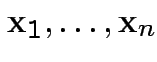 (each written as row vector).
Univariate case:
Data:
; covariate -vectors
(each written as row vector).
Model
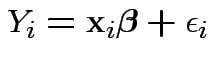
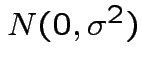 errors
 and unknown coefficient vector
 a
a  (column) vector.
Commonly: first entry in each  is 1;
corresponding
is 1;
corresponding  is "intercept". In text:
use
is "intercept". In text:
use  for so that is number of coefficients
other than intercept.
for so that is number of coefficients
other than intercept.
Model fitting: Maximum Likelihood = Least squares.
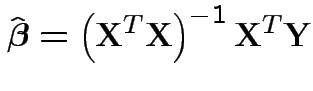
 is
is  , entries
  and
and
 is
is  with
with  th row .
Fitted response vector
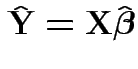
Fitted residual vector

What sort of hypotheses can we test:
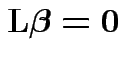
 matrix of constants
  .
.
Example: Test all  but are 0:
![$\displaystyle {\bf L}= \left[ {\bf0}_{(r-1)\times 1} \vert {\bf I}_{r-1 \times r-1}\right]
$](img25.gif)
Example: One way ANOVA with  groups: has columns.
Entry
groups: has columns.
Entry  for observation is 1 or 0 according as case number
belongs to group or not. For our data on 3 test scores:
for observation is 1 or 0 according as case number
belongs to group or not. For our data on 3 test scores:
![$\displaystyle {\bf X}= \left[\begin{array}{cccc}
1 & 0 & 0 & 0
\\
\vdots & \vdots & \vdots & \vdots
\\
0 & 0 & 0 & 1
\end{array}\right]
$](img28.gif)
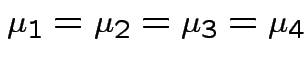 could use
![$\displaystyle {\bf L}= \left[\begin{array}{rrrr}
1 & -1 & 0 & 0 \\ 1 & 0 & -1 & 0 \\ 1 & 0 & 0 &-1
\end{array}\right]
$](img30.gif)
![$\displaystyle {\bf L}= \left[\begin{array}{rrrr}
1 & -1 & 0 & 0 \\ 0 & 1 & -1 & 0 \\ 0 & 0 & 1 &-1
\end{array}\right]
$](img31.gif)
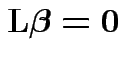
To test
 :
:
Fit model twice:
Full model: get Error sum of squares:

Restricted model: minimize
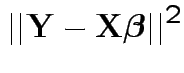
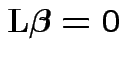 .
.
Method: assume rank of is  . (Full rank.)
Find
. (Full rank.)
Find  a
a
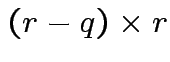 so that
![$\displaystyle {\bf P}=\left[\begin{array}{l} {\bf L}^* \\ {\bf L}\end{array}\right]
$](img39.gif)
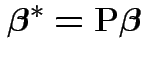
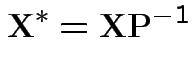
Model is
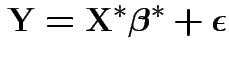
 into
into
 of
length
of
length  and
and
 of length
  .
.
Then


 test based on
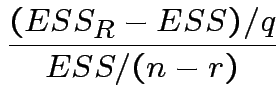
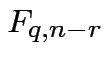 distribution on null.
Multivariate Case
Now
distribution on null.
Multivariate Case
Now  is a vector of
  responses. Assemble,
row by row, in data matrix
which is
responses. Assemble,
row by row, in data matrix
which is  . Write model
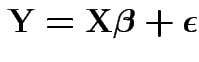 is
is
 .
.
Model for errors: rows are iid
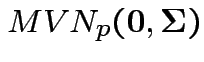 .
.
NOTE: fitting same regression model to each different response variable but with errors correlated.
Least squares estimates: as before
Fitted response matrix
Fitted residual matrix
What sort of hypotheses can we test:
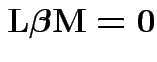
Example: Back to one way manova profile analysis:
Design matrix has entries
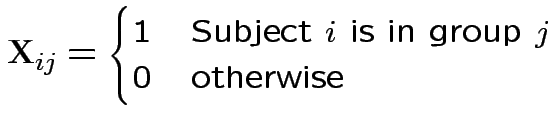
Matrix
has row equal to
 .
Number of rows = number of groups, number of columns = number of response
variables.
.
Number of rows = number of groups, number of columns = number of response
variables.
Hypotheses of interest:
1) Parallel profiles:

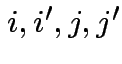 . Do case of 4 groups and 3 variables. So
is
. Do case of 4 groups and 3 variables. So
is  :
:
![$\displaystyle {\bf M}= \left[\begin{array}{rr} 1 & 1 \\ -1 & 0 \\
0 & -1 \end{array}\right]
$](img65.gif)
2) Coincident profiles:
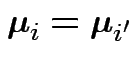 for
all and
for
all and  . Now
. Now  is the identity and is
as above.
is the identity and is
as above.
3) Constant profiles: is the identity, as above.
Testing
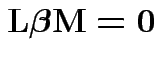 .
.
1) Multiply model equation by . Get

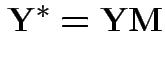
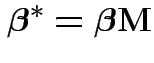
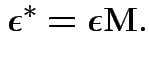 .
.
2) So now: drop  s and discuss test of
. Reparametrize again as in univariate:
Find a
s and discuss test of
. Reparametrize again as in univariate:
Find a
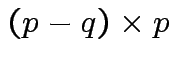 so that
Model is
into
with dimensions
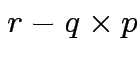 and
of dimension
and
of dimension
 .
.
Then
3) Again drop s and discuss test of
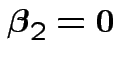 in model
![$\displaystyle {\bf Y}= \left[{\bf X}_1 \vert {\bf X}_2\right]\left[\begin{array...
...oldsymbol\beta_1 \\ \boldsymbol\beta_2\end{array}\right]
+\boldsymbol\epsilon
$](img79.gif)
Union Intersection Principle:
if and only if
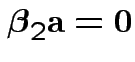 for all
 vectors
  . So multiply
model equation by get
. So multiply
model equation by get
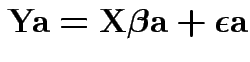
Get corresponding statistic:
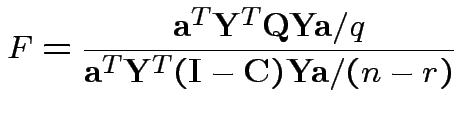
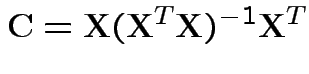

I.e. maximize over  .
.
Maximize
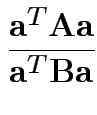
 :
:
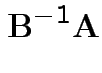
Solution for  not singular is largest eigenvalue of
Example: MANACOVA: 45 patients, 4 groups (defined by body type and obesity status).
Record 4 biochemical measurements on urine of each subject: three response variables, one covariate: specific gravity of the urine.
Compare groups adjusting for specific gravity.
run;
    data long;
    infile 'dq5.1';
    input group creatin chloride choline specgrav;
run;
proc print;
run;
proc glm;
    class group;
    model creatin chloride choline = group|specgrav;
    manova h= group*specgrav / printh printe;
run;
proc glm;
    class group;
    model creatin chloride choline = group specgrav;
    manova h= group / printh printe;
    means group / bon scheffe tukey;
run;
proc glm;
    class group;
    model creatin chloride choline = group;
    manova h= group / printh printe;
    means group / bon scheffe tukey;
run;
Begin by examining group by specific gravity
interaction:
Characteristic Roots and Vectors of:
      E Inverse * H, where
H = Type III SS&CP Matrix for SPECGRAV*GROUP
E = Error SS&CP Matrix
Manova Test Criteria and F Approximations for
the Hypothesis of no Overall SPECGRAV*GROUP Effect
S=3    M=-0.5    N=16.5
Statistic        Value     F NumDF DenDF Pr > F
Wilks' Lambda   0.6153 2.0939  9   85.33 0.0387
Pillai's Trace  0.3899 1.8426  9    111  0.0683
Hotg-Lly Trace  0.6167 2.3070  9    101  0.0211
Roy's Greatest  0.6026 7.4320  3     37  0.0005
NOTE: F Statistic for Roy's Greatest Root
     is an upper bound.
The group by specific gravity interaction appears to be
marginally significant so that adjusting for specific gravity
comparisons is difficult.
In what follows we ignore the possibility of any such interaction.
Look at model with no interaction term:
MANOVA Test Criteria and F Approximations for the
Hypothesis of No Overall group Effect
H = Type III SSCP Matrix for group
E = Error SSCP Matrix
S=3    M=-0.5    N=18
Statistic       Value  F  NumDF Den DF Pr > F
Wilks' Lambda  0.5972 2.43  9   92.633 0.0159
Pillai's Trace 0.4398 2.29  9      120 0.0208
Hotg-Lly Trace 0.6127 2.54  9   56.616 0.0159
Roy's Greatest 0.4877 6.50  3       40 0.0011
NOTE: F Statistic for Roy's Greatest Root is
an upper bound.
Conclusion: Pretty clear evidence of differences between groups. Should examine simultaneous confidence intervals. In same model: do we need covariate?
MANOVA Test Criteria and Exact F Statistics for the
Hypothesis of No Overall specgrav Effect
H = Type III SSCP Matrix for specgrav
E = Error SSCP Matrix
S=1    M=0.5    N=18
Statistic      Value   F  NumDF DenDF Pr > F
Wilks' Lambda  0.420 17.51  3    38   <.0001
Pillai's Trace 0.580 17.51  3    38   <.0001
Hotg-Lly Trace 1.382 17.51  3    38   <.0001
Roy's Greatest 1.382 17.51  3    38   <.0001
So covariate is significant. But what if we had not measured it?
MANOVA Test Criteria and F Approximations for the
Hypothesis of No Overall group Effect
H = Type III SSCP Matrix for group
E = Error SSCP Matrix
S=3    M=-0.5    N=18.5
Statistic     Value   F  NumDF DenDF  Pr > F
Wilks' Lambda  0.608 2.40  9   95.066 0.0171
Pillai's Trace 0.431 2.30  9  123     0.0203
Hotg-Lly Trace 0.580 2.47  9   58.185 0.0185
Roy's Greatest 0.434 5.93  3   41     0.0019
NOTE: F Statistic for Roy's Greatest Root is
an upper bound.
Same conclusion: difference in group means. Why is specgrav needed in model but irrelevant to conclusions? No real differences between groups in terms of specgrav
   data long;
    infile 'dq5.1';
    input group creatin chloride choline specgrav;
run;
proc glm;
    class group;
    model specgrav = group ;
run;
which gives
The GLM Procedure
Dependent Variable: specgrav
             Sum of
Source  DF  Squares MeanSquare F   Pr > F
Model    3  120.30  40.100241 1.19 0.3269
Error   41 1386.28  33.811636
Corrd   44 1506.58
Adjustment for covariates:
Suppose  is a covariate and
  a response. In order to
compare the effect of a treatment on we might have a treatment
and a control group.
a response. In order to
compare the effect of a treatment on we might have a treatment
and a control group.
Example: is blood pressure before and is blood pressure
after treatment (real or placebo depending on group).
Both and must be regarded as random in this example.
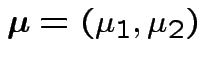
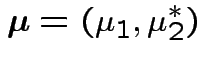
Models:  has BVN
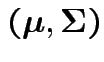 distribution with
 and
and
 which depend on whether the subject is in treatment or control.
Control group:
![$\displaystyle {\boldsymbol\Sigma}= \left[\begin{array}{cc}\sigma_1^2 & \rho\sigma_1\sigma_2 \\ \rho\sigma_1\sigma_2 & \sigma_2^2
\end{array}\right]
$](img99.gif)
Treatment group:
![$\displaystyle {\boldsymbol\Sigma}= \left[\begin{array}{cc}\sigma_1^2 & \rho^*\sigma_1\sigma_2^* \\ \rho\sigma_1\sigma_2^* & (\sigma_2^*)^2
\end{array}\right]
$](img101.gif)
If we knew parameters how would we summarize treatment effect?
No easy way. Simplifying assumptions: several possible.
Usual: Equal covariance matrices. Treatment effect is
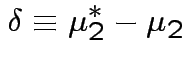
 ?
Notice:
?
Notice:
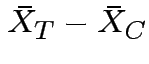
 for any choice of
  .
.
Variance is
![$\displaystyle \left(\frac{1}{n_T}+\frac{1}{n_C}\right)
\left[ \begin{array}{cc}...
...right]
{\boldsymbol\Sigma}
\left[ \begin{array}{c} 1 \\ a \end{array} \right]
$](img107.gif)
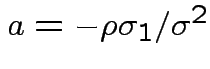 ; variance becomes

 is not too small.
Other treatment effect models?
Effect of treatment: ``after'' measurement is
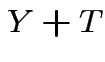
 is a
is a
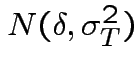 effect.
Could assume and  independent. (Not too realistic.)
Could ask: what does joint 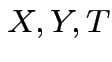 distribution have to be to
get same as previous model.
distribution have to be to
get same as previous model.
Potential problem: joint distribution of not
estimable from this experimental design.