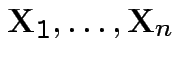
 iid
iid
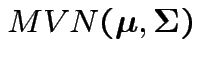 test
test
Given data
iid
test
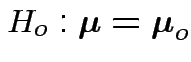

 -values from
  distribution using theorem.
Example: no realistic ones. This hypothesis is not intrinsically useful. However: other tests can sometimes be reduced to it.
Example: Ten water samples split in half. One half of each
to each of two labs. Measure biological oxygen demand (BOD) and
suspended solids (SS). For sample  let
let  be BOD for lab A,
 be SS for lab A,
  be BOD for lab B and
  be
SS for lab B. Question: are labs measuring the same thing? Is there
bias in one or the other?
be
SS for lab B. Question: are labs measuring the same thing? Is there
bias in one or the other?
Notation  is vector of 4 measurements on sample .
Data:
| Lab A | Lab B | |||
| Sample | BOD | SS | BOD | SS |
| 1 | 6 | 27 | 25 | 15 |
| 2 | 6 | 23 | 28 | 13 |
| 3 | 18 | 64 | 36 | 22 |
| 4 | 8 | 44 | 35 | 29 |
| 5 | 11 | 30 | 15 | 31 |
| 6 | 34 | 75 | 44 | 64 |
| 7 | 28 | 26 | 42 | 30 |
| 8 | 71 | 124 | 54 | 64 |
| 9 | 43 | 54 | 34 | 56 |
| 10 | 33 | 30 | 29 | 20 |
| 11 | 20 | 14 | 39 | 21 |
Model:
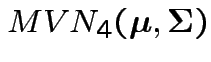
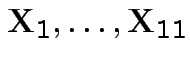 are iid
 .
.
Multivariate problem because: not able to assume independence between any two measurements on same sample.
Potential sub-model: each measurement is
true mmnt + lab bias + mmnt error.
Model for measurement error vector
 is multivariate normal mean 0 and diagonal covariance
matrix
is multivariate normal mean 0 and diagonal covariance
matrix
 .
.
Lab bias is unknown vector
 .
.
True measurement should be same for both labs so has form
![$\displaystyle [Y_{i1},Y_{i2},Y_{i1},Y_{i2}]
$](img18.gif)
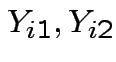 are iid bivariate normal with unknown
means
are iid bivariate normal with unknown
means
 and unknown
 variance
covariance
variance
covariance
 .
.
This would give structured model
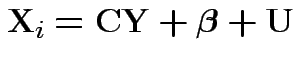
![$\displaystyle {\bf C}= \left[\begin{array}{cc} 1 & 0 \\ 0 & 1 \\ 1 & 0 \\ 0 &
1\end{array}\right]
$](img24.gif)
This model has variance covariance matrix
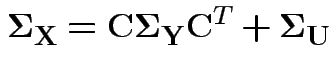 and 3 for the entries in
.
and 3 for the entries in
.
We skip this model and let
 be unrestricted.
Question of interest:
 and
and 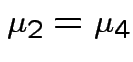
Reduction: partition as
![$\displaystyle \left[\begin{array}{c} {\bf U}_i \\ {\bf V}_i \end{array}\right]
$](img29.gif) and
and  each have two components.
Define
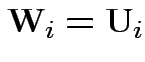 . Then our model makes
  iid
iid
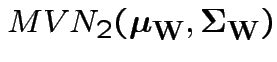 .
Our hypothesis is
.
Our hypothesis is
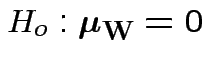
Carrying out our test in SPlus:
Working on CSS unix workstation:
Start SPlus then read in, print out data:
[61]ehlehl% mkdir .Data
[62]ehlehl% Splus
S-PLUS : Copyright (c) 1988, 1996 MathSoft, Inc.
S : Copyright AT&T.
Version 3.4 Release 1 for Sun SPARC, SunOS 5.3 : 1996
Working data will be in .Data
> # Read in and print out data
> eff <- read.table("effluent.dat",header=T)
> eff
   BODLabA SSLabA BODLabB SSLabB
 1       6     27      25     15
 2       6     23      28     13
 3      18     64      36     22
 4       8     44      35     29
 5      11     30      15     31
 6      34     75      44     64
 7      28     26      42     30
 8      71    124      54     64
 9      43     54      34     56
10      33     30      29     20
11      20     14      39     21
Do some graphical preliminary analysis.
Look for non-normality, non-linearity, outliers.
Make plots on screen or saved in file.
> # Make pairwise scatterplots on screen using
> # motif graphics device and then in a postscript
> # file.
> motif()
> pairs(eff)
> postscript("pairs.ps",horizontal=F,
+   height=6,width=6)
> pairs(eff)
> dev.off()
Generated postscript file "pairs.ps".
 motif
     2
> cor(eff)
          BODLabA    SSLabA   BODLabB    SSLabB
BODLabA 0.9999999 0.7807413 0.7228161 0.7886035
 SSLabA 0.7807413 1.0000000 0.6771183 0.7896656
BODLabB 0.7228161 0.6771183 1.0000001 0.6038079
 SSLabB 0.7886035 0.7896656 0.6038079 1.0000001
Notice high correlations.
Mostly caused by variation in true levels from sample to sample.
Get partial correlations.
Adjust for overall BOD and SS content of sample.
> aug <- cbind(eff,(eff[,1]+eff[,3])/2,
+                  (eff[,2]+eff[,4])/2)
> aug
   BODLabA SSLabA BODLabB SSLabB   X2   X3
 1       6     27      25     15 15.5 21.0
 2       6     23      28     13 17.0 18.0
 3      18     64      36     22 27.0 43.0
 4       8     44      35     29 21.5 36.5
 5      11     30      15     31 13.0 30.5
 6      34     75      44     64 39.0 69.5
 7      28     26      42     30 35.0 28.0
 8      71    124      54     64 62.5 94.0
 9      43     54      34     56 38.5 55.0
10      33     30      29     20 31.0 25.0
11      20     14      39     21 29.5 17.5
> bigS <- var(aug)
Now compute partial correlations for first four variables given means of BOD and SS:
> S11 <- bigS[1:4,1:4]
> S12 <- bigS[1:4,5:6]
> S21 <- bigS[5:6,1:4]
> S22 <- bigS[5:6,5:6]
> S11dot2 <- S11 - S12 %*% solve(S22,S21)
> S11dot2
           BODLabA     SSLabA    BODLabB     SSLabB
BODLabA  24.804665  -7.418491 -24.804665   7.418491
 SSLabA  -7.418491  59.142084   7.418491 -59.142084
BODLabB -24.804665   7.418491  24.804665  -7.418491
 SSLabB   7.418491 -59.142084  -7.418491  59.142084
> S11dot2SD <- diag(sqrt(diag(S11dot2)))
> S11dot2SD
         [,1]     [,2]     [,3]     [,4]
[1,] 4.980428 0.000000 0.000000 0.000000
[2,] 0.000000 7.690389 0.000000 0.000000
[3,] 0.000000 0.000000 4.980428 0.000000
[4,] 0.000000 0.000000 0.000000 7.690389
> R11dot2 <- solve(S11dot2SD)%*%
+           S11dot2%*%solve(S11dot2SD)
> R11dot2
          [,1]      [,2]      [,3]      [,4]
[1,]  1.000000 -0.193687 -1.000000  0.193687
[2,] -0.193687  1.000000  0.193687 -1.000000
[3,] -1.000000  0.193687  1.000000 -0.193687
[4,]  0.193687 -1.000000 -0.193687  1.000000
Notice little residual correlation.
Carry out Hotelling's  test of
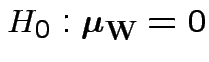 .
.
> w <- eff[,1:2]-eff[3:4]
> dimnames(w)<-list(NULL,c("BODdiff","SSdiff"))
> w
      BODdiff SSdiff
 [1,]     -19     12
 [2,]     -22     10
  etc
 [8,]      17     60
  etc
> Sw <- var(w)
> cor(w)
          BODdiff    SSdiff
BODdiff 1.0000001 0.3057682
 SSdiff 0.3057682 1.0000000
> mw <- apply(w,2,mean)
> mw
   BODdiff   SSdiff
 -9.363636 13.27273
> Tsq <- 11*mw%*%solve(Sw,mw)
> Tsq
         [,1]
[1,] 13.63931
> FfromTsq <- (11-2)*Tsq/(2*(11-1))
> FfromTsq
        [,1]
[1,] 6.13769
> 1-pf(FfromTsq,2,9)
[1] 0.02082779
Conclusion: Pretty clear evidence of difference in mean level between
labs.
Which measurement causes the difference?
> TBOD <- sqrt(11)*mw[1]/sqrt(Sw[1,1])
> TBOD
   BODdiff
 -2.200071
> 2*pt(TBOD,1)
   BODdiff
 0.2715917
> 2*pt(TBOD,10)
    BODdiff
 0.05243474
> TSS <- sqrt(11)*mw[2]/sqrt(Sw[2,2])
> TSS
  SSdiff
 2.15153
> 2*pt(-TSS,10)
     SSdiff
 0.05691733
> postscript("differences.ps",
+      horizontal=F,height=6,width=6)
> plot(w)
> abline(h=0)
> abline(v=0)
> dev.off()
Conclusion? Neither? Not a problem - summarizes evidence!
Problem: several tests at level 0.05 on same data. Simultaneous or Multiple comparisons.
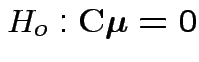 by computing
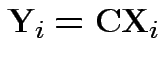 and then testing
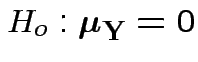 using Hotelling's .
Confidence interval for
 :
:
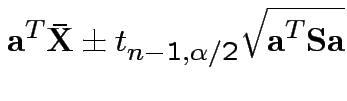
 distribution.
Give coverage intervals for 6 parameters of interest: 4 entries in
 and
and
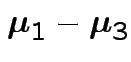 and
and
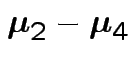
 |
 |
 |
 |
 |
 |
 |
 |
|
|
 |
|
|
 |
Problem: each confidence interval has 5% error rate. Pick out last interval (on basis of looking most interesting) and ask about error rate?
Solution: adjust 2.23, multiplier to get
 all intervals cover truth
Based on inequality:
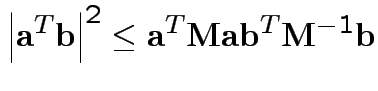
 .
.
Proof by Cauchy Schwarz:
inner product of vectors
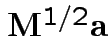 and
and
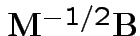 .
.
Put
 and
and
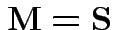 to get

 . Thus the event that there is any
such that
. Thus the event that there is any
such that
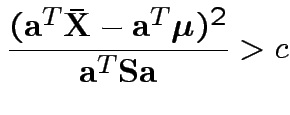
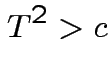
 to make the latter event have probability
  by taking
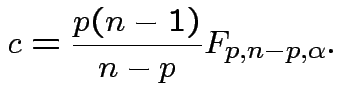
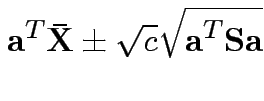
 .
.
In fact the probability of this happening is exactly equal to because for
each data set the supremum of
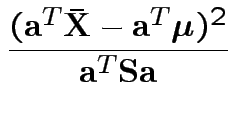 is .
is .
Our case
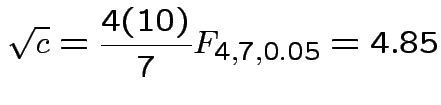
Coverage probability of single interval using
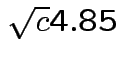 ?
From distribution:
?
From distribution:
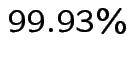
Probability all 6 intervals would cover using
?
Use Bonferroni inequality:
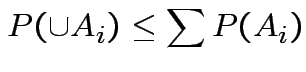

Usually just use

General Bonferroni strategy. If we want intervals for
 get interval for
  at
level
at
level
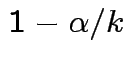 . Simultaneous coverage probability is
at least . Notice that Bonferroni narrower in
our example unless
. Simultaneous coverage probability is
at least . Notice that Bonferroni narrower in
our example unless
 giving
 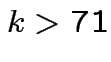 .
.
Motivations for :
1: Hypothesis
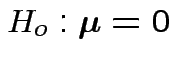 is true iff all
hypotheses
is true iff all
hypotheses
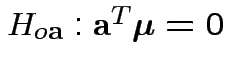 are true.
Natural test for
are true.
Natural test for
 rejects if
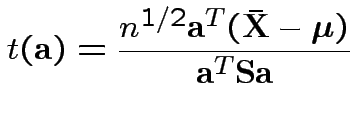
Fact:
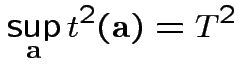
2: likelihood ratio method.
Compute
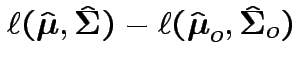
 indicates estimation assuming
  .
.
In our case to test
find


Now write


 .
.
Again conclude: likelihood ratio test rejects for 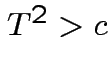 where
chosen to make level .
where
chosen to make level .
3: compare estimates of
 .
.
In univariate regression tests to compare a restricted model with a full model
have form

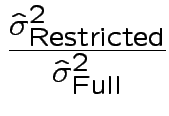
 denotes an error sum of squares and
 and estimate
of the residual variance -
and estimate
of the residual variance - 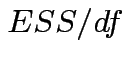 .
.
Here: substitute matrices.
Analogue of ESS for full model:

Analogue of ESS for reduced model:

 to be the change in the
Sum of Squares and Cross Products matrix.)
to be the change in the
Sum of Squares and Cross Products matrix.)
In 1 sample example:

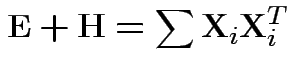
Test of
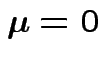 based on comparing


To make comparison. If null true
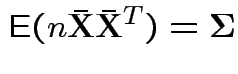
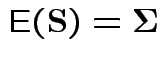
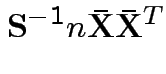
Measures of size based on eigenvalues of
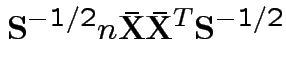
Suggested size measures for
 :
:
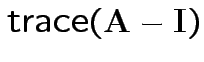 (= sum of eigenvalues).
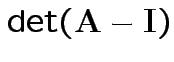 (= product of eigenvalues).
.
For our matrix: eigenvalues all 0 except for one.
(So really-matrix not close to  .)
.)
Largest eigenvalue is

But: see two sample problem for precise tests based on suggestions.
 .
Model
.
Model
 , independent.
Test
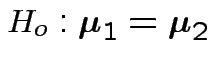 .
.
Case 1: for motivation only.
 known
known 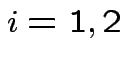 .
.
Natural test statistic: based on
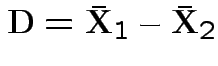
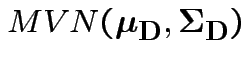 where
where
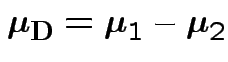
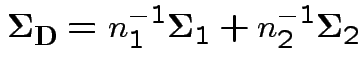

 distribution if null true.
If
not known must estimate. No universally
agreed best procedure (even for  -- called Behrens-Fisher problem).
Usually: assume
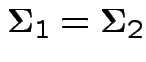 .
.
If so: MLE of
 is
is
 and of
is
and of
is
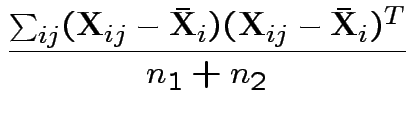 is
is
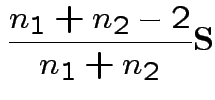
 Pooled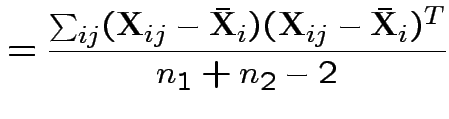
Possible test developments:
1) By analogy with 1 sample:
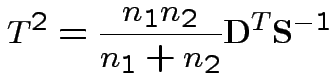 Pooled

2) Union-intersection: test of
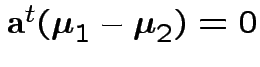 based on

 over all .
Get
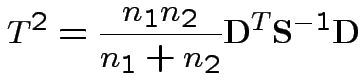
3) Likelihood ratio: the MLE of
 for the unrestricted model
is
for the unrestricted model
is
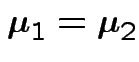 the mle of
is
the mle of
is
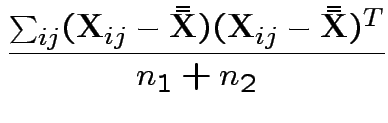

This simplifies to
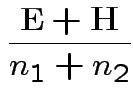
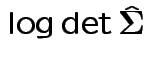 Full
Full Restricted

 :
:

If  are the eigenvalues of
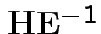 then
then
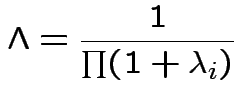
Two sample analysis in SAS on css network
    data long;
    infile 'tab57sh';
    input group a b c;
run;
proc print;
run;
proc glm;
    class group;
    model a b c = group;
    manova h=group / printh printe;
run;
Notes:
1) First 4 lines form DATA step:
a) creates data set named long by reading in 4 columns of data from file named tab57sh stored in same directory as I was in when I typed sas.
b) Calls variables group (=1 or 2 as label for the two groups) and a, b, c which are names for the 3 test scores for each subject.
2) Next two lines: print out data: result is (slightly edited)
    Obs    group     a     b     c
      1      1      19    20    18
      2      1      20    21    19
      3      1      19    22    22
     etc till
     11      2      15    17    15
     12      2      13    14    14
     13      2      14    16    13
3) Then use proc glm to do analysis:
a) class group declares that the variable group defines levels of a categorical variable.
b) model statement says to regress the variables a, b, c on variable group.
c) manova statement says to do both 3 univariate regressions
and a mulivariate regression and to print out the and  matrices where is the matrix corresponding to the presence
of the factor group in the model.
matrices where is the matrix corresponding to the presence
of the factor group in the model.
Output of MANOVA: First univariate results
    The GLM Procedure
 Class Level Information
        Class         Levels    Values
        group              2    1 2
 Number of observations    13
Dependent Variable: a
                Sum of
Source    DF   Squares  Mean Square F Value Pr > F
Model      1  54.276923  54.276923   19.38 0.0011
Error     11  30.800000   2.800000
Corrd Tot 12  85.076923
R-Square   Coeff Var      Root MSE        a Mean
0.637975    10.21275      1.673320      16.38462
Source    DF  Type ISS  Mean Square F Value Pr > F
group      1  54.276923  54.276923   19.38 0.0011
Source    DF  TypeIIISS Mean Square F Value Pr > F
group      1  54.276923  54.276923   19.38 0.0011

Dependent Variable: b
                Sum of
Source    DF   Squares  Mean Square F Value Pr > F
Model      1  70.892308  70.892308  34.20 0.0001
Error     11  22.800000   2.072727
Corrd Tot 12  93.692308

Dependent Variable: c
                Sum of
Source    DF   Squares Mean Square F Value Pr > F
Model      1   94.77692  94.77692   39.64 <.0001
Error     11   26.30000   2.39090
Corrd Tot 12  121.07692
The matrices and .
  E = Error SSCP Matrix
   a     b     c
a 30.8  12.2  10.2
b 12.2  22.8   3.8
c 10.2   3.8  26.3
Partial Correlation Coefficients from
    the Error SSCP Matrix / Prob > |r|
DF = 11     a              b              c
a    1.000000       0.460381       0.358383
                      0.1320         0.2527
b    0.460381       1.000000       0.155181
       0.1320                        0.6301
c    0.358383       0.155181       1.000000
       0.2527         0.6301
H = Type III SSCP Matrix for group
     a                 b                 c
a   54.276923077   62.030769231   71.723076923
b   62.030769231   70.892307692   81.969230769
c   71.723076923   81.969230769   94.776923077
The eigenvalues of
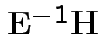 .
.
Characteristic Roots and Vectors of: E Inverse * H
H = Type III SSCP Matrix for group
E = Error SSCP Matrix
Characteristic       Characteristic Vector V'EV=1
Root     Percent        a           b           c
5.816159 100.00  0.00403434  0.12874606 0.13332232
0.000000   0.00 -0.09464169 -0.10311602 0.16080216
0.000000   0.00 -0.19278508  0.16868694 0.00000000
MANOVA Test Criteria and Exact F Statistics
 for the Hypothesis of No Overall group Effect
H = Type III SSCP Matrix for group
E = Error SSCP Matrix
S=1    M=0.5    N=3.5
Statistic            Value   F   NumDF DenDF Pr > F
Wilks' Lambda       0.1467 17.45    3     9  0.0004
Pillai's Trace      0.8533 17.45    3     9  0.0004
Hotelling-Lawley Tr 5.8162 17.45    3     9  0.0004
Roy's Greatest Root 5.8162 17.45    3     9  0.0004
Things to notice:
:
Wilk's Lambda:
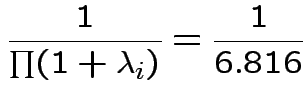


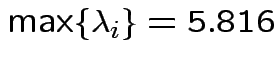
 sample problem.
Data
 .
.
Model
 independent
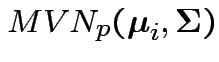 .
.
First problem of interest: test
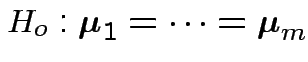
Based on and . MLE of
 is
.
is
.
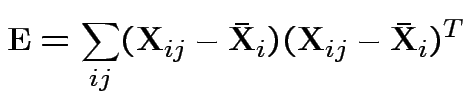 MLE of
 , the common value of the
is
, the common value of the
is
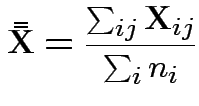

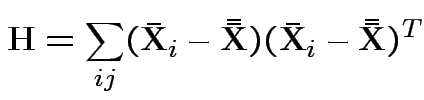
 to get factor of
  :
:
 is minimum of
  and
and  .
The data
.
The data
1 19 20 18
1 20 21 19
1 19 22 22
1 18 19 21
1 16 18 20
1 17 22 19
1 20 19 20
1 15 19 19
2 12 14 12
2 15 15 17
2 15 17 15
2 13 14 14
2 14 16 13
3 15 14 17
3 13 14 15
3 12 15 15
3 12 13 13
4  8  9 10
4 10 10 12
4 11 10 10
4 11  7 12
Code
    data three;
    infile 'tab57for3sams';
    input group a b c;
run;
proc print;
run;
proc glm;
    class group;
    model a b c = group;
    manova h=group / printh printe;
run;
    data four;
    infile 'table5.7';
    input group a b c;
run;
proc print;
run;
proc glm;
    class group;
    model a b c = group;
    manova h=group / printh printe;
run;
Pieces of output: first set of code does first 3 groups.
So: has rank 2.
Characteristic Roots & Vectors of: E Inverse * H
 Characteristic     Characteristic Vector V'EV=1
      Root Percent     a        b        c
6.90568180  96.94   0.01115  0.14375 0.08795
0.21795125   3.06  -0.07763 -0.09587 0.16926
0.00000000   0.00  -0.18231  0.13542 0.02083
S=2    M=0    N=5
Statistic         Value   F   NumDF  Den DF Pr > F
Wilks'           0.1039  8.41   6      24   <.0001
Pillai's         1.0525  4.81   6      26   0.0020
Hotelling-Lawley 7.1236 13.79   6   14.353  <.0001
Roy's            6.9057 29.92   3      13   <.0001
NOTE: F Statistic for Roy's is an upper bound.
NOTE: F Statistic for Wilks'is exact.
Notice two eigenvalues not 0. Note that exact distribution
for Wilk's Lambda is available.
Now 4 groups
      Root Percent      a       b       c
15.3752900  98.30   0.01128  0.13817 0.08126
0.2307260    1.48  -0.04456 -0.09323 0.15451
0.0356937    0.23  -0.17289  0.09020 0.04777
S=3    M=-0.5    N=6.5
Statistic          Value    F    NumDF Den DF Pr > F
Wilks'         0.04790913 10.12    9   36.657 <.0001
Pillai's       1.16086747  3.58    9       51 0.0016
Hot'ng-Lawley 15.64170973 25.02    9   20.608 <.0001
Roy's         15.37528995 87.13    3       17 <.0001
NOTE: F Statistic for Roy's is an upper bound.
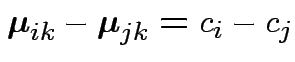
 and
and  which do not depend on
  . This is
an additive model for the means.
. This is
an additive model for the means.
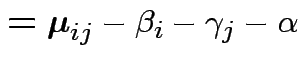
Test ?
Define
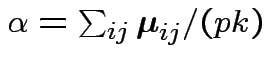 Then put
 |
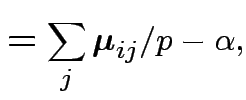 |
|
 |
 |
|
 |
 |
 are all 0 then
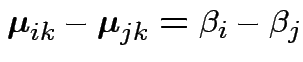 are 0.
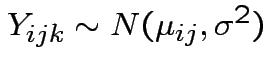
Data 
 .
.
Model: independent,
 .
.
Note: this is the fixed effects model.
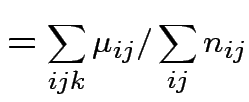
Usual approach: define grand mean, main effects, interactions:
 |
 |
|
 |
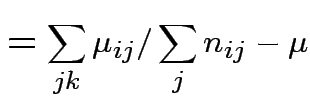 |
|
 |
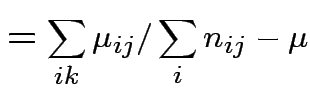 |
|
 |
 |
Test additive effects:
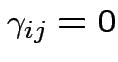 for all
  .
.
Usual test based on ANOVA:
Stack observations into vector  , say.
Estimate  ,
,  , etc by least squares.
Form vectors with entries  ,
,
 etc.
etc.
Write

 .
.
Fact: all vectors on RHS are independent and orthogonal. So:

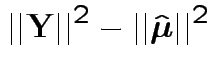
Our problem is like this one BUT the errors are not modeled as independent.
In the analogy:
labels group.
labels the columns: ie is a, b, c.
runs from 1 to
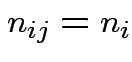 .
.
But

Now do analysis in SAS.
Tell SAS that the variables A, B and C are repeated measurements of the same quantity.
proc glm;
    class group;
    model a b c = group;
    repeated scale;
run;
The results are as follows:
General Linear Models Procedure
Repeated Measures Analysis of Variance
Repeated Measures Level Information
Dependent Variable  A   B    C
Level of SCALE      1   2    3

Manova Test Criteria and Exact F
   Statistics for the Hypothesis of no
   SCALE Effect
H = Type III SS&CP Matrix for SCALE
               E = Error SS&CP Matrix
S=1    M=0    N=7
Statistic
                  Value     F   NumDF DenDF Pr > F
Wilks' Lambda    0.56373  6.1912   2    16  0.0102
Pillai's Trace   0.43627  6.1912   2    16  0.0102
Hotelling-Lawley 0.77390  6.1912   2    16  0.0102
Roy's            0.77390  6.1912   2    16  0.0102
Note: should look at interactions first.
Manova Test Criteria and F Approximations
 for the Hypothesis of no SCALE*GROUP Effect
S=2    M=0    N=7
Statistic          Value   F   NumDF DenDF Pr > F
Wilks' Lambda    0.56333 1.7725  6    32  0.1364
Pillai's Trace   0.48726 1.8253  6    34  0.1234
Hotelling-Lawley 0.68534 1.7134  6    30  0.1522
Roy's            0.50885 2.8835  3    17  0.0662
NOTE: F Statistic for Roy's Greatest
        Root is an upper bound.
NOTE: F Statistic for Wilks' Lambda is exact.
Repeated Measures Analysis of Variance
Tests of Hypotheses for Between Subjects Effects
Source DF Type III SS Mean Square  F    Pr > F
GROUP   3  743.900000  247.966667 70.93 0.0001
Error  17   59.433333    3.496078
Repeated Measures Analysis of Variance
Univariate Tests of Hypotheses for
          Within Subject Effects
Source: SCALE                    Adj Pr > F
DF TypeIIISS MS      F   Pr > F G - G  H - F
 2  16.624   8.312  5.39 0.0093 0.0101 0.0093
Source: SCALE*GROUP
DF TypeIII   MS    F   Pr > F G - G  H - F
6   18.9619 3.160 2.05 0.0860 0.0889 0.0860
Source: Error(SCALE)
DF TypeIII SS     Mean Square
34  52.4667     1.54313725
Greenhouse-Geisser Epsilon = 0.9664
       Huynh-Feldt Epsilon = 1.2806
Greenhouse-Geisser, Huynh-Feldt test to see if
has certain structure.
Return to 2 way anova model. Express as:

For fixed effects model is
 iid
iid
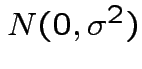 .
.
For MANOVA model vector of
is MVN but
with covariance as for  .
.
Intermediate model. Put in subject effect.
Assume
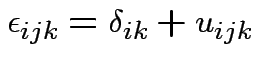
 iid
and
iid
and
 are
iid
are
iid
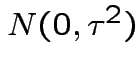 . Then
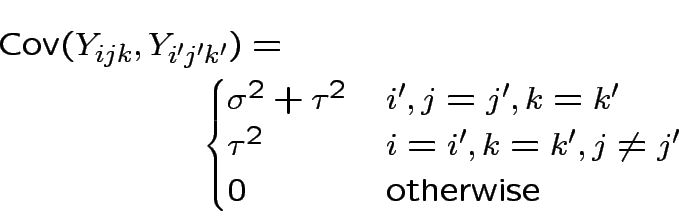
Essentially model says
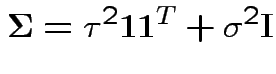 .
.
Do univariate anova: The data reordered:
1 1 1 19
1 1 2 20
1 1 3 18
2 1 1 20
2 1 2 21
2 1 3 19
 et cetera
2 4 2 10
2 4 3 12
3 4 1 11
3 4 2 10
3 4 3 10
4 4 1 11
4 4 2 7
4 4 3 12
The four columns are now labels for subject number, group, scale (a, b or c) and the response. The sas commands:
    data long;
    infile 'table5.7uni';
    input subject group scale score;
run;
proc print;
run;
proc glm;
    class group;
    class scale;
    class subject;
    model score =group subject(group)
                 scale group*scale;
    random subject(group) ;
run;
Some of the output:
Dependent Variable: SCORE
               Sum of    Mean
Source   DF    Squares  Square F    Pr > F
Model    28   843.5333 30.126 19.52 0.0001
Error    34    52.4667  1.543
Total  62   896.0000
Root MSE      SCORE Mean
1.242231        15.33333


Source         DF  TypeISS    MS      F     Pr > F

GROUP           3 743.9000 247.9667 160.69  0.0001
SUBJECT(GROUP) 17  59.4333   3.4961   2.27  0.0208
SCALE           2  21.2381  10.6190   6.88  0.0031
GROUP*SCALE     6  18.9620   3.1603   2.05  0.0860

Source         DF TypeIIISS     MS    F     Pr > F
GROUP           3 743.9000  247.9667 160.69 0.0001
SUBJECT(GROUP) 17  59.4333    3.4961   2.27 0.0208
SCALE           2  16.6242    8.3121   5.39 0.0093
GROUP*SCALE     6  18.9619    3.1603   2.05 0.0860

Source         Type III Expected Mean Square

GROUP          Var(Error) + 3 Var(SUBJECT(GROUP))
                    + Q(GROUP,GROUP*SCALE)
SUBJECT(GROUP) Var(Error) + 3 Var(SUBJECT(GROUP))
SCALE          Var(Error) + Q(SCALE,GROUP*SCALE)
GROUP*SCALE    Var(Error) + Q(GROUP*SCALE)
Type I Sums of Squares:
Type III Sums of Squares:
Notice hypothesis of no group by scale interaction is acceptable.
Under the assumption of no such group by scale interaction the hypothesis of no group effect is tested by dividing group ms by subject(group) ms.
Value is 70.9 on 3,17 degrees of freedom.
This is NOT the F value in the table above since the table above is for FIXED effects.
Notice that the sums of squares in this table match those produced in the repeated measures ANOVA. This is not accidental.

.
Model: independent,
 .
.
Note: fixed effects model.
Usual approach: define grand mean, main effects, interactions:
 |
 |
|
 |
 |
|
 |
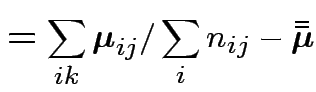 |
|
 |
 |
Test additive effects:
for all .
Exactly parallel to univariate 2 way ANOVA:
Estimate , , etc by least squares.
Formulas exactly like univariate.
Form vectors with entries ,
etc.
Write
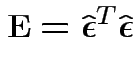
This defines the matrix of fitted residuals
.
Fact:
 matrices.
Also
The SAS commands for a two way analysis of variance with 3 response variables.
data mas;
    infile 'mas';
    input row column y1 y2 y3;
proc print;
proc glm;
     class row column;
     model y1-y3 = row | column;
           manova h=_all_ / printh printe;
run;
Features of the code:
OBS   ROW    COLUMN     Y1      Y2      Y3
 1     1        1      18.2    16.5    0.2
 2     1        1      18.7    19.5    0.3
 3     1        1      19.5    19.8    0.2
 4     1        2      19.2    19.5    0.2
 5     1        2      18.4    19.8    0.2
 6     1        2      20.7    19.4    0.2
 7     2        1      21.3    23.3    0.3
 8     2        1      19.6    22.3    0.5
 9     2        1      20.2    19.0    0.4
10     2        2      18.9    22.0    0.3
11     2        2      20.7    21.1    0.2
12     2        2      21.6    20.3    0.2
13     3        1      20.7    16.7    0.3
14     3        1      21.0    19.3    0.4
15     3        1      17.2    15.9    0.3
16     3        2      20.2    19.0    0.2
17     3        2      18.4    17.9    0.3
18     3        2      20.9    19.9    0.2
Here is the matrix
:
Error SS&CP Matrix
     Y1           Y2         Y3
Y1 21.106667   8.783333  -0.336667
Y2  8.783333  26.646667   0.173333
Y3 -0.336667   0.173333   0.046667
and the matrix used to test the hypothesis of no
interactions, that is,
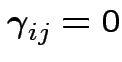 for all
:
for all
:
H = Type III SS&CP Matrix for ROW*COLUMN
        Y1      Y2         Y3
Y1   0.28778   0.435     0.06
Y2   0.435     3.2233    0.13667
Y3   0.06      0.13667   0.01333
This leads to the test statistics:
S=2    M=0    N=4
Statistic  Value    F   NumDF DenDF Pr > F
Wilks'    0.6576  0.7771  6     20  0.5973
Pillai's  0.3673  0.8249  6     22  0.5629
Hot'g-L'y 0.4827  0.7241  6     18  0.6359
Roy's     0.3839  1.4077  3     11  0.2926
Conclusion: there is no evidence that interaction terms are needed. In other words the effect of changing the level of the row variable does not depend on the level of the column variable, and vice versa.
No interaction:
investigate main effects.
H = Type III SS&CP Matrix for COLUMN
      Y1      Y2        Y3
Y1  0.37556  0.9533   -0.13
Y2  0.95333  2.42     -0.33
Y3 -0.13    -0.33      0.045
S=1    M=0.5    N=4
Statistic   Value     F  NumDF DenDF Pr > F
Wilks'    0.41672  4.6656  3    10   0.0275
Pillai's  0.58328  4.6656  3    10   0.0275
Hot'g-L'y 1.39968  4.6656  3    10   0.0275
Roy's     1.39968  4.6656  3    10   0.0275
H = Type III SS&CP Matrix for ROW
    Y1       Y2        Y3
Y1 4.8144  8.68944  0.37889
Y2 8.6894 32.68778  0.53556
Y3 0.3789  0.53556  0.03111
S=2    M=0    N=4
Statistic  Value    F  NumDF DenDF Pr>F
Wilks'    0.2144 3.8652   6   20 0.0101
Pillai's  1.0680 4.2019   6   22 0.0058
Hot'g-L'y 2.3465 3.5198   6   18 0.0175
Roy's     1.4169 5.1953   3   11 0.0177
Conclusions: both row and column effects appear to exist.
Rerun model without interactions.
Common tactic to increase degrees of freedom for estimation of error variance.
data mas;
    infile 'mas';
    input row column y1 y2 y3;
proc print;
proc glm;
     class row column;
     model y1-y3 = row column;
           manova h=_all_ / printh printe;
run;
Notice absence of | which means no interaction
included in model.
Effect: only changed. Pool above with for
interaction.
E = Error SSCP Matrix
       y1       y2       y3
y1  21.39444  9.21833 -0.27667
y2   9.21833 29.87     0.31
y3  -0.27667  0.31     0.06
H = Type III SSCP Matrix for row
E = Error SSCP Matrix
S=2    M=0    N=5
Statistic    Value   F  NumDF DenDF Pr > F
Wilks'       0.2630 3.80  6    24   0.0084
Pillai's     0.9700 4.08  6    26   0.0052
Hot'g-Lawley 1.9162 3.71  6 14.353  0.0195
Roy's        1.1377 4.93  3    13   0.0168
Compare:
![$\displaystyle \left[\begin{array}{rrr}
21.39 & 9.22 & -0.28
\\
9.22 & 29.87 & 0.31
\\
-0.28 & 0.31 & 0.06
\end{array}\right] =
$](img246.gif)
![$\displaystyle \left[\begin{array}{rrr}
0.29 & 0.44 & 0.06
\\
0.44 & 3.22 & 0....
...8& -0.34
\\
8.78 & 26.65 & 0.17
\\
-0.34 & 0.17 & 0.05
\end{array}\right]
$](img247.gif) .
Further topics in MANOVA:
.
Further topics in MANOVA:
1) In 1 way manova there is a likelihood ratio test for the hypothesis of
homogeneous variances against the alternative of a different
in
each group.
2) Univariate analyses have advantage of increased power; price is increased assumptions.
3) In SAS proc glm the statements means may be used to generate multiple comparisons procedures. SAS implements many such (Bonferroni, Scheffé, Tukey, ...
4) The random statement causes production of a table of expected mean squares.
Plot variable mean versus variable level for each group.
Put group mean vectors in rows of 4 3 matrix tab5.7means then:
plot(c(1,1,1,1,2,2,2,2,3,3,3,3),tab5.7means,
     type='n',xaxt='n',xlab="",ylab="Mean")
 lines(1:3,tab5.7means[1,])
 lines(1:3,tab5.7means[2,])
 lines(1:3,tab5.7means[3,])
 lines(1:3,tab5.7means[4,])
axis(side=1,at=1:3,labels=c("A","B","C"))
If accepted use same output to test no group effect.
Recall output from SAS
Univariate Tests of Hypotheses for
          Within Subject Effects
Source: SCALE*GROUP
DF TypeIII   MS    F   Pr > F G - G  H - F
6   18.9619 3.160 2.05 0.0860 0.0889 0.0860
As before: weak evidence of non-parallel profiles. Notice
adjustments in univariate test designed to improve
approximations.
Test for no group effect assuming no interaction: model is
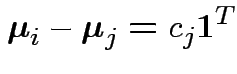
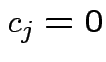 .
.
Repeated Measures Analysis of Variance
Tests of Hypotheses: Between Subjects Effects
Source DF Type III SS Mean Square  F    Pr > F
GROUP   3  743.900000  247.966667 70.93 0.0001
Error  17   59.433333    3.496078
New data set (to match sas total variables, divide by  :
:
1 32.908965343808667
1 34.641016151377542
1 36.373066958946424
1 33.48631561299829
   et cetera
4 18.475208614068023
4 17.897858344878397
4 17.320508075688771
Sas code:
    data profile;
    infile 'prof.dat';
    input group  average;
run;
proc glm;
    class group;
    model average = group;
run;
This gives the output
Dependent Variable: average
              Sum of
Source    DF Squares Mean Sq   F    Pr > F
Model      3 743.90  247.9667 70.93 <.0001
Error     17  59.43    3.4961
Corrd Tot 20 803.33
Notice agreement with SAS output.
Conclusion: profiles are credibly parallel in the 4 groups
but not co-incident. Notice small sample size. Had they
been co-incident we might test hypothesis of constant profiles:
no scale effect.