Instructor | History 318 Home Page |
Schedule of Weekly Readings and Questions
Please note that the 13:30 tutorial on Thursday takes place in CC 5120,
not AQ 5120.
The Foundations of Early Modern France
THE EMERGENCE OF THE FRENCH ROYAL STATE
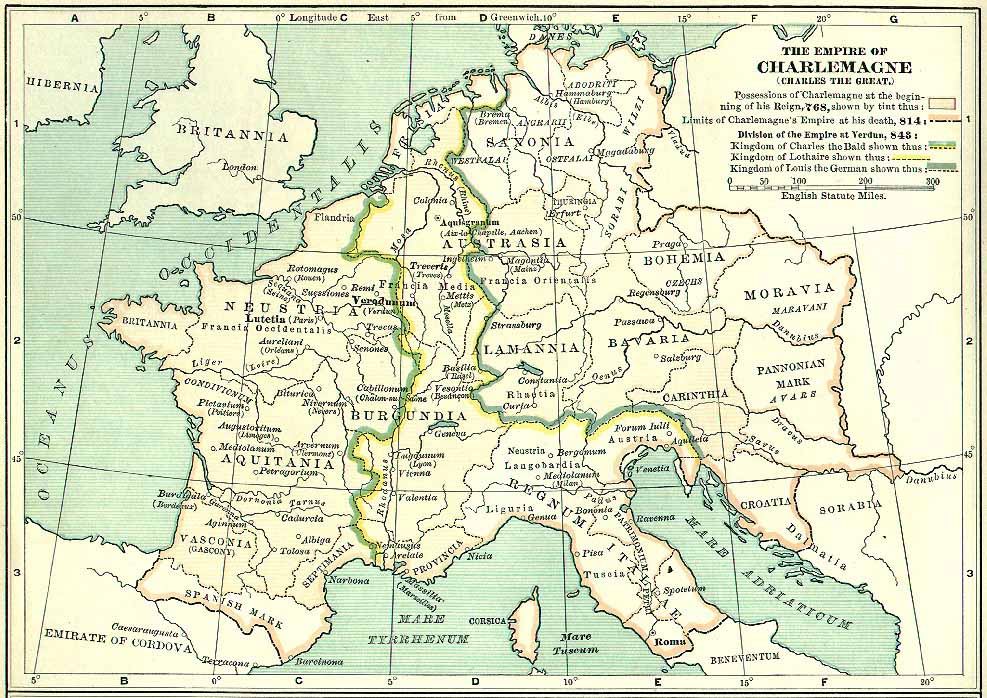
Charlemagne's Empire
(another map) ...divided by
the Treaty of Verdun (843)...
map
power base of the French monarchy in the ninth century: Ile de France
(region around Paris and Orléans)
Hundred Years War (1337-1453),
Map of France during the final phase of the War.
laguue d'oïl in north vs. langue d'oc in south.
THE MONARCHY AND FINANCE
sources of revenue:
(1) income from the royal domain, (2) indirect taxes, e.g. the gabelle, (3) borrowing,
(4) direct taxes, e.g. the taille.
THE STRUCTURES OF AUTHORITY
the sacral monarchy: the advantage for the monarchy of Louis IX, the canonized king.
See the coronation of Louis IX,
Louis at prayer ,
Louis serving the poor.
See a page from the Coronation Ordinal of 1250.
In Creating French Culture: Monarchs and Monasteries, we read: "The fifteen miniatures of the
Coronation Ordinal of 1250 present the oldest known iconographic cycle showing the coronation of a French king in
the cathedral of Rheims, virtually as it would be staged until 1825. The archbishop of Rheims, assited by the abbots of
Saint-Remi of Rheims and of Saint-Denis, officiated in the presence of the peers of the realm. This manuscript was consulted
for the coronations of Francis I (1515) and Henry IV (1594)" (http://www.loc.gov/exhibits/bnf/bnf0003.html).
Beneath the illumination we see the words of anointing:
Unguo te in regem de oleo sanctificato in nomine patris et filii
et spiritus sancti. Dicant omnes: Amen.
Translation: "I anoint you as king with sanctified oil in the name of the Father and of the Son and of the Holy Spirit."
All say: Amen."
See the coronation of Philip VI.
See an illuminated page from the Hours of Henry II,
produced between 1547-1550. Here we see King Henry II (1547-1559), who, immediately after his coronation,
is touching his subjects to heal them of scrofula. The archbishop of Rheims stands on the far right.
Kings of France
the Estates General: the three estates: clergy, nobility, everyone else. In the period that we are studying,
the Estates General met in 1560-61, 1576, 1588, 1614-15, 1789
the provincial estates: In the early modern period the main provincial estates were in Normandy, Languedoc, Dauphiné, Burgundy, Provence, Brittany.
two types of provinces: pays d'élection, pays d'état
The sovereign courts
(1) parlements: courts of law but also charged with registering royal editcs or laws; they could protest or
"remonstrate" against royal edicts but could not veto them. The principal parlement was in Paris; others were
situated in Toulouse, Bordeaux, Grenoble, Dijon, Rouen, Aix-en-Provence, Rennes, Pau, Metz, Douai,
Besançon, Nancy.
lettre de juisson, lit de justice
(2) Grand Conseil in Paris: had power to register edicts for entire kingdom and could even supplant
parlements; had jurisdiction over contradictory decrees issued by various parlements;
(3) chambre des comptes
(4) cours des aides
(5) court of monies dealt with currency matters, esp. counterfeiting.
FRANCE AND EUROPE
1494: Charles VIII upset the balance of power among the major Italian states (Republics of Venice, Florence, Duchy of Milan, Kdm of Naples, Papal States)
by invading Italy at request of Duke of Milan to attack Kdm of Naples. Here Charles was making good on the old claim of the House of Anjou on
Naples. Charles initially successful in taking Naples but eventually a coaltion of Italian powers drove him out of Italy.
1499: Louis XII crossed the Alps and took control of Milan and Genoa. A few years later Julius II, the warrior pope, with the help of the expert Swiss
infantry drove French troops out of Italy, so by 1515 France had lost all of its Italian possessions.
1515: Francis I (1515-1547) invaded to defend his dynastic ambitions and to avenge earlier French losses. With the greatest weight of artillery yet seen in Italy he
defeated a force of Swiss infantry defending the duchy of Milan at Marignano in September 1515.
France's interest in Italy brought it into conflict with the Holy Roman Empire. Thus was born the Habsburg-Valois conflict. The Habsburgs were
the dynasty that ruled the Holy Roman Empire; the Valois ruled France until 1589 when the dynasty died out. Francis I's rival was
Charles V, who between 1519 and 1556 ruled
the Habsburg Empire: Holy Roman Empire = German Empire,
Low Countries, Spain and subject territories (Naples, American colonies).
1525: Francis I lost the Battle of Pavia (in Italy) and was taken prisoner by Imperial troops. He was released in 1526.
Francis I painted as a god. The caption reads:
Francis in war is a furious Mars,
In peace Minerva and Diana when hunting
When it comes to speaking well, copious Mercury
When it comes to loving well, true Love, full of grace
O fortunate France, honour therefore the face
Of your great King who suprasses Nature.
For in honouring him, you serve in the same place
Minerva, Mars, Diana, Love, Mercury.
This page was last revised on 3 September 2002 and has been visited
times.