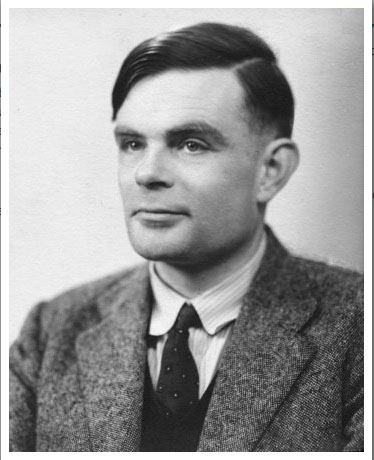
Alan
Turing (1912-1954) was the brilliant British mathematician
who is widely recognized as the father of the modern
computer at the University of Manchester, having
demonstrated its theoretical possibility in what is known
as the Turing machine. He also became famous after his
death when his role during World War II in deciphering the
German “Enigma” code that was key to the British war
effort in the Atlantic finally became publicly known.
The composer's work Enigma is
an unstaged but dramatic rendition of two key periods in
Turing’s personal life, the first from his early years
when he became infatuated with the brilliant Christopher
Morcom who died young, and the second from his final years
when he was convicted of gross indecency (as was Oscar Wilde more than a
half century earlier) because of a homosexual liaison and
eventually appears to have committed suicide. In between
these two sections is a piano and multi-channel soundscape
piece From The Unseen World based on the
digitally processed “Christopher arpeggio” which turns it
into an ethereal swirl of harmonics, the title being a
phrase of Turing’s to refer to the spirit dimension – and
by extension to Christopher. The pitches that are not
part of the arpeggio are heard in a bell-like chord that
symbolizes the real world.
The
composer assembled the libretto from Turing’s life and
words, including a section of Tennyson’s In
Memoriam, and the piece begins with a poem written by
a 15-year old Manchester student, Hallie Fletcher, in 2010
in response to Turing’s life. Video recorded dancer: Hans
Seidemann; audio recorded baritone: Michael Mori. Audio
spatialization with the TiMax2
SoundHub, produced by Outboard Inc (UK).
Enigma was premiered during
the Mantis Festival at the University of Manchester (where
Turing worked at the end of his life) by William George
and Barry Truax at a Turing tribute concert during the Turing Centenary
Year on October 28, 2012.
An earlier staged version of the
two Turing scenes (for 3 singers and dancer) was
commissioned by Vancouver New Music with the assistance of
the Canada Council, and premiered in Vancouver in
November, 2010.
From The Unseen World can also be
performed independently. See also the article in Musicworks.
From The
Unseen World is
available on the Cambridge Street Records CD, The
Elements and Beyond.
Complete documentation of the work is on the WSP Database
(truax@sfu.ca for guest access).
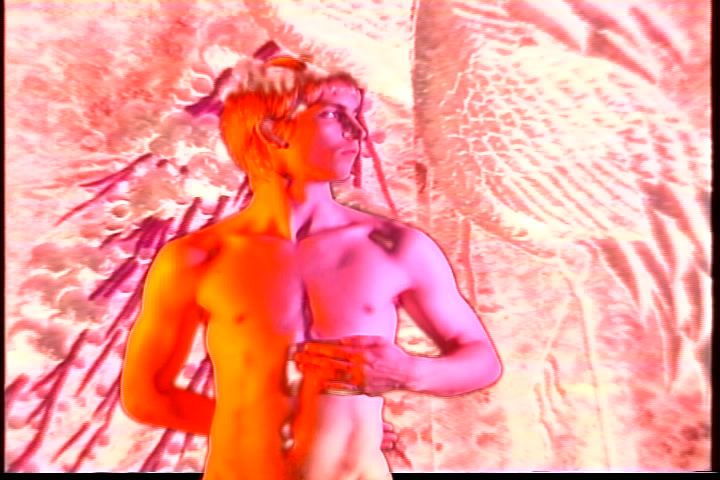
Still image from the
"Death of Christopher" video section of Enigma.
 Sound Example available