Conclusion
 In conclusion, various methods exist by which to map population density. Traditionally, choropleth maps have been used to visually depict population distribution. Even remotely sensed imagery can depict the areas where population is located, however, it cannot distinguish whether these areas are residential or nonresidential. Surface modeling is a better alternative for mapping population density as population is a continuous surface even though each person is discrete.
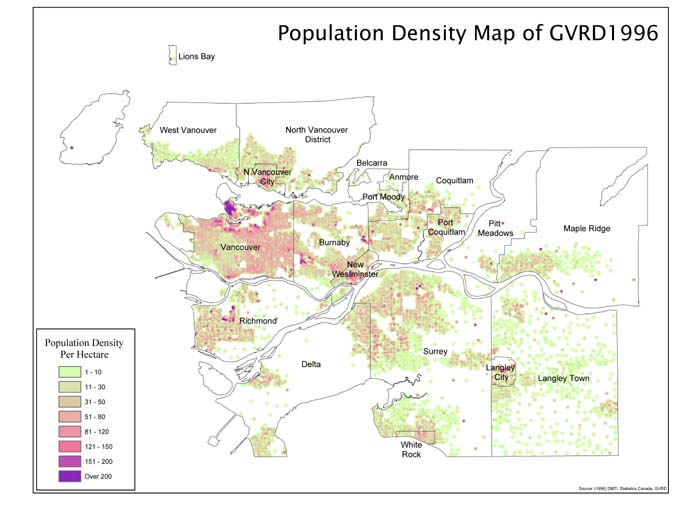
The results of this project show the obvious locations for densely populated areas such as Downtown Vancouver, Lonsdale Corridor and Central Burnaby. What is noteworthy however is the distribution of people in rural agricultural areas such as Langley. The spottiness of the distribution in that area provides clues to the type of people that live there and their lifestyle.
Although new errors have the potential to arise as one works to increase the accuracy of a project of this magnitude, we have attempted to address these errors and account for them. The project has still achieved its goal of visually representing the population density distribution of the Greater Vancouver Regional District using centroids.
next ► Appendices