 Exercise 7:
 Exercise 7:
- Draw by hand using a straight edge (ruler) for the tree diagrams, the phrase structure for the following phrases including spell-out: (don't forget null forms, Case, links, and every operator). Account for your derivations:
- Has the nurse seen Mary?
- Don't skip the lecture today.
- This next exercise is tougher. It is intended to work your intellectual attributes. You now have all of the necessary tools to complete the problem. I will give you a few hints to help you to proceed with the problem.
- Consider the following sentences--bold font indicates emphasis:
- Mary saw six geese. (not five geese)
- Mary saw six geese. (not slew them)
- Mary saw six geese. (not Hillary)
- Mary saw six geese. (not moose).
- Mary did see six geese. (not sees)
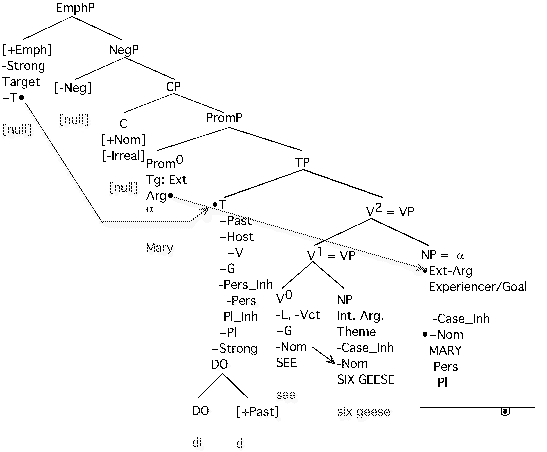
- What logical operator would you use to differentiate the differences in emphasis in the above sentences? Where would it go, and what property(ies) does it have? Hint: the operator must take NegP into its scope. Which of the three strategies does it employ? Draw a tree structure for number 5 (did see) above.
The operator is [+Emph], [-Emph] marks sentences with no emphasis. This operator targets various categories, not just the internal and the external arguments. The operator must c-command (take scope over) the target category. it should go outside of NegP. Not given was a sixth example where the negative is emphasized:
- I guess not!
For whatever reason, the negative particle is emphsized. The head of the link from the operator to the target form is [+Strong]. In the case of number 5, T is targeted. Since T is targeted it becomes strong,. This means that T must be spelled out at T and not on the verb. T still requires a verbal host. The apporpriate dummy verb, do, is inserted to act as a host.

 Go back to
