Information Transfer--direct government
In the past few years features have been playing a more dominant role in syntax. Grammatical features have been around for some time, but it wasn't until 1995 when Chomsky suggested that transformation are movements or copying of features. We have been taking this view in 322 in the past few years.
However, it now becoming clear that should be described in terms of features. C-command has been view in terms of nodes rather than features. Perhaps now is the time to change our views slightly. There won't be any great changes or startling new ideas. We have already suggested that government might be seen as the feature [+G]. We might want to keep the traditional notion of c-command for antecedent government. Hence, let us call the c-command of features "f-command." (Note that "c" stands for constituent, hence f for "feature" is appropriate here.
Let us propose that a feature f-commands a feature of the same type: tense f-commands tense, person f-commands person, number f-commands number, and so forth:
F-command:
A feature X commands another feature X, if the projection of the feature X dominates the second feature X.
We think now of government as a property of each feature. In this case, a governor needs to f-command its governee. Barriers are now barriers to a feature. Features are copied through feature links now rather than through head-to-head links.
The original idea of c-command may still be needed for antecedent government. A-government still works principally on phrases--maximal phrases.
The problem of what governs what came up recently. In the interrogative mood the feature [+Interr] is marked for T\___ and is also marked as [+G]. The remaining features do not occur in T, hence they cannot govern the same features respectively in T. Only [+Interr] governs T and an F-link is established between [+Interr] in C and [+Interr] in T.
When it comes to drawing links in a diagram, it is better to just draw a link from the consituent to the next one. Normally, not more than one link will be necessary. In the rare cases where there is more than one, drawing in two could be useful, especially if one of the links from a bridge with the next link and other one does not.
Information Transfer--direct government
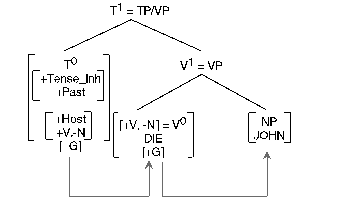
This section is a bit more technical, but it becomes more necessary when government becomes involved. The first way to transfer information is the transferof feature values from the governor to the goveernee. A link directly links features, if the same feature occurs in the tail and the head of the link:
1
The link directly connects the feature [+Past] in the tail to the same feature in the head when it is copied to V. Similarly the feature [+V,-N] must be directly linked before information can be passed; both forms must agree for this to happen. The features cannot copied down to NP, because there is no set of V features in NP.
In some sense, we can think of linking as individual links between like features.
Information Transfer--Chains
Often a node will be linked to its governor, on the one hand, and its governee on the other hand:
The two links are not linked to each other initially. No information can be passed from one link to the other. The head of a link must contain the appropriate features before information can be transferred to them. however, a bridge may be built between the head of one link and the tail of another link if both are pointing to the same category, and the category is a governor. This may be repeated as long as the conditions are met.