 Intermediate
Syntax
Intermediate
Syntax
Keywords - L322.3
Intermediate
Syntax  Week 3: The Logical Structure of the Noun Phrase--Part 2.
- The phonological form is spelled out late
- All syntactic and morphological processes must apply first.
- These will be covered in next section.
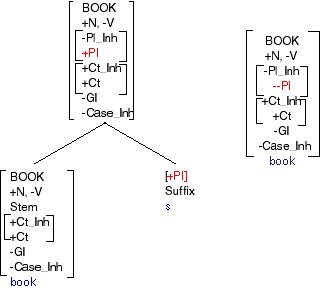
- Singular nouns do not split into a stem plus a derivational suffix, with the exception of a few Latinate nouns: radi+us, radi+i).
- This analysis may be wrong. The singular form is the root 'radi' plus the stem extender "us": "radi+us". The stem extender disappears in the plural and in derivational forms.
- If so, then words like radius are irregular in their stem formation, not in their plural formation.
- FOOT expands into two lexical forms (words): foot, feet.
- FOOT is a set of lexical features assigned to the lexical entry for foot.
- FOOT+[-Pl] is spelled out as foot.
- FOOT+[+Pl] is spelled out as feet
- Irregular nouns:
- Irregular nouns such as foot, feet do not split into a stem plus a morpheme.
- Because the feature [±Plural] may be either [-Plural] or [+Plural], the lexical entry FOOT has two lexical items: foot, feet.
- Other nouns of this type: goose, tooth, mouse, louse.
- Some nouns have no distinct plural form: deer, elk, moose, sheep. There is no splitting here.
- Some nouns take the suffix '-en': ox, oxen; child, children; brother, brethren (in the religious sense).
- The most exceptional noun is 'child'. It has an irregular ending and an irregular stem: child, child-r+en. Phonologically, the vowel changes in the stem.
- Operator
- Discourse item
- Real World Knowledge (the sun, the dog)
- [DEFINITE] (or [DEF])
- Demonstratives
- [+Dem]
- [+Close]
- Category: D (Det, Determiner)
- Number: [±Pl]
- Number = [+Bound, +Weak]
- [+Pl] morphemic form:
- default = '-s'.
- rare = '-en'.
- merge: mice, teeth, lice, geese, feet.
- unmarked merge: deer, antelope, sheep, elk
- plural only: cattle, police; scissors, pants, shears, tights
- Qu < NP>
- [±Def]
- [+Def]
- [±Dem]
- [±Prox]
- [+Dem] = this
- [-Dem = that
- [D NULL] is [-Def]. A book <- [-Def] ONE BOOK.
- [±Count]
- Lexically derived plural or singular.
- Quant --> [±Count]
- [+Count] --> all definite numerals
- [-Count] --> SOME, MANY, MUCH, FEW, A FEW, SEVERAL.
- [±Prox]
- [+Prox] --> this, these
- [-Prox] --> that, those
- [+Def, -Dem] = the
- [-Def] = a/an, one, NULL
TWO spell out lexical features Qu category + Count -- Plural + Quantified + +FV (Fixed Value) two
| ONE | Spell Out | lexical features |
|
|
category | |
|
|
Ct_Inh | |
|
|
Ct | |
|
|
Pl_Inh | |
|
|
one | Pl |
