 In 222 and in most classes on transformational syntax if not all,
it is assumed that the subject of the sentence is defined as:
In 222 and in most classes on transformational syntax if not all,
it is assumed that the subject of the sentence is defined as:
In 222 and in most classes on transformational syntax if not all,
it is assumed that the subject of the sentence is defined as:
The NP that is immediately dominated by S.
This definition assumes that S does not immediately dominate any other node, an assumption which we will claim is correct. In some sense the above definition may be true, but it misses something. One problem that arises is what is S and what is its head? 'S' as a node was abandonned in the early 80s. It was replaced with INFL (inflection) or TP (tense phrase). The former we do not adopt here, the latter we do, albeit in a slightly modified form.
What we will assume here is that the subject is a head-position (S), and that its complement is TENSE (or VP, whose head is V and must be modified by all required operators including TENSE). As in all other cases a head plus its complement forms a phrase. Hence:
SP --> S Comp-S.
While all other nodes seem to have some connection to conceptual forms in one way or another, S does not. S is a grammatical form that seems to occur in all languages.
 What
function does S have? Although it is not clear and is certainly
controversial, the subject seems to bring a node into prominence.
This is the point of view that we shall adopt here. Furthermore,
most languages seem to have a restriction that one NP must be
prominent in the active voice. In some languages (Polish, Ukrainian,
Lesotho, e.g.) there is a passive construction where there is
no prominent NP. English is not one of them.
What
function does S have? Although it is not clear and is certainly
controversial, the subject seems to bring a node into prominence.
This is the point of view that we shall adopt here. Furthermore,
most languages seem to have a restriction that one NP must be
prominent in the active voice. In some languages (Polish, Ukrainian,
Lesotho, e.g.) there is a passive construction where there is
no prominent NP. English is not one of them.
 Is the subject position filled at A-structure (argument structure)?
No, since the subject has no connection to conceptual structure
which feeds A-structure. Initially, we will assume that one NP
must raise to S, in which case the NP is prominent.
Is the subject position filled at A-structure (argument structure)?
No, since the subject has no connection to conceptual structure
which feeds A-structure. Initially, we will assume that one NP
must raise to S, in which case the NP is prominent.
There is also another factor associated with the subject. We will claim that C (the head of mood, otherwise called a complementizer) assigns Case to the subject NP. This may be a more important feature of grammar, though there are some problems with this. We will not cover them here.
More recently we have moved to the point of view that the subject
is the prominence operator. Most if not all languages have a prominence
operator. It may work in different ways in different languages.
We will concentrate on English. The prominence operator is a modifier
of the projection of V (basically, though it appears that it may
also modify the projection of N). Its function is to target either
the internal argument of the verb or the external argument of
the verb. It cannot directly target other arguments (those between
the internal and the external arguments).
Let us just sketch out a sample English sentence: "The ruffian stole a radio." In its logical form eliminating all operators except prominence for the sake of exposition, it is:
PROM, [+Target, +Nom] < STEAL <<a RADIO> THE RUFFIAN, [NIL Nom]>>>
In the active voice, PROM targets the external argument 'THE RUFFIAN'. An antecedent link is established between PROM and the target argument. The relevant features of both PROM and the targeted argument are copied so that NIL (underspecified) features are assigned a value:
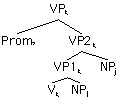
This program does not make clear indices. The internal argument is 'i', the external argument is 'j', and the verb is 'k'. Prom is not assigned an index initially. It is assigned one only after the antecedent link is establish (this program does not let us make links). The user may target either argument; in this case he target the external argument, and the voice must be active. The user may target the internal argument; in this case the voice is passive.
This is our introduction to subject and prominence. The subject of the sentence is the prominent argument in the projection of V.

This page last updated 14 FE 2000.
