Keywords - L322.3a F97
 Intermediate
Syntax
Intermediate
Syntax
 Week 3: Lexical Insertion, Tense, Case
Theory, and Raising
Week 3: Lexical Insertion, Tense, Case
Theory, and Raising
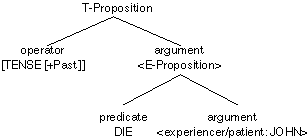
- Lexical insertion
- Lexical items are selected from the lexicon that appropriate match
each predicate and operator:
(1)
(2)
(3)
 D-structure
- (3) is called a deep-structure or more commonly today a D-Structure.
- '-ed' is a bound form called an affix.
- Affixes require a host.
- A host is a word-stem that the affix is adjoined to.
The first principle is morphological in nature:
(4) Bound Forms
- A bound form ([-Free] affix) requires a host or the structure will
crash.
- The affix must find a host.
- 1. Raise the verb
- 2. Lower the affix.
- Which one?
- Answer can be found in constructions containing a transitive verb and
a preverbal adverb:
(5) Liberace slowly played the piano.
(6)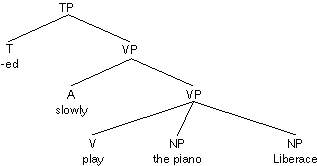
- If play is raised to T, the adverb comes out in the wrong place
- Let us first place Liberace at the beginning of the sentence in the
subject position. We will formally account for this below:
(7) *Liberace played slowly the piano.
- If 'ed' is lowered to the verb, the adverb comes out in
the correct place:
(8) Liberace slowly played the piano.
The follow structure is now generated:
(9)
Raising to Subject
- The structure in (9) still represents an unacceptable sentence:
(10) *slowly played the piano Liberace.
- Let's go back to the simpler form to resolve it:
(11) *played John.
- In 222 you learned the subject is to the right of the verb and is.
dominated by S.
- Let's raise John up and adjoin it to T.
(12)
- TP here corresponds to S learned in 222.
- In the two level hypothesis, the subject is adjoined to TP.
(13)
- In the three-level (X-bar) hypothesis the lower TP in (13) corresponds
to T-bar:
(14)
- This raising is motivated by two principles.
- We will discuss the first one now, the other later.
- The first is what Chomsky calls:
- The Extended Projection Principle
(15) All sentences require a subject.
- In (9).or (11) there are two forms that could move to the subject position.
- The subject cannot be a V, it can only be a NP.
- Hence, NP John raises to the subject position.
-

Irregular verbs
- three types
- -d/-t
- frequently a change of stem vowel
- past form is same as PPP (non-progressive form)
- above ending never spelled as '-ed'; only /d/ or /t/
- tell, told; sell, sold; make, made; do, did; say, said.
- lend, lent; send, sent; dream, dreamt; feel, felt; leave, left.
- strong verbs (so-called by Germanicists)
- Always change of vowel in past tense
- no past tense affix
- some have a PPP affix (some allophone of '-en').
- sink, sank, sunk; swim, swam, swum; drink, drank, drunk; write, wrote,
written.
- Irregular endings determined by verb stem
- [+Past] cannot be spelled out as '-ed' before adjoined to host
- The irregular changes in the verb stem cannot
- General property of all affixes: [+Weak]
- [+Weak] lower; [-Weak] cannot lower.
- Once lowered, the affix that is selected must match the affix given
in the lexical entry.
- If an unmatched affix is selected, structure crashes.
- English dialects vary on distribution of regular and irregular verbs.
- If the verb selects no affix (the strong verbs), merge is the result.
- The lexical item is assigned to the node that dominates V and T.
- drank,. for example, contains DRINK and [+Past].
course outline.322
