 Problem I:
Spring 1999
Week 11
Exercise No. 9
Problem I:
Determine the argument structure for the following sentences, determine its surface structure, and explain each step: what motivates each step in the following example:
(1) Who does Mary like?
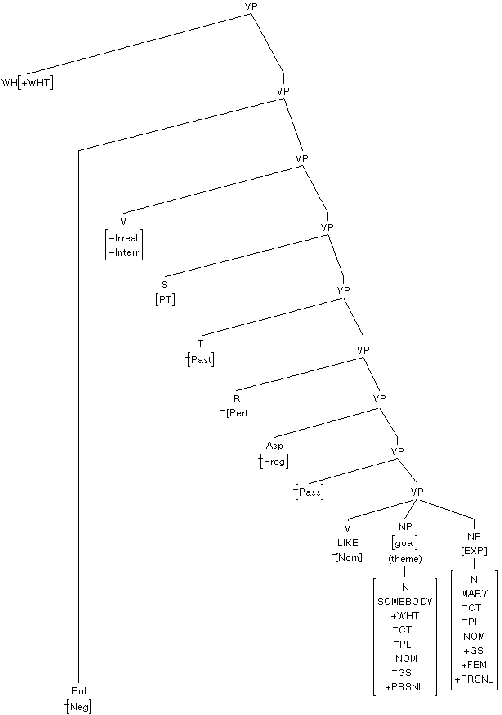
NOTE: Explain each step. Many of you didn't on the last homework.
Starting with WH
WH: n/c
Pol: n/c
C: [+Strong] blocks lowering; this forces T to raise to be copied into C to satisfy the hosting properties of +Q.
S: n/c
T: features raised to C.
R: n/c
Asp: n/c
Vce: n/c
LIKE: n/c
NP, WH: raises to WH to satisfy hosting properties.
NP, MARY: raises to S to satisfy hosting properties.
Problem II
Determine the argument structure for:
(2) What has Bill been doing?

Complete the derivation.

(Note: I can't make arrows in this program nor can I change the font of an individual character. Hence, 'w' stands for omega here.)
Problem III:
how are the following forms spelled out:
+WH, SOMEBODY, -Nom. as who or whom
+WH, SOMETHING, +Nom. as what
+WH, SOMEBODY, +Nom. as who.
Problem IV:
Determine the string derivation of:
WH Pol[+Neg] C[-Irreal] S[+PT] T[+Past] R[-Perf] Asp[-Prog] Vce[-Pass] <PAINT+[-Nom] [NP SOMETHING, WHT, WH\___, [ Nom]] [NP JOHN-[ Nom]]?
answer:
WH, [NP SOMETHING, WHT, WH\___, [ Nom]], what
Pol[+Neg], [NULL]
C[-Irreal], T[+Past] R[-Perf], {DO}, did+n't or did not (?)
S[+PT], JOHN[+Nom], John
T[+Past], [NULL]
R[-Perf], [NULL]
Asp[-Prog], [NULL]
Vce[-Pass] PAINT+[-Nom], paint
[NP SOMETHING, WHT, WH\___, [--Nom]], [NULL]
[NP JOHN-[+Nom]], [NULL]
You don't have to draw a tree for this; thus rearrange the forms and spell them out; example:
Pol[-Neg] C[-Irreal] S[+PT] T[-Past] R[-Perf] Asp[-Prog] Vce[+Pass] [V SEE, [-Nom] [NP THE MOLE+[PT]] [ Nom] [NP THE CAT [ Nom]]
-->
Pol[-Neg] C[-Irreal] S[+PT]+NP THE MOLE [+Nom] T[-Past] R[-Perf] Asp[-Prog] Vce[+Pass] [V SEE, [-Nom] [NP THE MOLE+[PT] [+Nom]] [P, [-Nom] {BY} ] [NP THE CAT [-Nom]>
Problem V:
This is another exercise on problem solving rather than testing what you already know. Determine the argument structure for the following in linear form:
Mary asked Bill if he is coming to class.
Cf. *Mary asked Bill is he coming to class. (No quotes)
You don't have to do a derivation here. Cite the lexical entry for the question operator to account for both matrix clauses and embedded clauses.
Pol[-Neg] C[-Irreal] S[+PT] T[+Past] R[-Perf] Asp[-Prog] Vce[-Pass] V-ASK [NP BILL+[ Nom]] [ Pol[-Neg] C[+Irreal, +Interr] S[+PT] T[-Past] R[-Perf] Asp[+Prog] Vce[-Pass] V-COME [PP to [NP CLASS, [ Nom]]]]
1. The question operator, [+Q], is marked as [-Strong] and (no host) if the clause contains a WH-word in the external position (WH-subject) in matrix sentences,
2. [+Strong], T\___ (otherwise in matrix sentences)
3. [-Strong], (no host), spelled out as 'if' in embedded clauses.

 Course Outline L322
