Exercise I:
 Exercise I:
- Go to Syntactic Structure Testing in Computer Program Aids and complete Exercise 15 therein.
- Next, go to Grammar 1a Lexicon MAC/DOS and open it. This grammar is very minimal and does very little. The idea here is get you familiar with generating sentences. Next week, if all goes well, we introduce the lexicon, where you will introduce new lexical items which will be stored for future reference. This ofrm of the grammar is not generatin the plural ending--which we represent here in paranetheses--don't panic.
- Produce the following sentences:
1. one car
2. two bush(es)
3. one unicorn
4. some soap
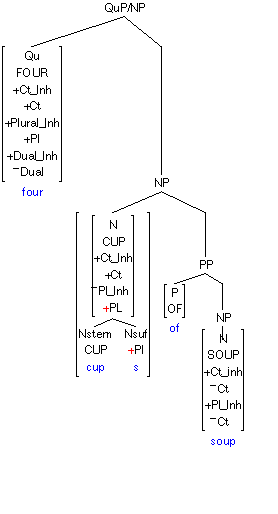
5. four cups of soup
6. *one people
7. *three pencil(s).
8. Draw by hand on a separate piece of paper the tree structure for #5 above, and indicate the government link(s) that occur here. Account for agreement in #1 and #2 above.
- Government links can't be shown in the above structure.
- D governs NP/QuP and Qu, Qu governs NP and N.
1. ONE is inherently [+Pl_Inh] and [-Pl], CAR is inherently [-Pl_Inh]. CAR needs an absolute varlue for Plural. Since ONE governs CAR, the features between them must agree. Though feature copying, the minus value of Plural is copied to CAR, which is spelled out as 'car'.
2. TWO is inherently [+Pl_Inh] and [+Pl], BUSH is inherently [-Pl_Inh]. BUSH needs an absolute varlue for Plural. Since TWO governs BUSH, the features between them must agree. Though feature copying, the plus value of Plural is copied to BUSH. The form splits into a stem, spelled out as 'bush' and a verb suffix. The feature [+Pl] is is assigned to the vsuffix which is spelled out as 'es' (according to the rules of English morphology). The nominal forms are merged into a single spelled word: bushes.
 Note
the final version of the Grammar 1 is not ready yet. This exercise
is to make you familiar with using the program. The lexicon that
you save here will not work in the next exercise. It is my intention
to have the lexicon that you build in Grammar 2 to be a permanent
one that you can add data to.
Note
the final version of the Grammar 1 is not ready yet. This exercise
is to make you familiar with using the program. The lexicon that
you save here will not work in the next exercise. It is my intention
to have the lexicon that you build in Grammar 2 to be a permanent
one that you can add data to.

Go back to