Exercise
3:
Exercise
3:
Exercise
3:
- The grammar exercise will be delayed.
Draw a tree structure for:
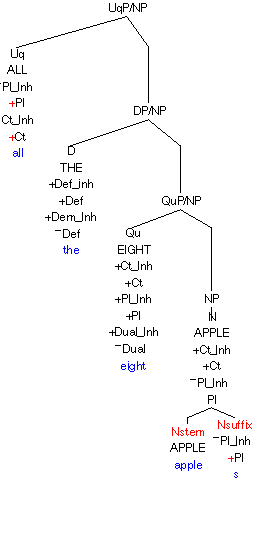
(1). All the eight apples
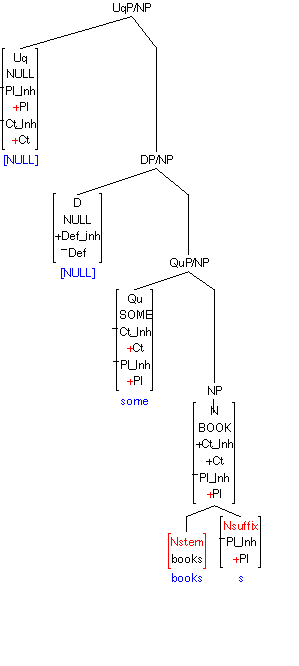
(2). Some books.
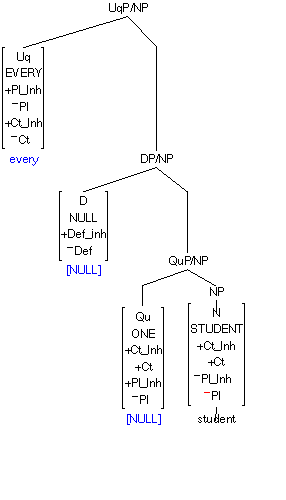
(3) Every student
indicate in a list each rule that you have applied to get from the underlying L(logical)-structure ALL THE 8 APPLE. (don't forget the NULL operators). Indicate which rules are applied as the derivation is applied.
Agreement applies in each of the above examples. First, a government link must be established between each head and its governee. Connected inks form a chain. in the first example, 'apple' needs to be marked for plural. The feature [+Pl] is copied from the quantifier to the noun, and agreement in number between the quantifier and the noun holds. The determiner 'the' is not marked for number; no agreement is required. The universal quantifier 'all' is marked minus for inherent number and count. In order to fill the value for these features and to satisfy agreement, the features of count and number are passed through the chain along the two links satisfying both of these conditions. Note, however, the feature Count [+Ct] may not be marked at all in 'all'. Number must be marked in order to satisfy the fact that 'all' is [-Dual]. There appears to be no restriction between 'all' and count and mass nouns. I will accept as OK either marking 'all' as [-Ct_Inh] or not marking 'all' for this feature at all.
'Some books': Agreements applies in the same manner here as above. And, it is not necessarily the case that we need to mark [UQ NULL] as [-Ct_Inh] for the same reasons as above. For that matter it may not be necessary to even mark it for [Pl_Inh], since there appears to be no restriction. The Least Effort (Minimalist) Principle bars us from doing so should this be the case. Here, I will accept both or none.
'Every student': Agreement applies in the same manner here as above. in this case 'every' is marked as [-Pl] and [+Ct].