
Chapter Contents

Previous

Next
|
Chapter Contents |
Previous |
Next |
| The PDLREG Procedure |
The simple finite distributed lag model is expressed in the form

 ) polynomials can capture the true lag
distribution. The lag coefficient can be written in the Almon
polynomial lag
) polynomials can capture the true lag
distribution. The lag coefficient can be written in the Almon
polynomial lag

Emerson (1968) proposed an efficient method of constructing orthogonal polynomials from the preceding polynomial equation as


where wi is the weighting factor, and n = p+1 . PROC PDLREG uses the equal weights (wi = 1) for all i. To construct the orthogonal polynomials, the following recursive relation is used:
The constants Aj, Bj, and Cj are determined as follows:
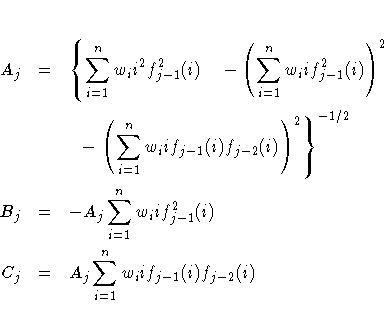
where f-1(i)=0 and 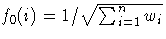 .
.
PROC PDLREG estimates the orthogonal polynomial coefficients,
 ,to compute the coefficient estimate of each independent variable (X)
with distributed lags.
For example, if an independent variable is specified as X(9,3),
a third-degree polynomial is used to specify the distributed lag coefficients.
The third-degree polynomial is fit as a constant term,
a linear term, a quadratic term, and a cubic term.
The four terms are constructed to be orthogonal.
In the output produced by the PDLREG procedure for this case,
parameter estimates with names X**0, X**1, X**2, and X**3 correspond to
,to compute the coefficient estimate of each independent variable (X)
with distributed lags.
For example, if an independent variable is specified as X(9,3),
a third-degree polynomial is used to specify the distributed lag coefficients.
The third-degree polynomial is fit as a constant term,
a linear term, a quadratic term, and a cubic term.
The four terms are constructed to be orthogonal.
In the output produced by the PDLREG procedure for this case,
parameter estimates with names X**0, X**1, X**2, and X**3 correspond to
 , and
, and
 , respectively.
A test using the t statistic and the approximate p-value
("Approx Pr > |t|") associated with X**3
can determine whether a second-degree polynomial rather
than a third-degree polynomial is appropriate.
The estimates of the ten lag coefficients associated
with the specification X(9,3) are labeled X(0), X(1), X(2), X(3), X(4), X(5),
X(6), X(7), X(8), and X(9).
, respectively.
A test using the t statistic and the approximate p-value
("Approx Pr > |t|") associated with X**3
can determine whether a second-degree polynomial rather
than a third-degree polynomial is appropriate.
The estimates of the ten lag coefficients associated
with the specification X(9,3) are labeled X(0), X(1), X(2), X(3), X(4), X(5),
X(6), X(7), X(8), and X(9).
|
Chapter Contents |
Previous |
Next |
 Top |
Copyright © 1999 by SAS Institute Inc., Cary, NC, USA. All rights reserved.