
Chapter Contents

Previous

Next
|
Chapter Contents |
Previous |
Next |
| Forecasting Process Details |

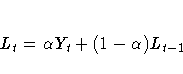
The smoothing equation is
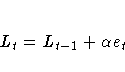
The error-correction form of the smoothing equation is
(Note: For missing values, et=0.)
The k-step prediction equation is

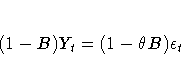
The ARIMA model equivalency to simple exponential smoothing is the ARIMA(0,1,1) model

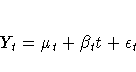
The moving-average form of the equation is

For simple exponential smoothing, the additive-invertible region is

The variance of the prediction errors is estimated as
![{var}(e_{t}(k))
= {var}({\epsilon}_{t})
[{\ssbeleven 1 + \sum_{j=1}^{k-1}{{\alpha}^2}}]
= {var}({\epsilon}_{t})( 1 + (k-1){\alpha}^2)](images/tf9eq48.gif)
The smoothing equations are
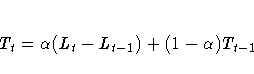
This method may be equivalently described in terms of two successive applications of simple exponential smoothing:
![S_{t}^{{\ssbeleven [1]}}
= {\alpha}Y_{t} + (1-{\alpha}) S_{t-1}^{{\ssbeleven [1]}}](images/tf9eq51.gif)
![S_{t}^{{\ssbeleven [2]}}
= {\alpha} S_{t}^{{\ssbeleven [1]}}
+ (1-{\alpha}) S_{t-1}^{{\ssbeleven [2]}}](images/tf9eq52.gif)
where St[1] are the smoothed values of Yt and St[2] are the smoothed values of St[1]. The prediction equation then takes the form:
![\hat{Y}_{t}(k)
= (2+{\alpha}k/(1-{\alpha})) S_{t}^{{\ssbeleven [1]}}
- (1+{\alpha}k/(1-{\alpha})) S_{t}^{{\ssbeleven [2]}}](images/tf9eq53.gif)
The error-correction form of the smoothing equations is
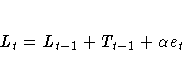
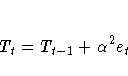
(Note: For missing values, et=0.)
The k-step prediction equation is
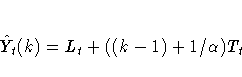
The ARIMA model equivalency to double exponential smoothing is the ARIMA(0,2,2) model
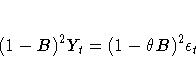
The moving-average form of the equation is
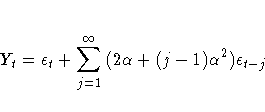
For double exponential smoothing, the additive-invertible region is
The variance of the prediction errors is estimated as
![{var}(e_{t}(k))
= {var}({\epsilon}_{t})
[{\ssbeleven 1 + \sum_{j=1}^{k-1}{(2{\alpha} + (j-1){\alpha}^2)^2}}]](images/tf9eq59.gif)
The smoothing equations are
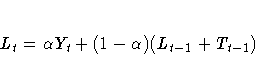
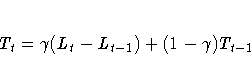
The error-correction form of the smoothing equations is
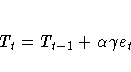
(Note: For missing values, et=0.)
The k-step prediction equation is
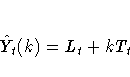
The ARIMA model equivalency to linear exponential smoothing is the ARIMA(0,2,2) model


The moving-average form of the equation is
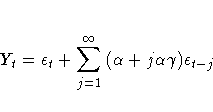
For linear exponential smoothing, the additive-invertible region is
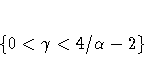
The variance of the prediction errors is estimated as
![{var}(e_{t}(k))
= {var}({\epsilon}_{t})
[{\ssbeleven 1 + \sum_{j=1}^{k-1}{({\alpha} + j{\alpha}{\gamma})^2}}]](images/tf9eq69.gif)
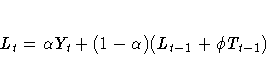
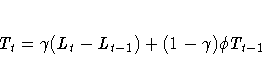
The smoothing equations are
The error-correction form of the smoothing equations is
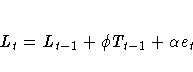
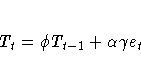
(Note: For missing values, et=0.)
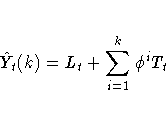
The k-step prediction equation is
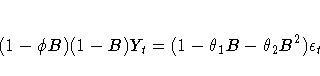
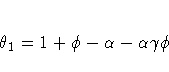
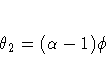
The ARIMA model equivalency to damped-trend linear exponential smoothing is the ARIMA(1,1,2) model
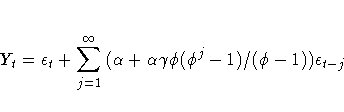
The moving-average form of the equation (assuming  ) is
) is
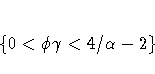
For damped-trend linear exponential smoothing, the additive-invertible region is
The variance of the prediction errors is estimated as
![{var}(e_{t}(k))
= {var}({\epsilon}_{t})
[ 1 + \sum_{j=1}^{k-1}{({\alpha} + {\alpha}{\gamma}
{\phi}({\phi}^j - 1)/({\phi} - 1) )^2}]](images/tf9eq81.gif)
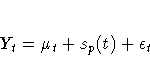
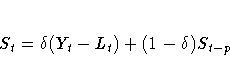
The smoothing equations are
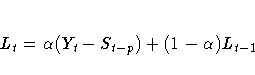
The error-correction form of the smoothing equations is
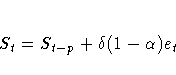
(Note: For missing values, et=0.)
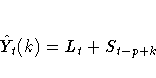
The k-step prediction equation is
The ARIMA model equivalency to seasonal exponential smoothing is the ARIMA(0,1,p+1)(0,1,0)p model


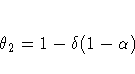
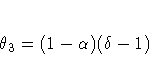
The moving-average form of the equation is
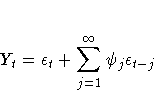
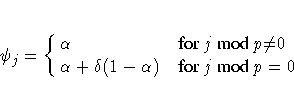
For seasonal exponential smoothing, the additive-invertible region is

The variance of the prediction errors is estimated as
![{var}(e_{t}(k))
= {var}({\epsilon}_{t})
[{\ssbeleven 1 + \sum_{j=1}^{k-1}{{\psi}_{j}^2}}]](images/tf9eq94.gif)
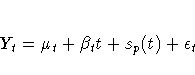
The smoothing equations are
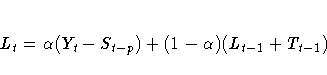
The error-correction form of the smoothing equations is
(Note: For missing values, et=0.)
The k-step prediction equation is
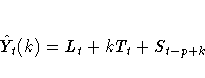
The ARIMA model equivalency to the additive version of Winters method is the ARIMA(0,1,p+1)(0,1,0)p model
![(1-B)(1-B^p)Y_{t}
= [{\ssbeleven 1 - { \sum_{i=1}^{p+1}{{\theta}_{i}B^i}}}]
{\epsilon}_{t}](images/tf9eq97.gif)
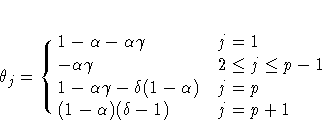
The moving-average form of the equation is
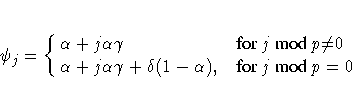
For the additive version of Winters method (see Archibald 1990), the additive-invertible region is
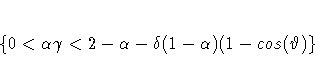
where  is the smallest non-negative solution to the
equations listed in Archibald (1990).
is the smallest non-negative solution to the
equations listed in Archibald (1990).
The variance of the prediction errors is estimated as
The model equation for the multiplicative version of Winters method is

The smoothing equations are
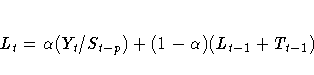
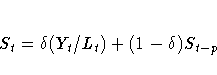
The error-correction form of the smoothing equations is
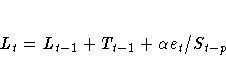
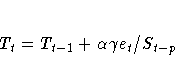
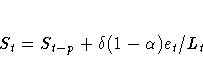
(Note: For missing values, et=0.)
The k-step prediction equation is
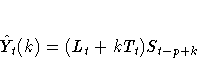
The multiplicative version of Winters method does not have an ARIMA equivalent; however, when the seasonal variation is small, the ARIMA additive-invertible region of the additive version of Winters method described in the preceding section can approximate the stability region of the multiplicative version.
The variance of the prediction errors is estimated as
![{var}(e_{t}(k))
= {var}({\epsilon}_{t})
[{\ssbeleven \sum_{i=0}^{{\infty}}{\sum_{j=0}^{p-1}{({\psi}_{j+ip}S_{t+k}/S_{t+k-j})^2 }}}]](images/tf9eq109.gif)
where  are as described for the additive version
of Winters method,
and
are as described for the additive version
of Winters method,
and  for
for  .
.
|
Chapter Contents |
Previous |
Next |
 Top |
Copyright © 1999 by SAS Institute Inc., Cary, NC, USA. All rights reserved.