
Chapter Contents

Previous

Next
|
Chapter Contents |
Previous |
Next |
| The AUTOREG Procedure |
Consider the following linear regression model:

where X is an N*k data matrix,  is a
k*1 coefficient vector, and
is a
k*1 coefficient vector, and  is a N*1
disturbance vector.
The error term is assumed to be generated by the jth
order autoregressive process
t=
is a N*1
disturbance vector.
The error term is assumed to be generated by the jth
order autoregressive process
t= t-
t- jt-j where
 ,
,  is a sequence of independent normal error terms with mean 0 and
variance
is a sequence of independent normal error terms with mean 0 and
variance  2. Usually,
the Durbin-Watson statistic is used to test the null hypothesis
2. Usually,
the Durbin-Watson statistic is used to test the null hypothesis
 against
 .
Vinod (1973) generalized the Durbin-Watson statistic:
.
Vinod (1973) generalized the Durbin-Watson statistic:

where  are OLS residuals.
Using the matrix notation,
are OLS residuals.
Using the matrix notation,

where M = IN-X(X'X)-1X' and Aj is a (N-j) ×N matrix:
![A_{j} =
[ \matrix{ -1 & 0 & { ... } & 0 & 1 & 0 & { ... } & 0 \cr
0 & -1 & 0 &...
...ots} &
{\vdots} & {\vdots} \cr
0 & { ... } & 0 & -1 & 0 & { ... } & 0 & 1}
]](images/auteq172.gif)
and there are j-1 zeros between -1 and 1 in each row of matrix Aj.
The QR factorization of the design matrix X yields a N*N orthogonal matrix Q
where R is a N*k upper triangular matrix. There exists a N*(N-k) submatrix of Q such that Q1Q1' = M and Q1'Q1 = IN-k. Consequently, the generalized Durbin-Watson statistic is stated as a ratio of two quadratic forms:

where  are upper
n eigenvalues of
MAj'AjM and
are upper
n eigenvalues of
MAj'AjM and
 is a standard normal variate, and
n = min(N-k, N-j).
These eigenvalues are obtained by a singular value decomposition of
Q1'Aj'
(Golub and Loan 1989; Savin and White 1978).
is a standard normal variate, and
n = min(N-k, N-j).
These eigenvalues are obtained by a singular value decomposition of
Q1'Aj'
(Golub and Loan 1989; Savin and White 1978).
The marginal probability (or p-value) for dj given c0 is
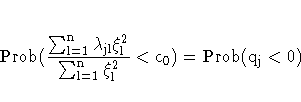
where

When the null
hypothesis  holds,
the quadratic form qj has the characteristic function
holds,
the quadratic form qj has the characteristic function

The distribution function is uniquely determined by this characteristic function:
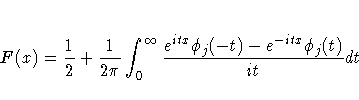
For example, to test  given
given  against
  , the marginal probability
(p-value) can be used:
, the marginal probability
(p-value) can be used:

where

and  is the calculated value of the
fourth-order Durbin-Watson statistic.
is the calculated value of the
fourth-order Durbin-Watson statistic.
In the Durbin-Watson test,
the marginal probability indicates positive autocorrelation
( ) if it is
less than the level of significance (
) if it is
less than the level of significance ( ), while you can conclude
that a negative autocorrelation (
), while you can conclude
that a negative autocorrelation ( ) exists
if the marginal probability based on the computed Durbin-Watson statistic
is greater than 1-. Wallis (1972) presented
tables for bounds tests of fourth-order autocorrelation and
Vinod (1973) has given tables for a five percent significance level for
orders two to four. Using the AUTOREG procedure, you can calculate
the exact p-values for the general order of Durbin-Watson
test statistics. Tests for the absence of autocorrelation of order
p can be performed sequentially; at the jth step, test
given
) exists
if the marginal probability based on the computed Durbin-Watson statistic
is greater than 1-. Wallis (1972) presented
tables for bounds tests of fourth-order autocorrelation and
Vinod (1973) has given tables for a five percent significance level for
orders two to four. Using the AUTOREG procedure, you can calculate
the exact p-values for the general order of Durbin-Watson
test statistics. Tests for the absence of autocorrelation of order
p can be performed sequentially; at the jth step, test
given  against
  .
However, the size of the sequential test is not known.
.
However, the size of the sequential test is not known.
The Durbin-Watson statistic is computed from the OLS residuals, while that of the autoregressive error model uses residuals that are the difference between the predicted values and the actual values. When you use the Durbin-Watson test from the residuals of the autoregressive error model, you must be aware that this test is only an approximation. See "Regression with Autoregressive Errors" earlier in this chapter. If there are missing values, the Durbin-Watson statistic is computed using all the nonmissing values and ignoring the gaps caused by missing residuals. This does not affect the significance level of the resulting test, although the power of the test against certain alternatives may be adversely affected. Savin and White (1978) have examined the use of the Durbin-Watson statistic with missing values.

where  and
and  is the least-squares
variance estimate for the coefficient of the lagged dependent variable.
Durbin's t-test consists of regressing the OLS residuals
is the least-squares
variance estimate for the coefficient of the lagged dependent variable.
Durbin's t-test consists of regressing the OLS residuals
 on explanatory variables and
 and testing the significance of the estimate for
coefficient of .
and testing the significance of the estimate for
coefficient of .
Inder (1984) shows that the Durbin-Watson test for the absence of first-order autocorrelation is generally more powerful than the h-test in finite samples. Refer to Inder (1986) and King and Wu (1991) for the Durbin-Watson test in the presence of lagged dependent variables.
|
Chapter Contents |
Previous |
Next |
 Top |
Copyright © 1999 by SAS Institute Inc., Cary, NC, USA. All rights reserved.