
Chapter Contents

Previous

Next
|
Chapter Contents |
Previous |
Next |
| Language Reference |
 ).
If opt[1]=0, then a column of 1s is added as
the last column to the input matrix X; that
is, you do not need to add this column of 1s yourself.
The default is opt[1]=0.
).
If opt[1]=0, then a column of 1s is added as
the last column to the input matrix X; that
is, you do not need to add this column of 1s yourself.
The default is opt[1]=0.

 .
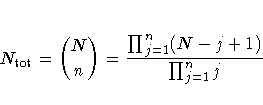
The total number of subsets consisting of
n observations out of N observations is
.
The total number of subsets consisting of
n observations out of N observations is
| n | 1 | 2 | 3 | 4 | 5 | 6 | 7 | 8 | 9 | 10 |
| Nlower | 500 | 50 | 22 | 17 | 15 | 14 | 0 | 0 | 0 | 0 |
| Nupper | 1000000 | 1414 | 182 | 71 | 43 | 32 | 27 | 24 | 23 | 22 |
| NRep | 500 | 1000 | 1500 | 2000 | 2500 | 3000 | 3000 | 3000 | 3000 | 3000 |
| n | 11 | 12 | 13 | 14 | 15 |
| Nlower | 0 | 0 | 0 | 0 | 0 |
| Nupper | 22 | 22 | 22 | 23 | 23 |
| NRep | 3000 | 3000 | 3000 | 3000 | 3000 |
 is added by
default as the last column of X.
If the matrix X is not specified,
y is analyzed as a univariate data
set.
is added by
default as the last column of X.
If the matrix X is not specified,
y is analyzed as a univariate data
set.
 print "Stackloss Data";
 aa = { 1  80  27  89  42,
        1  80  27  88  37,
        1  75  25  90  37,
        1  62  24  87  28,
        1  62  22  87  18,
        1  62  23  87  18,
        1  62  24  93  19,
        1  62  24  93  20,
        1  58  23  87  15,
        1  58  18  80  14,
        1  58  18  89  14,
        1  58  17  88  13,
        1  58  18  82  11,
        1  58  19  93  12,
        1  50  18  89   8,
        1  50  18  86   7,
        1  50  19  72   8,
        1  50  19  79   8,
        1  50  20  80   9,
        1  56  20  82  15,
        1  70  20  91  15 };
Rousseeuw & Leroy (1987, p.76) cite a large number of papers where this data set was analyzed before and state that most researchers "concluded that observations 1, 3, 4, and 21 were outliers," and some people also reported observation 2 as outlier.
For N=21 and n=4 (three explanatory variables including intercept), you obtain a total of 5985 different subsets of 4 observations out of 21. If you decide not to specify optn[5], your LMS and LTS algorithms draw Nrep=2000 random sample subsets. Since there is a large number of subsets with singular linear systems, which you do not want to print, you chose optn[2]=2; for reduced printed output.
  a = aa[,2:4]; b = aa[,5];
  optn = j(8,1,.);
  optn[2]= 2;    /* ipri */
  optn[3]= 3;    /* ilsq */
  optn[8]= 3;    /* icov */

  CALL LMS(sc,coef,wgt,optn,b,a);
   LMS: The 13th ordered squared residual will be minimized.


                 Median and Mean

                       Median              Mean

   VAR1                    58      60.428571429
   VAR2                    20      21.095238095
   VAR3                    87      86.285714286
   Intercep                 1                 1
   Response                15      17.523809524

        Dispersion and Standard Deviation

                   Dispersion            StdDev

   VAR1           5.930408874      9.1682682584
   VAR2           2.965204437       3.160771455
   VAR3          4.4478066555      5.3585712381
   Intercep                 0                 0
   Response       5.930408874      10.171622524
The following are the results of LS regression:
                    Unweighted Least-Squares Estimation


                      LS Parameter Estimates

                         Approx                 Pr >
Variable    Estimate     Std Err    t Value     |t|

VAR1        0.715640   0.134858     5.31      <.0001
VAR2        1.295286   0.368024     3.52      0.0026
VAR3       -0.152123   0.156294    -0.97      0.3440
Intercep   -39.919674 11.895997    -3.36      0.0038

Variable    Lower WCI   Upper WCI

VAR1        0.451323  0.979957
VAR2        0.573972  2.016600
VAR3       -0.458453  0.154208
Intercep   -63.2354  -16.603949


                     Sum of Squares = 178.8299616
                       Degrees of Freedom = 17
                    LS Scale Estimate = 3.2433639182

                     Cov Matrix of Parameter Estimates

            VAR1        VAR2         VAR3       Intercep

VAR1        0.018187   -0.036511    0.007144    0.287587
VAR2       -0.036511    0.135442    0.000010   -0.651794
VAR3       -0.007144    0.000011    0.024428   -1.676321
Intercep    0.287587   -0.651794    1.676321  141.514741

                     R-squared = 0.9135769045
                  F(3,17) Statistic = 59.9022259
                    Probability = 3.0163272E-9
These are the LMS results for the 2000 random subsets:
            Random Subsampling for LMS


                                 Best
   Subset    Singular       Criterion     Percent

      500          23        0.163262          25
     1000          55        0.140519          50
     1500          79        0.140519          75
     2000         103        0.126467         100

         Minimum Criterion= 0.1264668282
       Least Median of Squares (LMS) Method
    Minimizing 13th Ordered Squared Residual.
   Highest Possible Breakdown Value =  42.86 %
         Random Selection of 2103 Subsets
       Among 2103 subsets 103 are singular.

            Observations of Best Subset

  15                11                19                10

              Estimated Coefficients

  VAR1              VAR2              VAR3          Intercep

  0.75               0.5                 0            -39.25


          LMS Objective Function = 0.75
           Preliminary LMS Scale = 1.0478510755
                Robust R Squared = 0.96484375
                 Final LMS Scale = 1.2076147288
For LMS observations, 1, 3, 4, and 21 have scaled residuals larger than 2.5 (table not shown) and are considered outliers. These are the corresponding WLS results:
                       Weighted Least-Squares Estimation


                     RLS Parameter Estimates Based on LMS

                            Approx             Pr >
  Variable    Estimate     Std Err  t Value     |t|

  VAR1        0.797686  0.067439    11.83     <.0001
  VAR2        0.577340  0.165969     3.48     0.0041
  VAR3       -0.067060  0.061603    -1.09     0.2961
  Intercep  -37.652459  4.732051    -7.96     <.0001


                        Lower WCI   Upper WCI

                        0.665507    0.929864
                        0.252047    0.902634
                       -0.187800    0.053680
                      -46.927108  -28.37781

                   Weighted Sum of Squares = 20.400800254
                          Degrees of Freedom = 13
                     RLS Scale Estimate = 1.2527139846

                   Cov Matrix of Parameter Estimates

              VAR1         VAR2         VAR3         Intercep

   VAR1       0.004548    -0.007921    -0.001199     0.001568
   VAR2      -0.007921     0.027546    -0.000463    -0.065018
   VAR3      -0.001199    -0.000463     0.003795    -0.246102
   Intercep   0.001568    -0.065018    -0.246102    22.392305

                   Weighted R-squared = 0.9750062263
                    F(3,13) Statistic = 169.04317954
                       Probability = 1.158521E-10
                There are 17 points with nonzero weight.
                     Average Weight = 0.8095238095
|
Chapter Contents |
Previous |
Next |
 Top |
Copyright © 1999 by SAS Institute Inc., Cary, NC, USA. All rights reserved.