
Chapter Contents

Previous

Next
|
Chapter Contents |
Previous |
Next |
| General Statistics Examples |
The technique of parameter estimation in linear models using
the notion of regression quantiles is a generalization of
the LAE or LAV least absolute value estimation technique.
For a given quantile q, the estimate
b* of  in the model

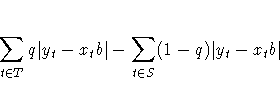
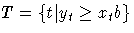 and
and 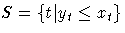 .For q=0.5, the solution b* is
identical to the estimates produced by the LAE.
The following routine finds this
estimate using linear programming:
.For q=0.5, the solution b* is
identical to the estimates produced by the LAE.
The following routine finds this
estimate using linear programming:
      /* Routine to find Regression Quantiles                   */
      /* yname:   name of dependent variable                    */
      /* y:       dependent variable                            */
      /* xname:   names of independent variables                */
      /* X:       independent variables                         */
      /* b:       estimates                                     */
      /* predict: predicted values                              */
      /* error:   difference of y and predicted                 */
      /* q:       quantile                                      */
      /*                                                        */
      /* notes: This subroutine finds the estimates b           */
      /* that minimize                                          */
      /*                                                        */
      /* q * (y - Xb) * e - (1-q) * (Xb - y) * ^e               */
      /*                                                        */
      /* where e = ( Xb <= y ). When q = .5 this is equivalent  */
      /* to minimizing the sum of the absolute deviations.      */
      /*                                                        */
      /* This subroutine follows the approach given in:         */
      /*                                                        */
      /* Koenker, R. and G. Bassett (1978)                      */
      /*                                                        */
      /* Bassett, G. and R. Koenker (1982).                     */
      /*                                                        */
   start rq(yname,y,xname,x,b,predict,error,q);
      bound=1.0e10;
      coef=x`;
      m=nrow(coef);
      n=ncol(coef);

         /* Build rhs and bounds */
      r=repeat(0,m+2,1);
      L=repeat(q-1,1,n)||repeat(0,1,m)||-bound||-bound;
      u=repeat(q,1,n)||repeat(.,1,m)||{ . . };

         /* Build coefficient matrix and basis */

      a=(y`||repeat(0,1,m)||{ -1 0 })//
        (repeat(0,1,n)||repeat(-1,1,m)||{ 0 -1 })//
        (coef||I(m)||repeat(0,m,2));
      basis=n+m+2-(0:n+m+1);

         /* Find a feasible solution */
      call lp(rc,p,d,a,r,,u,L,basis);
         /* Find the optimal solution */
      L=repeat(q-1,1,n)||repeat(0,1,m)||-bound||{0};
      u=repeat(q,1,n)||repeat(0,1,m)||{ . 0 };
      call lp(rc,p,d,a,r,n+m+1,u,L,basis);

         /* Report the solution */
      variable=xname`;
      b=d[3:m+2];
      predict=X*b;
      error=y-predict;
      wsum=sum(choose(error<0,(q-1)*error,q*error));
      print ,,'Regression Quantile Estimation' ,
              'Dependent Variable: ' yname ,
              'Regression Quantile: ' q ,
              'Number of Observations: ' n ,
              'Sum of Weighted Absolute Errors: ' wsum ,
               variable b,
               X y predict error;
   finish rq;
The following example uses data on the
United States population from 1790 to 1970:
   z = { 3.929 1790 ,
         5.308 1800 ,
         7.239 1810 ,
         9.638 1820 ,
        12.866 1830 ,
        17.069 1840 ,
        23.191 1850 ,
        31.443 1860 ,
        39.818 1870 ,
        50.155 1880 ,
        62.947 1890 ,
        75.994 1900 ,
        91.972 1910 ,
       105.710 1920 ,
       122.775 1930 ,
       131.669 1940 ,
       151.325 1950 ,
       179.323 1960 ,
       203.211 1970 };

   y=z[,1];
   x=repeat(1,19,1)||z[,2]||z[,2]##2;
   run rq('pop',y,{'intercpt' 'year' 'yearsq'},x,b1,pred,resid,.5);
The output is shown below.
      /* Compare L1 residuals with least squares residuals  */
      /* Compute the least squares residuals                */
   resid2=y-x*inv(x`*x)*x`*y;

      /* x axis of plot */
   xx=repeat(x[,2] ,3,1);

      /* y axis of plot */
   yy=resid//resid2//repeat(0,19,1);

      /* plot character*/
   id=repeat('1',19,1)//repeat('2',19,1)//repeat('-',19,1);
   call pgraf(xx||yy,id,'Year','Residual',
              '1=L(1) residuals, 2=least squares residual');
The output generated is shown below.
|
|
|
Chapter Contents |
Previous |
Next |
 Top |
Copyright © 1999 by SAS Institute Inc., Cary, NC, USA. All rights reserved.