| Robust Regression Examples |
Example 9.5: MVE: Stackloss Data
This example analyzes the three regressors
of Brownlee's (1965) stackloss data.
By default, the MVE subroutine, like the MINVOL subroutine,
tries only 2000 randomly selected subsets in its search.
There are, in total, 5985 subsets of 4 cases out of 21 cases.
   title2 "***MVE for Stackloss Data***";
   title3 "*** Use All Subsets***";
      a = aa[,2:4];
      optn = j(8,1,.);
      optn[1]= 2;              /* ipri */
      optn[2]= 1;              /* pcov: print COV */
      optn[3]= 1;              /* pcor: print CORR */
      optn[6]= -1;             /* nrep: use all subsets */
   call mve(sc,xmve,dist,optn,a);
The first part of the output shows the
classical scatter and correlation matrix.
Output 9.5.1: Some Simple Statistics
| Minimum Volume Ellipsoid (MVE) Estimation |
| Consider Ellipsoids Containing 12 Cases. |
| Classical Covariance Matrix |
| |
VAR1 |
VAR2 |
VAR3 |
| VAR1 |
84.057142857 |
22.657142857 |
24.571428571 |
| VAR2 |
22.657142857 |
9.9904761905 |
6.6214285714 |
| VAR3 |
24.571428571 |
6.6214285714 |
28.714285714 |
| Classical Correlation Matrix |
| |
VAR1 |
VAR2 |
VAR3 |
| VAR1 |
1 |
0.781852333 |
0.5001428749 |
| VAR2 |
0.781852333 |
1 |
0.3909395378 |
| VAR3 |
0.5001428749 |
0.3909395378 |
1 |
| Classical Mean |
| VAR1 |
60.428571429 |
| VAR2 |
21.095238095 |
| VAR3 |
86.285714286 |
|
The second part of the output shows the results
of the optimization (complete subset sampling).
Output 9.5.2: Iteration History
| Random Subsampling for MVE |
| Subset |
Singular |
Best
Criterion |
Percent |
| 500 |
23 |
165.830053 |
25 |
| 1000 |
55 |
165.634363 |
50 |
| 1500 |
79 |
165.634363 |
75 |
| 2000 |
103 |
165.634363 |
100 |
| Minimum Criterion= 165.63436284 |
| Among 2103 subsets 103 are singular. |
| Observations of Best Subset |
| 14 |
20 |
7 |
10 |
Initial MVE Location
Estimates |
| VAR1 |
58.5 |
| VAR2 |
20.25 |
| VAR3 |
87 |
| Initial MVE Scatter Matrix |
| |
VAR1 |
VAR2 |
VAR3 |
| VAR1 |
34.829014749 |
28.413143611 |
62.32560534 |
| VAR2 |
28.413143611 |
38.036950318 |
58.659393261 |
| VAR3 |
62.32560534 |
58.659393261 |
267.63348175 |
|
The third part of the output shows the
optimization results after local improvement.
Output 9.5.3: Table of MVE Results
| Final MVE Estimates (Using Local Improvement) |
| Number of Points with Nonzero Weight=17 |
| Robust MVE Location Estimates |
| VAR1 |
56.705882353 |
| VAR2 |
20.235294118 |
| VAR3 |
85.529411765 |
| Robust MVE Scatter Matrix |
| |
VAR1 |
VAR2 |
VAR3 |
| VAR1 |
23.470588235 |
7.5735294118 |
16.102941176 |
| VAR2 |
7.5735294118 |
6.3161764706 |
5.3676470588 |
| VAR3 |
16.102941176 |
5.3676470588 |
32.389705882 |
Eigenvalues of Robust
Scatter Matrix |
| VAR1 |
46.597431018 |
| VAR2 |
12.155938483 |
| VAR3 |
3.423101087 |
| Robust Correlation Matrix |
| |
VAR1 |
VAR2 |
VAR3 |
| VAR1 |
1 |
0.6220269501 |
0.5840361335 |
| VAR2 |
0.6220269501 |
1 |
0.375278187 |
| VAR3 |
0.5840361335 |
0.375278187 |
1 |
|
The final output presents a table containing the classical
Mahalanobis distances, the robust distances, and the weights
identifying the outlying observations (that is, the leverage
points when explaining y with these three regressor variables).
Output 9.5.4: Mahalanobis and Robust Distances
| Classical Distances and Robust (Rousseeuw) Distances |
| Unsquared Mahalanobis Distance and |
| Unsquared Rousseeuw Distance of Each Observation |
| N |
Mahalanobis Distances |
Robust Distances |
Weight |
| 1 |
2.253603 |
5.528395 |
0 |
| 2 |
2.324745 |
5.637357 |
0 |
| 3 |
1.593712 |
4.197235 |
0 |
| 4 |
1.271898 |
1.588734 |
1.000000 |
| 5 |
0.303357 |
1.189335 |
1.000000 |
| 6 |
0.772895 |
1.308038 |
1.000000 |
| 7 |
1.852661 |
1.715924 |
1.000000 |
| 8 |
1.852661 |
1.715924 |
1.000000 |
| 9 |
1.360622 |
1.226680 |
1.000000 |
| 10 |
1.745997 |
1.936256 |
1.000000 |
| 11 |
1.465702 |
1.493509 |
1.000000 |
| 12 |
1.841504 |
1.913079 |
1.000000 |
| 13 |
1.482649 |
1.659943 |
1.000000 |
| 14 |
1.778785 |
1.689210 |
1.000000 |
| 15 |
1.690241 |
2.230109 |
1.000000 |
| 16 |
1.291934 |
1.767582 |
1.000000 |
| 17 |
2.700016 |
2.431021 |
1.000000 |
| 18 |
1.503155 |
1.523316 |
1.000000 |
| 19 |
1.593221 |
1.710165 |
1.000000 |
| 20 |
0.807054 |
0.675124 |
1.000000 |
| 21 |
2.176761 |
3.657281 |
0 |
| Distribution of Robust Distances |
| MinRes |
1st Qu. |
Median |
Mean |
3rd Qu. |
MaxRes |
| 0.6751244996 |
1.5084120761 |
1.7159242054 |
2.2282960174 |
2.0831826658 |
5.6373573538 |
| Cutoff Value = 3.0575159206 |
The cutoff value is the square root of the 0.975 quantile of the chi square distribution
with 3 degrees of freedom. |
There are 4 points with large robust distances receiving zero weights. These may include
boundary cases. Only points whose robust distances are subs
tantially larger than the
cutoff value should be considered outliers. |
|
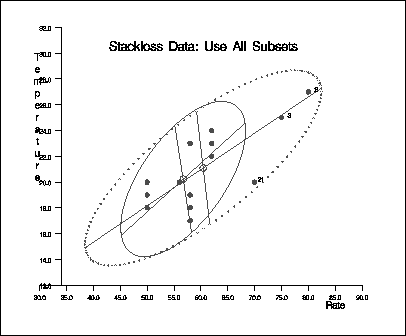
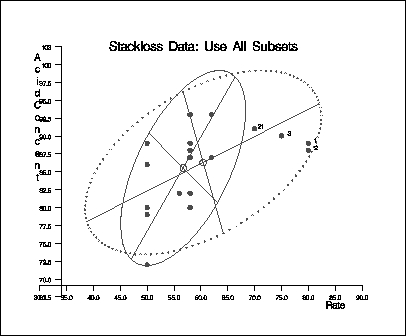
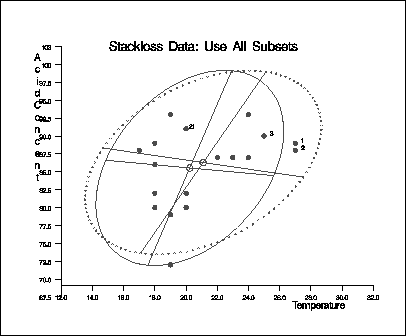
The following specification generates three
bivariate plots of the classical and robust tolerance
ellipsoids, one plot for each pair of variables:
      optn = j(8,1,.); optn[6]= -1;
      vnam = { "Rate", "Temperature", "AcidConcent" };
      filn = "stl";
      titl = "Stackloss Data: Use All Subsets";
   call scatmve(2,optn,.9,a,vnam,titl,1,filn);
The output follows.
Output 9.5.5: Stackloss Data: Rate vs. Temperature
Output 9.5.6: Stackloss Data: Rate vs. Acid Concent
Output 9.5.7: Stackloss Data: Temperature vs. Acid Concent
Copyright © 1999 by SAS Institute Inc., Cary, NC, USA. All rights reserved.