
Chapter Contents

Previous

Next
|
Chapter Contents |
Previous |
Next |
| The LOGISTIC Procedure |
Suppose the response variable can take on the ordered values
1, ... , k, k+1
where k is an integer  . If you use
events/trials syntax,
each observation is split into two observations. One has response value 1 with
a frequency equal to the frequency of the original observation (which is 1 if
the FREQ statement is not used)
times the value of the events variable. The
other observation has
response value 2 and a frequency equal to the
frequency of the original observation times the value
of (trials - events). These two observations will have
the same explanatory variable values and the same FREQ and WEIGHT
values as the original observation.
. If you use
events/trials syntax,
each observation is split into two observations. One has response value 1 with
a frequency equal to the frequency of the original observation (which is 1 if
the FREQ statement is not used)
times the value of the events variable. The
other observation has
response value 2 and a frequency equal to the
frequency of the original observation times the value
of (trials - events). These two observations will have
the same explanatory variable values and the same FREQ and WEIGHT
values as the original observation.
For either single-trial or events/trials syntax, let j index all observations. In other words, for single-trial syntax, j indexes the actual observations. And, for events/trials syntax, j indexes the observations after splitting (as described previously). If your data set has 30 observations and you use single-trial syntax, j has values from 1 to 30; if you use events/trials syntax, j has values from 1 to 60.
The likelihood for the jth observation with ordered response value yj and explanatory variables vector xj is given by
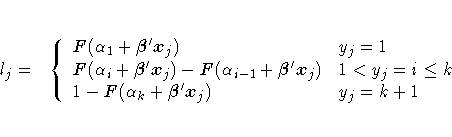
where F(.) is the logistic, normal, or extreme-value distribution function,
 are
intercept parameters, and
are
intercept parameters, and  is the slope parameter vector.
|
Chapter Contents |
Previous |
Next |
 Top |
Copyright © 1999 by SAS Institute Inc., Cary, NC, USA. All rights reserved.