Displayed Output
PROC NESTED displays the following items
for each dependent variable:
- Coefficients of Expected Mean Squares, which are
the coefficients of the n+1 variance
components making up the expected mean square.
Denoting the element in the ith row and jth column of
this matrix by Cij, the expected value of the
mean square due to the ith classification factor is
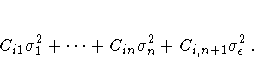
Cij is always zero for i > j, and if the design is
balanced, Cij is equal to the common size of all
classification groups of the jth factor for  . Finally, the mean square for error is always an
unbiased estimate of
. Finally, the mean square for error is always an
unbiased estimate of  . In other words, Cn+1,n+1=1.
For every dependent variable, PROC NESTED
displays an analysis of variance table.
Each table contains the following:
- each Variance Source in the model (the different
components of variance) and the total variance
- degrees of freedom (DF) for the corresponding sum of squares
- Sum of Squares for each classification factor.
The sum of squares for a given classification
factor is the sum of squares in the dependent
variable within the factors that precede it in
the model, corrected for the factors that follow it.
(See the "Computational Method" section.)
- F Value for a factor, which is the ratio of its
mean square to the appropriate error mean square.
The next column, labeled PR > F, gives the significance
levels that result from testing the hypothesis
that each variance component equals zero.
- the appropriate Error Term for an F test,
which is the mean square due to the next
classification factor in the nesting order.
(See the "Error Terms in F Tests" section.)
- Mean Square due to a factor, which is the corresponding
sum of squares divided by the degrees of freedom
- estimates of the Variance Components.
These are computed by equating the mean squares to their
expected values and solving for the variance terms.
(See the "Computational Method" section.)
- Percent of Total, the proportion
of variance due to each source.
For the ith factor, the value is
-
100 ×[ source variance component/ total variance component]
- Mean, the overall average of the dependent variable.
This gives an unbiased estimate
of the mean of the population.
Its variance is estimated by a certain linear
combination of the estimated variance components,
which is identical to the mean square due to the
first factor in the model divided by the total
number of observations when the design is balanced.
If there is more than one dependent variable, then the NESTED
procedure displays an
"analysis of covariation" table for each pair of dependent variables
(unless the AOV option is specified in the PROC NESTED statement).
See the "Analysis of Covariation" section for
details. For each source of variation, this table includes the following:
- Degrees of Freedom
- Sum of Products
- Mean Products
- Covariance Component, the estimate of
the covariance component
Items in the analysis of covariation table are computed analogously
to their counterparts in the analysis of variance table.
The analysis of covariation table also includes the following:
- Variance Component Correlation
for a given factor.
This is an estimate of the correlation between
corresponding effects due to this factor.
This correlation is the ratio of the covariance
component for this factor to the square root of
the product of the variance components for the
factor for the two different dependent variables.
(See the "Analysis of Covariation" section.)
- Mean Square Correlation for a given
classification factor.
This is the ratio of the Mean Products for this factor
to the square root of the product of the Mean Squares
for the factor for the two different dependent variables.
Copyright © 1999 by SAS Institute Inc., Cary, NC, USA. All rights reserved.


