
Chapter Contents

Previous

Next
|
Chapter Contents |
Previous |
Next |
| The PHREG Procedure |
Two estimators of the survivor function are available: one is the product-limit estimate and the other is based on the empirical cumulative hazard function.
 .Let
.Let  denote
the censoring times in
[ti , ti+1); l ranges over
Ci .
The likelihood function for all individuals is given by
denote
the censoring times in
[ti , ti+1); l ranges over
Ci .
The likelihood function for all individuals is given by
![{\cal L}=\prod_{i=0}^k
\{ \prod_{l \in {\cal D}_i}
( [S_{0}(t_{i})]^{ {\rm exp...
... )
\prod_{l \in {\cal C}_i} [S_{0}(\gamma_{l}+0)]^{{\rm exp}(z'_{l}{\beta})}
\}](images/phreq136.gif)
 and allowing the
probability mass to fall only on the observed event times
t1, , tk.
By considering
a discrete model with hazard contribution
and allowing the
probability mass to fall only on the observed event times
t1, , tk.
By considering
a discrete model with hazard contribution
 at ti, you take
 , where
 . Substitution into the likelihood function produces
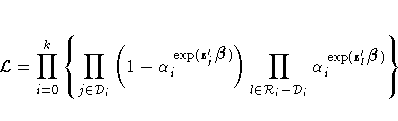
 with
with  estimated from the partial
likelihood function and then
maximize with respect to
estimated from the partial
likelihood function and then
maximize with respect to  , ,
, , ,
the maximum likelihood estimate
,
the maximum likelihood estimate
 of
of  becomes a solution of
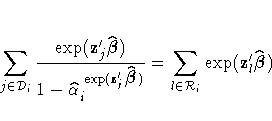 can be found explicitly. Otherwise,
an iterative solution is obtained by the Newton method.
can be found explicitly. Otherwise,
an iterative solution is obtained by the Newton method.
The estimated baseline cumulative hazard function is
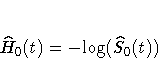
 is the estimated baseline
survivor function given by
is the estimated baseline
survivor function given by
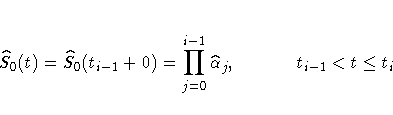
For details, refer to Kalbfleisch and Prentice (1980).
For a given realization of the
explanatory variables  ,the product-limit estimate of the survival function at
  is
is
![\hat{S}(t,{\xi})= [\hat{S}_{0}(t)]^{\exp({\beta}'{\xi})}](images/phreq152.gif) be a given realization of the
explanatory variables.
The empirical cumulative hazard function estimate
at is
be a given realization of the
explanatory variables.
The empirical cumulative hazard function estimate
at is
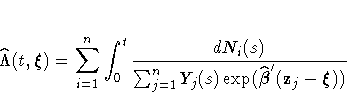
 is given by
the following (Tsiatis 1981):
is given by
the following (Tsiatis 1981):
![& &\hat{var}\{n^{\frac{1}2}(\hat{\Lambda}(t,{\xi}) -
\Lambda(t,{\xi}))\} \ & = ...
...i}))]^2} + \biggr.
\biggl. H'(t,{\xi})\hat{V}(\hat{{\beta}})H(t,{\xi}) \biggr\}](images/phreq155.gif)
 is the estimated covariance matrix of
  and
and
![H(t,{\xi}) = \sum_{i=1}^n\int_{0}^t
\frac{\sum_{l=1}^n Y_{l}(s)(Z_{l}-{\xi})\ex...
...{\xi}))}
{[\sum_{j=1}^n Y_{j}(s)\exp(\hat{{\beta}}'(z_{j} - {\xi}))]^2} dN_i(s)](images/phreq157.gif)
The empirical cumulative hazard function (CH) estimate of the
survivor function for is
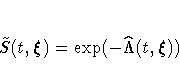
 and
and  correspond to the product-limit (PL) and
empirical cumulative hazard function (CH) estimates of the survivor function
for , respectively.
Both the standard error of log() and the standard error of
log() are approximated by
correspond to the product-limit (PL) and
empirical cumulative hazard function (CH) estimates of the survivor function
for , respectively.
Both the standard error of log() and the standard error of
log() are approximated by  , which is the
square root of the variance estimate of
; refer to Kalbfleish and
Prentice (1980, p. 116). By the
delta method, the standard errors of and are given by
, which is the
square root of the variance estimate of
; refer to Kalbfleish and
Prentice (1980, p. 116). By the
delta method, the standard errors of and are given by
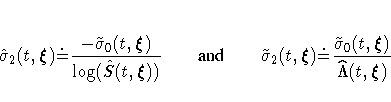
 )] and
log[-log()] are given by
)] and
log[-log()] are given by
Let  be the upper
  percentile point of the standard normal distribution.
A
percentile point of the standard normal distribution.
A 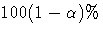 confidence interval for the survivor function
 is given in the following table.
| Method | CLTYPE | Confidence Limits |
| LOG | PL | ![\exp[\log(\hat{S}(t,{\xi})) +- z_{\frac{\alpha}2}\tilde{\sigma}_{0}(t,{\xi})]](images/phreq166.gif) |
| LOG | CH | ![\exp[\log(\tilde{S}(t,{\xi})) +- z_{\frac{\alpha}2}\tilde{\sigma}_{0}(t,{\xi})]](images/phreq167.gif) |
| LOGLOG | PL | ![\exp\{-\exp[\log(-\log(\hat{S}(t,{\xi}))) +- z_{\frac{\alpha}2}\hat{\sigma}_{2}(t,{\xi})]\}](images/phreq168.gif) |
| LOGLOG | CH | ![\exp\{-\exp[\log(-\log(\tilde{S}(t,{\xi}))) +- z_{\frac{\alpha}2}\tilde{\sigma}_{2}(t,{\xi})]\}](images/phreq169.gif) |
| NORMAL | PL | 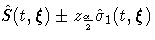 |
| NORMAL | CH | 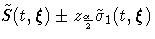 |
|
Chapter Contents |
Previous |
Next |
 Top |
Copyright © 1999 by SAS Institute Inc., Cary, NC, USA. All rights reserved.