

- People
- Administration & Staff
- Research faculty
- Gabriela Aceves-Sepúlveda
- Alissa N. Antle
- Sheelagh Carpendale
- Parmit Chilana
- Jon Corbett
- Steve DiPaola
- Halil Erhan
- Brian Fisher
- Diane Gromala
- Marek Hatala
- Kate Hennessy
- Alireza Karduni
- Sylvain Moreno
- Carman Neustaedter
- Will Odom
- Philippe Pasquier
- Niranjan Rajah
- Bernhard Riecke
- Gillian Russell
- Thecla Schiphorst
- Chris Shaw
- Wolfgang Stuerzlinger
- Ron Wakkary
- Ö. Nilay Yalçin
- Teaching faculty
- Emeritus
- Adjunct Faculty
- Alumni
- Work at SIAT
- Opportunities
- Research
- Programs
- News & Events
- Spaces & Equipment
- Media
- Showcase
- Contact
- Staff & faculty resources
Undergraduate
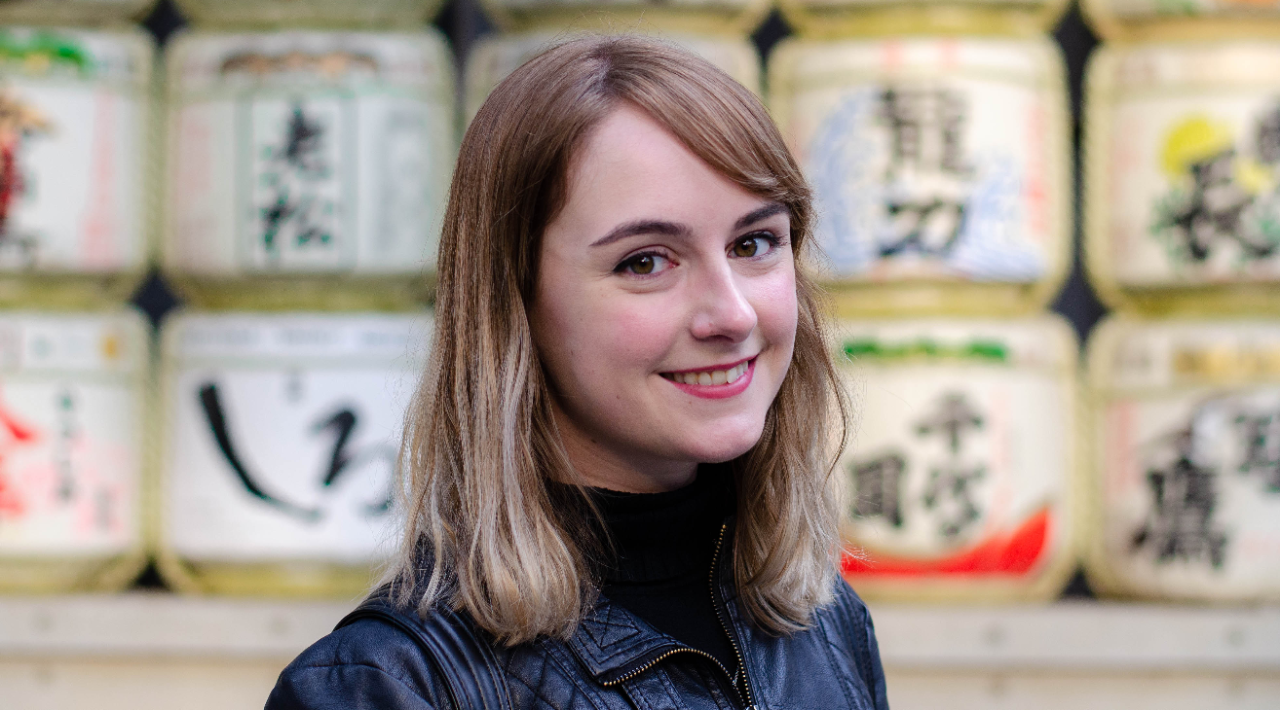
Undergrad Alumni Spotlight: Stephanie Bourgeois
Stephanie Bourgeois, a recent graduate from SIAT’s undergraduate program, tells us about her journey to Japan and beginning a Masters degree in Media Design at Keio University in Tokyo.
Why did you choose the School of Interactive Arts & Technology over other programs for your undergraduate degree?
I always knew that I wanted to pursue post secondary studies in an artistic field, and originally, I had assumed that meant I would end up in a very traditional kind of art school. However, when I was still in high school, a family friend began their studies in SIAT, and they encouraged me to visit the SFU Surrey Open House event. I was absolutely blown away by the kinds of projects students were working on as early as first year. As soon as I discovered that there was such an innovative program available which combined so many different creative elements with modern technology, I found it much more enticing than the kind of studies that any other schools had to offer. There really was no comparison, and even now several years later there is still no other school quite like SIAT.
What was your experience like at SIAT?
I had a very positive experience at SIAT. I found that I had a lot in common with my classmates and it was easy to build relationships with them. This was of course facilitated by the large amount of group work that many of the courses required. I also found the teaching staff to be very experienced, knowledgeable and approachable. I started off focussing on design courses, but eventually found that I was more interested in media arts. Eventually I ended up completing and graduating with both Design and Media Arts concentrations. I think it was very worthwhile for me to take courses in both streams, as I feel the variety of skills I learned prepared me well for a wide range of job opportunities.
What are the most important skills that you acquired as an undergrad student at SIAT that helped shape your current success?
I would say the number one most transferable and valuable skill I learned while at SIAT was how to work efficiently in a team. Learning how to be a good team member, and how to lead a team effectively, have proven to be very useful skills in my career so far. Tying into this, another important skill I learned in SIAT is cross cultural communication. I had the pleasure of working with teammates with all sorts of different cultural and linguistic backgrounds, and while at times this proved to be challenging, I believe it really prepared me for the reality of working in the field. Furthermore, being comfortable with short deadlines helped me settle into new work environments quickly.
Beyond this, SIAT also taught me a wide range of software and technical skills that were a necessity to find employment after graduation. I’m sure it comes as no surprise that being adept with the Adobe Suite is an excellent asset for employability. In media arts I have also found that having technical experience with a range of tools from audio recorders and lighting set ups to Arduino circuits and sensors was highly valued by employers as well.
What are you working on now? And, what does the future look like for you? What motivated you to move to Japan and what attracted you to Keio University’s graduate program in Media Design?
I have been interested in Japan for a long time, and I always felt it would be an excellent place to study design. During my last semester at SFU I began the lengthy application process for the MEXT Scholarship to study in Japan. I was very fortunate and was awarded the scholarship and am currently a research student at Keio University’s Graduate School of Media Design (KMD). I was recently also admitted to KMD’s master’s program, which I will be starting in September 2019.
I was drawn to Keio and KMD for multiple reasons; for one, Keio is extremely highly regarded in Japan, and this particular program is available entirely in English. Furthermore, I found KMD to be a very similar program to SIAT, with a heavy focus on projects and building and implementing designs, not just talking about them.
My current research project focuses on how media arts and design can improve and facilitate cross cultural communication for tourists visiting Japan, in part in relation to the upcoming 2020 Tokyo Olympics. I am working to design a small, portable “companion” for tourists which would help them navigate different social situations that are rather unique to Japan. KMD’s masters program is project-based, and so I am hoping to be able to pursue this idea beyond my research student term and into my degree.
Do you have any advice that you would like to give to current undergrad and / or recent graduates?
A big piece of advice I would give current undergrads is to document your class projects! Take lots of photos and videos of your work and make notes and write ups about them. Start building your portfolio right now. It is so much easier to add to it as you go, as opposed to trying to put one together after four (or more) years of classes. You never know when a job opportunity will come up and it will ask for proof of a certain skill which you can demonstrate with a simple presentation of a past project.
Another piece of advice I would give is don’t be afraid to explore the world! The skills you learn in SIAT are not region locked – you can work in design, media arts or interactive systems around the world. Creativity is a skill you can travel with. There are tons of scholarships, bursaries and internships for design in so many different places. Don’t be afraid to go see how people design in other parts of the world. For me, so far, it has been an amazing experience.