Recording Industry Advertising
Historical Timeline
Note: Music examples are from the finale to Tchaikovsky's 1812 Overture; historical recordings courtesy of The British Library
Tinfoil, Cylinders (Acoustic)
1877Discs (Acoustic)
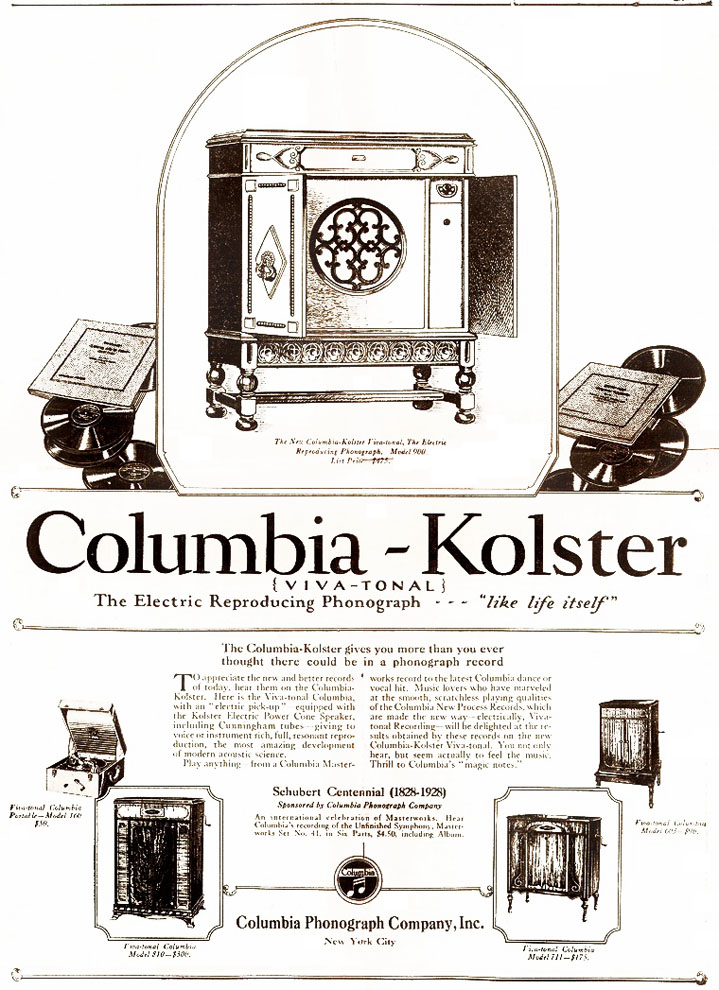
1887Electrical
1926Long Play
1948Stereophonic, Hi-Fi
1958Quadraphonic
1972Compact Disc (Digital)
1983Tinfoil: 60 rpm
Wax Cylinder: 100 rpmDisc Shellac
78 rpm
7", 10", 12"Vinyl
33.3, 45 rpm
7", 10", 12"same same Laser Disc
200-500 rpm
5"Ear-tubes Horn Amplifier LP player, pickup and amplifier Two loudspeakers, amplifier and stereo cartridge Amplifier, decoder, four loudspeakers CD player with D/A converter 4 minutes 4 minutes 4 minutes 20 minutes 30 minutes 30 minutes 80 minutes
1-3 kHz 200 Hz - 6 kHz 20 Hz - 14 kHz 20 Hz - 20 kHz same same s/n: 28 dB
30 dB 57 dB
90 - 110 dB Edison Concert Band, cylinder n.d. Royal Albert Hall Orch, 1916 Philadelphia, Stokowski, 1930 London Philharmonic, Boult, 1952 New York Philharmonic, Bernstein
New Philharmonia, 1990
The Phonograph (1900-1930)
The Acoustic Era
all ads taken from Busy Man's & Macleans magazine by Lisa Czembor
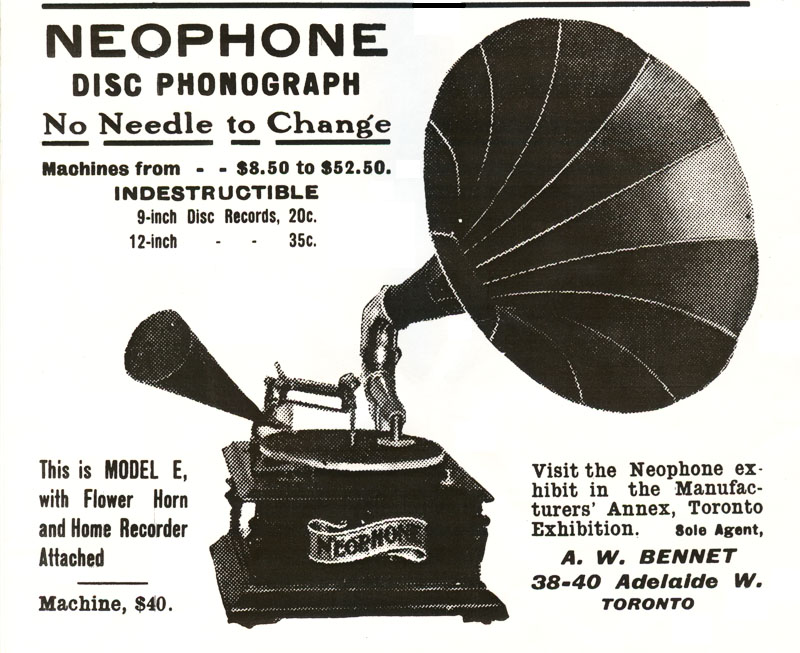
Neophone Disc Phonograph, Sept. 1906
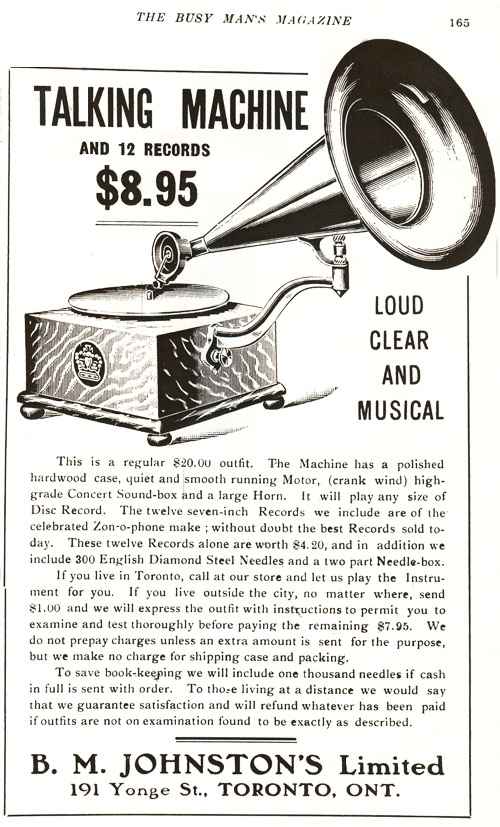
B.M. Johnston's Talking Machine, Oct. 1906
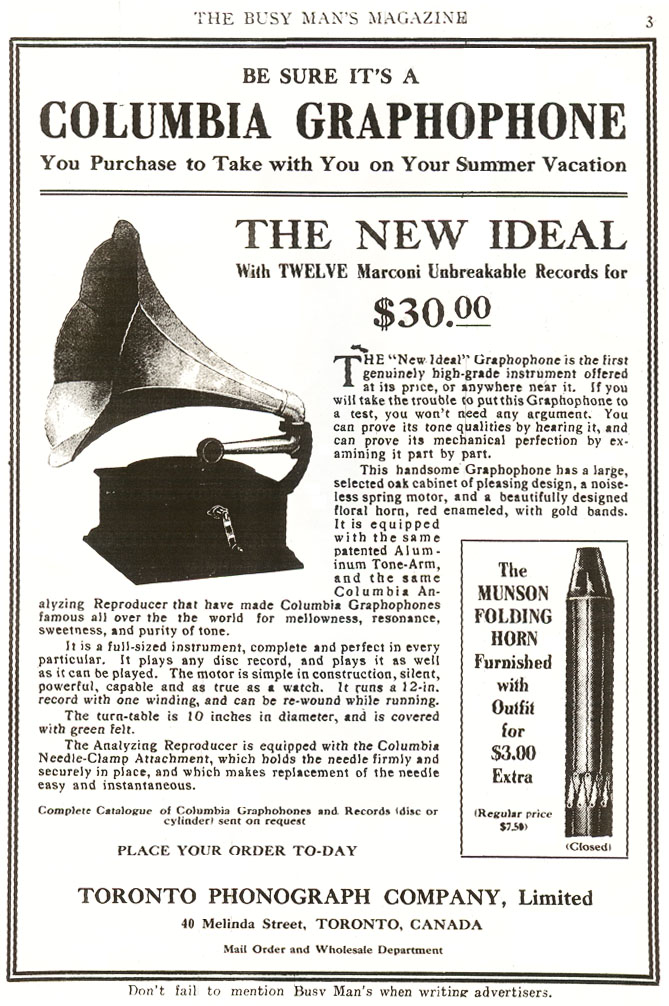
Columbia Graphophone, June 1909
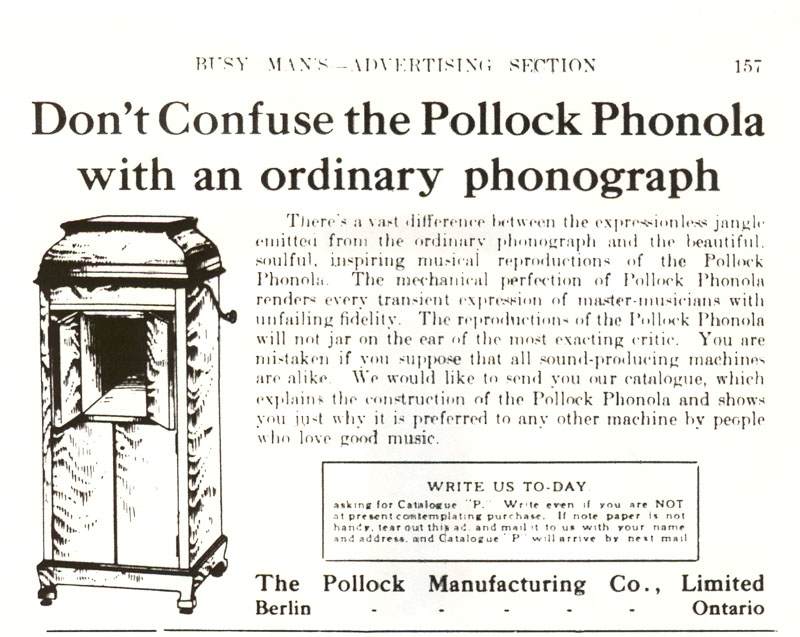
Pollock Phonola, Feb. 1911
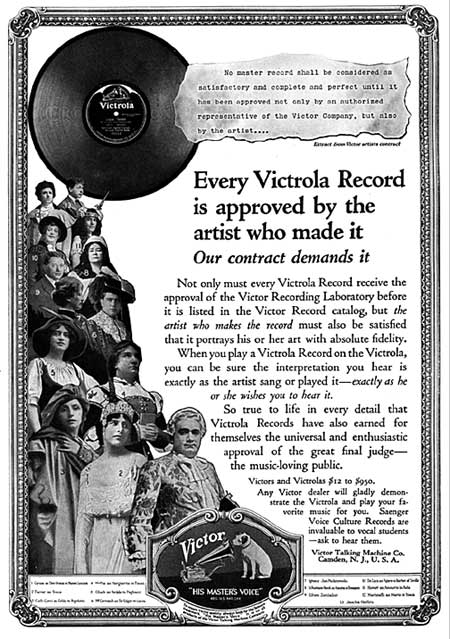
Victor & Berliner Gram-o-phone "When the Family Gather 'round the Hearth", Feb. 1911
Victor & Berliner Gram-o-phone "An Educational Influence in the Home", March 1911
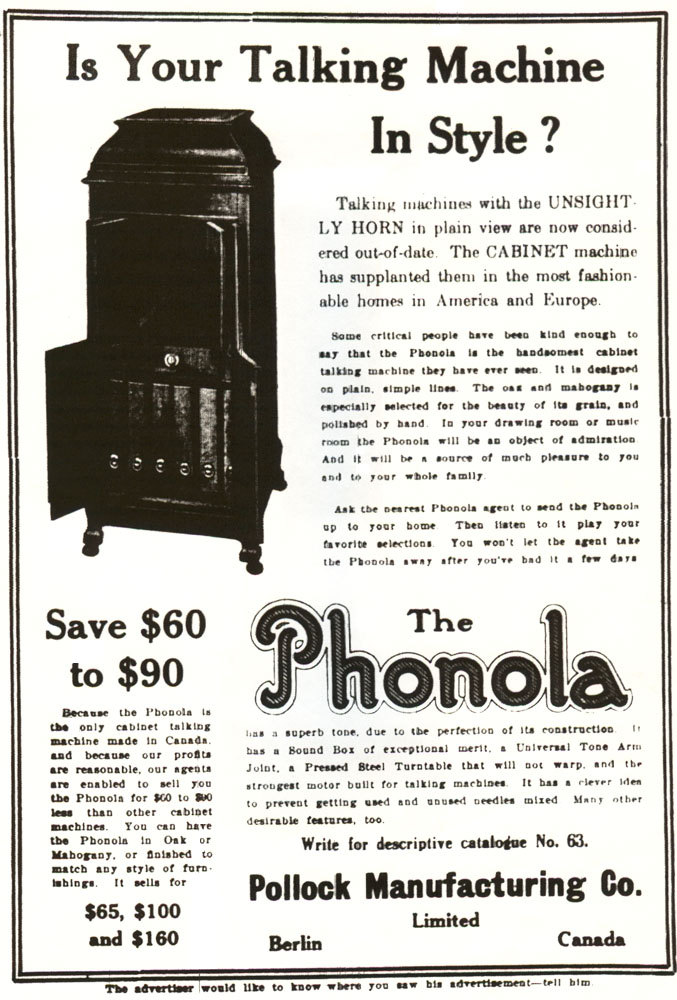
The Phonola "Is Your Talking Machine in Style", April 1911
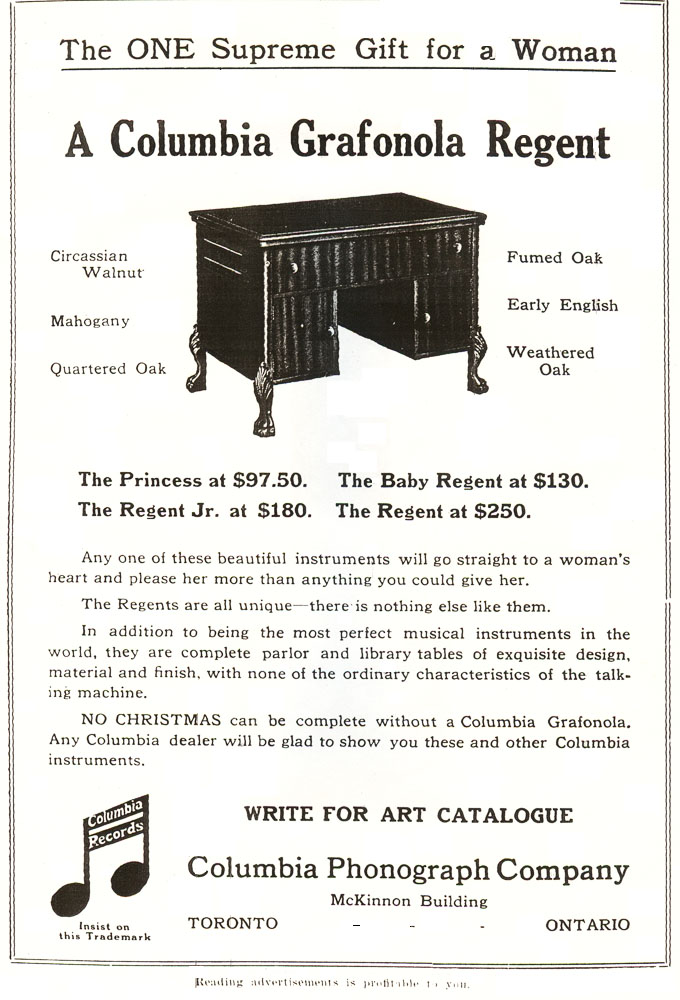
Columbia Grafonola, "The ONE Supreme Gift for a Woman", Dec. 1912
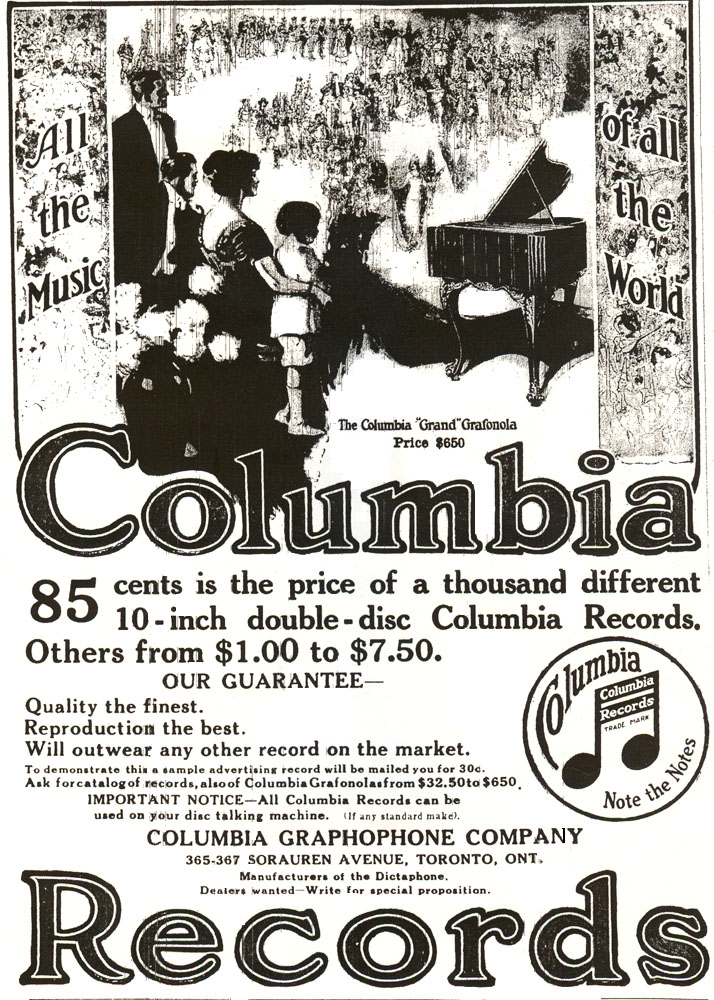
Columbia Records "All the Music of all the World", Feb. 1914
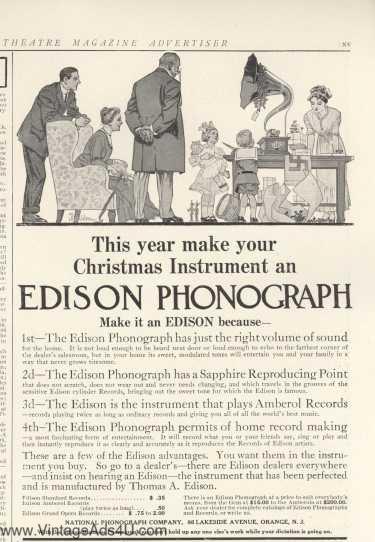
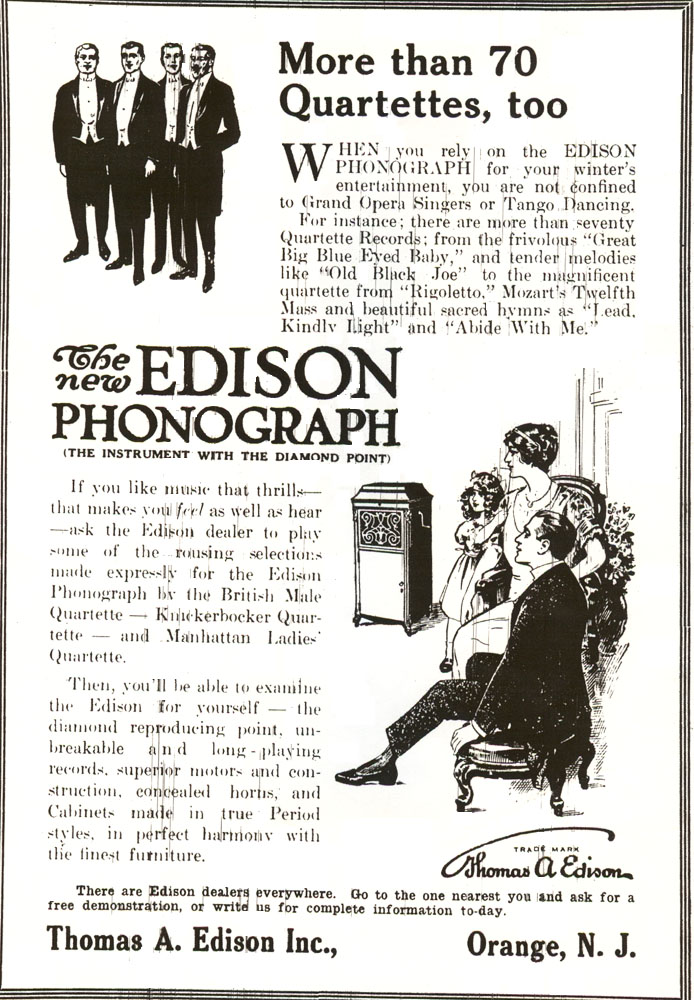
Thomas A. Edison Inc. Phonograph "More than 70 Quartettes, too", Dec. 1914
Aeolian-Vocalion "The Music of Childhood", Jan. 1918
The New Edison "Testing the New Edison's RE-CREATION of Lazzari's Glorious Voice, Oct. 1918
"The most sensitive ear could not detect the slightest difference between the tone of the singer and the tone of the mechanical device" said a critic after hearing a 1916 demonstration where a tenor performed with an Edison Diamond Disk acoustic phonograph"Everybody, including myself, was astonished to find that it was impossible to distinguish between my own voice, and Mr. Edison's re-creation of it" Metropolitan Opera soprano Anna Case (both quotes from Read & Welch, From Tin Foil to Stereo, 1976)