One of the trickiest types of processing in real-time is the continuous speed change that produces a continuous rise or fall in pitch, what in musical terms is called a glissando. Interestingly enough, a comparison of the traditional analog and modern digital approaches to this problem is quite revealing.
On the one hand, digital signal processing, for instance in an editor, can easily give you the option of transposing pitch quite precisely (usually with a choice of standard musical intervals, e.g. an octave, fifth, etc. or even by smaller units called cents, where 100 cents corresponds to a semitone). The editor will also likely provide the choice of whether the duration remains the same or correlates with the direction of the pitch shift, e.g. shorter with upward transpositions, and lower with downward ones. This latter type of correlation is exactly what happens in the analog domain when the speed of the tape is altered, most typically by being played at half or double the normal tape speed, resulting in an octave down or up respectively. In the digital domain these same shifts up or down can be realized efficiently, for instance by simply skipping every other sample or by repeating every sample respectively, with other transpositions using a similar calculation.
The option of keeping the duration the same while transposing the pitch requires a greater amount of calculation and while it may be speedy, it cannot be easily realized in an interactive real-time situation. Interestingly enough, in the analog domain, the historical Tempophone usually allowed both options (changing either pitch or duration independently) by using a clever design of rotating heads and tape speed control as described in the link. However, the quality of the playback heads was usually of lesser quality than the standard machines.
To return to the question of a continuous speed and pitch control in real time – thereby allowing live interaction – why is it so difficult to do this in the digital domain? The main reason for the complexity of the calculation is the general rule that the sampling rate must stay fixed. The sampling rate is determined by a clock that governs how quickly digital samples are converted into sound, and the programmer is usually not allowed to adjust that rate. However, some specialized apps, such as GRM Tools and its Doppler Shift and Pitch Accumulator modules, may provide continuous pitch changes by the method mentioned above – stepping through the sound file at different rates. The interface will determine whether the changes can be pre-programmed, rather than manipulated by a virtual knob, as well as over what frequency range the transposition can operate.
In the corresponding analog situation, the tape speed of a professional tape recorder could in some cases be varied continuously (with a rotary knob) if the voltage being supplied to the motor was variable. In the later digitally controlled analog recorders, a very precise continuous speed change was possible, typically with a plus or minus 25% range. In the earlier analog recorders, an external variable speed controller had to be added to change the voltage to the motor, but it couldn't go too low as that would damage the motor.
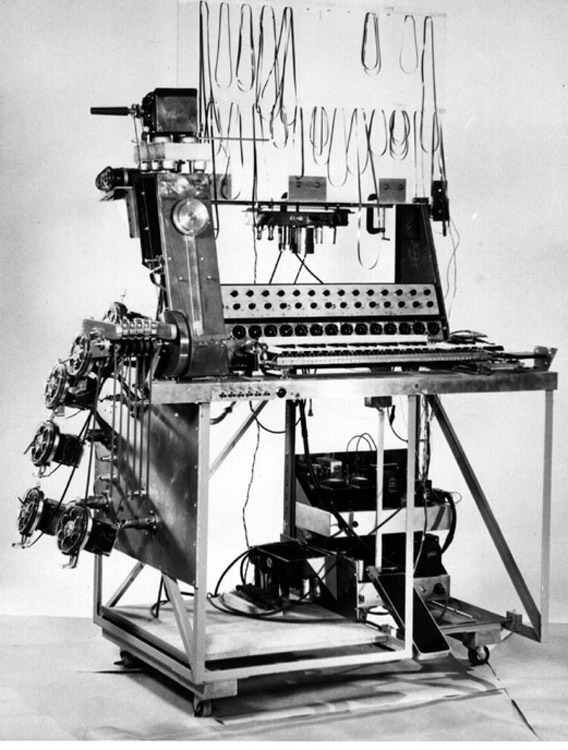
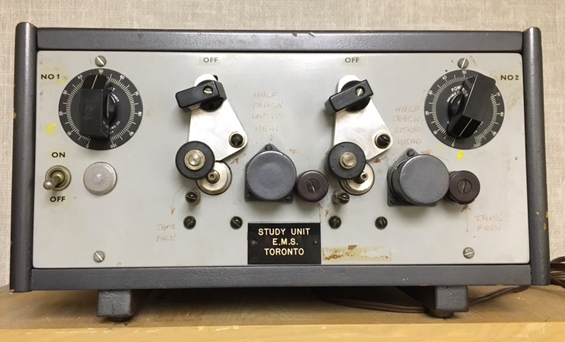
Using a different (and very heavy) type of motor, an extended range of speeds was possible, as in the two devices shown here, the first being the Special Purpose Tape Recorder designed by Hugh LeCaine with multiple tape loops whose speed could be controlled from a keyboard – the machine with which he produced his classic work Dripsody (1955) using the recording of a single drop of water. The second is a double loop machine, designed for the Universty of Toronto studio, and used in the Sonic Research Studio at Simon Fraser University for many years. Its speed control knob could produce several octaves of speed and pitch changes.
Hugh LeCaine's Special Purpose Tape Recorder used to play loops at different speeds
Dual tape loop player with variable speed control
The following sound example from Barry Truax’s Soundscape Study (1974) was realized with the dual loop player. The excerpt is a mix of water flowing down a drain and footsteps descending a wooden staircase. The loops start out quite fast, and then slow down. The water sound stays very much in the domain of water sounds, but the footsteps initially repeat so quickly that they sound more like a machine, and then gradually as they slow down, they enter the range of human footsteps. Around 40” they are spliced to the original recording, but continue slowing down until they are isolated percussive events. The metamorphosis reflects Murray Schafer’s comments (in The Tuning of the World) that human rhythms have sped up over time into machine rhythms and eventually become electrical drones. The loop machine was also used by Hildegard Westerkamp in her first composition Whisper Study.
As noted above, the digital equivalent of "tape speed" is the sampling rate, which normally is not variable in a program. However, in some custom digital software, it has been possible to vary the speed at which samples are delivered to the D/A converter and thereby change the sampling rate and the pitch of the sound file. Technically, the sampling rate is changed by inserting "no operation" commands into the synthesis code to slow it down.
This is an example realized with the microprogrammable DMX-1000 in Barry Truax's PODX system as used in The Wings of Nike (1987). At the end of the first section, the sampled vocal sounds that have been granulated and formed into a continuous texture are gradually slowed down over a minute and a half by the interval of the fifth (from a sampling rate of 30 kHz to 20 kHz) with a slow ramp on the speed variable (and a slight rise near the end before the final descent). The accompanying computer graphic images show a winged shape descending into what appears to be an ocean, hence the inspiration for the effect.
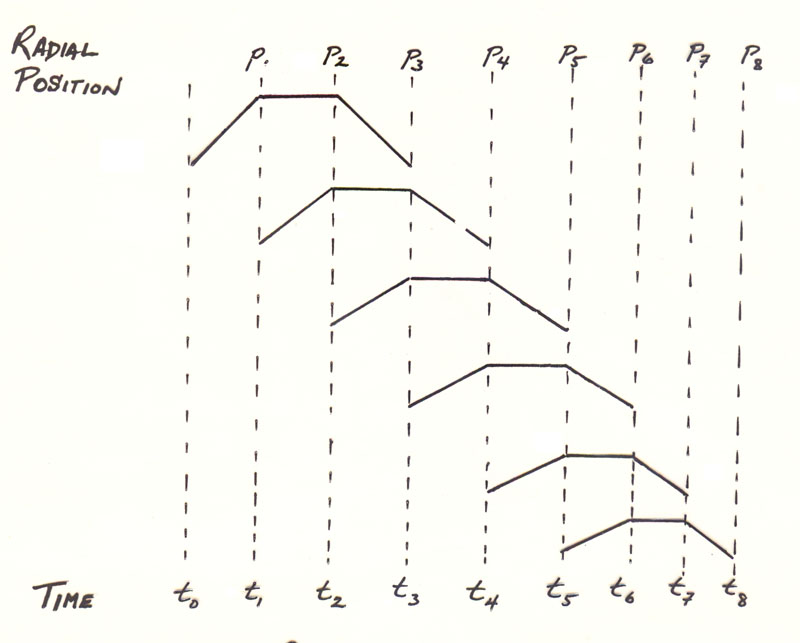
In the acoustic world, a continuous pitch change, in music called a glissando, such as with a siren or the human voice, needs some equivalent continuous physical action to cause the smooth pitch shift, whether by a rotating object or the vibration of the vocal cords. However, in the world of digital synthesis, the same glissando can be generated by overlapping discrete pitches in fairly close succession, as diagrammed below, which will be interpreted by the auditory system as being continuous, as in the following sound example. Each component event may also have its own spatial position, shown here as positions p1, p2, etc., in order to create a spatial trajectory. Granulated vocal material slowing down continuously in The Wings of Nike (1987), 1st movement
Downward glissando (with Doppler shift) arriving at a drone, from Wave Edge (1983)