The Projection
of X, X a Category
 When X takes a complement, X plus its complements forms a phrase.
By extension of this concept, X forms a phrase when it is intransitive.
X - XP forms a projection of X. The minimal projection
of X is the head, X. The maximum projection of X is the
XP in the projection that is not dominated by XP in the same projection.
When X takes a complement, X plus its complements forms a phrase.
By extension of this concept, X forms a phrase when it is intransitive.
X - XP forms a projection of X. The minimal projection
of X is the head, X. The maximum projection of X is the
XP in the projection that is not dominated by XP in the same projection.
The last sentence in the
above paragraph is intended to cover adjunction. If Y is adjoined
to XP, a new node XP is created such that it immediately dominates
Y and XP. Thus the projection of X may grow as long as some node
is adjoined to XP, or in some case to X.
The concept of the projection
of X is useful in defining c-command. Wean we say X c-commands
a node YP, we really mean that the maximal projection of X c-commands
YP.
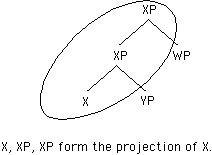
In the following structure,
the oval encircles the projection of X.
(1)
 The notion the extended projection of X is useful in conjunction
constructions. If XP-1 and XP-2 are conjoined, they are dominated
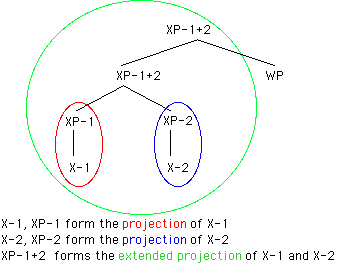
by XP-1+2. The node XP-1+2 forms the extended projection of X-1
and X-2.
The notion the extended projection of X is useful in conjunction
constructions. If XP-1 and XP-2 are conjoined, they are dominated
by XP-1+2. The node XP-1+2 forms the extended projection of X-1
and X-2.
Consider the following
example:
(2). The
dog and the cat saw themselves in the mirror.
Neither the maximal projection
the dog nor the cat alone can function as the antecedent
of themselves alone. Only the extended projection of the
dog and the cat can function as the antecedent.
(3).