 Contents: Adjunction | Negative
Adjunct (Particle) | Phrasal (Complex)
Verbs
Contents: Adjunction | Negative
Adjunct (Particle) | Phrasal (Complex)
VerbsAdjunction
Linguistics 222
Intermediate Syntax
Contents: Adjunction | Negative
Adjunct (Particle) | Phrasal (Complex)
Verbs

 Adjunction
is a configuration that is different from complementation. Items
that are adjoined to a host are not arguments. When a node Y is
adjoined to some node X, X dominates both X and Y. In the standard
model of configurational syntax modifiers are adjoined to the
nodes that they modify (unless the modifiers are predicates):
Adjunction
is a configuration that is different from complementation. Items
that are adjoined to a host are not arguments. When a node Y is
adjoined to some node X, X dominates both X and Y. In the standard
model of configurational syntax modifiers are adjoined to the
nodes that they modify (unless the modifiers are predicates):

Here, tall is modifying students. Tall is adjoined to NP, and is dominated by NP students. Adverbs are adjoined to the verbs they modify:

Here, the adverb slowly is adjoined to the VP read a book. Note that VP dominates VP, hence AP is adjoined to VP. What is not found in the literature is that in adjunction of this type, the projection is technically an argument of the modifier. That is, students is an argument of tall. and read a book is an argument of slowly. How all this happens is a topic for advanced syntax.
 Other kinds of adjuncts occur. For example,
the negative particle not is adjoined to the right of an auxiliary
verb but not to a main verb in modern English:
Other kinds of adjuncts occur. For example,
the negative particle not is adjoined to the right of an auxiliary
verb but not to a main verb in modern English:

Even here does read is an argument of the negative particle not. The above structure represents descriptive adequacy; it does not represent explanatory adequacy.
Phrasal
verbs (complex verbs) demonstrate another example of adjunction.
A complex verb contains a head verb and an intransitive preposition--the
preposition can only be a head, not a phrase:
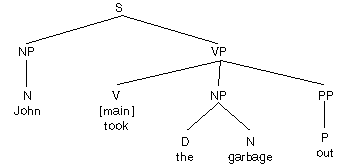
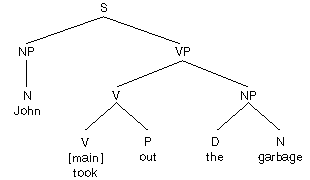
Note the following sentences:
The verb take here takes two arguments: a NP and a PP. In the second sentence, the PP argument is split into two constituents. The dislocated or repositioned constituent does not form a third argument, but an adjunct form. Such dislocated structures are real adjunction structures. A complete analysis of them cannot be done here but in L322.

Contents:
Adjunction | Negative
Adjunct (Particle) | Phrasal (Complex)
Verbs
 Go to conjunction
Go to complement
Go to modifier
vs. complement
Go to x-bar
theory
To return to 222 course outline Click
here.
This page last updated 13 DE 99.
